3. OOP injury biomechanics
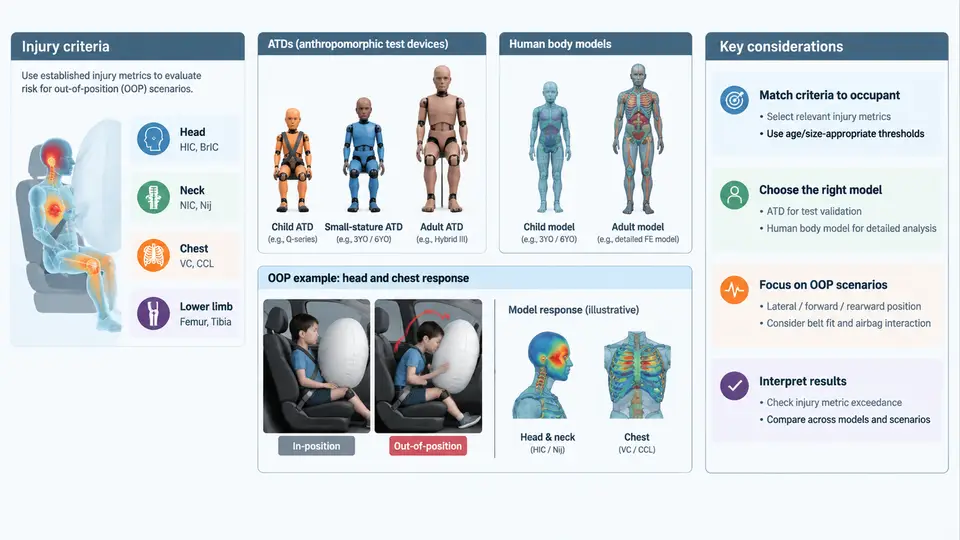
Out-of-position (OOP) injury biomechanics sits at the intersection of occupant kinematics, tissue tolerance, and restraint deployment timing. For small-stature adults and children, the problem is not simply "scaled-down adult behavior." Geometric proportions, material properties, and the timing of airbag deployment relative to the occupant's position all change the injury pathway. This section explains the injury criteria used to quantify OOP risk, the Anthropomorphic Test Devices (ATDs) that measure it, and the Human Body Models (HBMs) that increasingly complement physical testing.
Why Small-Stature and Child Occupants Behave Differently
Three factors dominate. First, mass and stiffness scaling: a child's thorax is more compliant and its mass is concentrated higher relative to the pelvis, so the same airbag impulse produces larger head excursion. Second, proximity to the deploying module: a child leaning forward or kneeling on the seat places the head or chest within the airbag's initial expansion zone, where membrane forces and gas-jet momentum are highest. Third, restraint geometry mismatch: a seat belt routed across the abdomen rather than the iliac crest, or a belt-positioning booster used incorrectly, changes load paths entirely.
The practical consequence is that OOP injury risk is governed by deployment-phase interaction, not by the post-deployment ride-down that dominates in-position scenarios. Injury criteria must therefore capture short-duration, high-rate loading.
Injury Criteria Relevant to OOP Loading
Injury criteria convert measured physical quantities into a normalized risk index. The most relevant for OOP work are:
- HIC (Head Injury Criterion) — integrates resultant head acceleration over the most critical time window. HIC15 is standard for the short, impulsive loading typical of airbag contact; HIC36 is used for longer-duration events. A HIC15 of 700 is a common regulatory threshold.
- Nij (Neck Injury Criterion) — combines axial force and bending moment to predict neck injury. It is critical for children because their proportionally larger head mass loads the neck more heavily.
- Chest deflection and VC (Viscous Criterion) — VC = velocity of chest deformation × instantaneous deflection. It captures soft-tissue injury from high-rate compression, which is exactly the OOP airbag loading mode.
- Abdomen compression — measured directly in child ATDs; relevant when a deploying airbag or misrouted belt loads the abdomen.
- THOR/Tibia indices — lower-extremity loading, relevant when the occupant is kneeling or the knees are near the instrument panel.
These criteria are not interchangeable. A HIC value below threshold does not guarantee neck safety, and a compliant chest can still fail under viscous loading. OOP assessments therefore report a vector of criteria, not a single number.
Anthropomorphic Test Devices for Small-Stature and Child Occupants
ATDs are calibrated mechanical surrogates. For OOP work, the relevant devices are:
| ATD | Represented Population | Key OOP Measurement Capability |
|---|---|---|
| Hybrid III 5th percentile female | Small-stature adult female | Head acceleration, neck force/moment, chest deflection, pelvis acceleration |
| Hybrid III 6-year-old | 6-year-old child | Head, neck, chest, abdomen; abdomen is a pressure-based insert |
| Hybrid III 3-year-old | 3-year-old child | Same channels, smaller geometry, higher head-to-body mass ratio |
| Q-series (Q3, Q6, Q10) | 3-, 6-, 10-year-old children | Improved biofidelity, multi-axis neck, abdominal pressure sensors, more realistic spine |
| THOR 5th percentile female | Small-stature adult female | Advanced thorax and abdomen instrumentation, better OOP response |
The Q-series and THOR-5F are preferred for OOP because their neck and thorax biofidelity is better than the older Hybrid III family. However, Hybrid III remains widely used for regulatory compliance, so engineers often run both and compare.
Human Body Models: When and Why
HBMs are finite-element representations of human anatomy. For OOP, they offer three advantages over ATDs: they can represent subject-specific geometry (a 4-year-old vs. a 6-year-old), they output tissue-level quantities (strain, stress) rather than only rigid-body accelerations, and they can be repositioned continuously without mechanical joints limiting the posture.
Common HBMs in OOP research include the THUMS family (Total Human Model for Safety), the GHBMC models, and the PIPER child model. A typical OOP workflow with an HBM looks like this:
- Import the occupant model and the vehicle interior (seat, instrument panel, airbag module).
- Position the model in the target OOP posture — for example, head 150 mm from the airbag module cover, torso rotated 20° toward the door.
- Apply the airbag deployment pressure curve and the seat belt pre-tensioner timing.
- Run the explicit dynamic simulation and extract head acceleration, neck force, chest deflection, and tissue strain.
- Compare the tissue-level results against injury thresholds (e.g., brain strain > 0.20 is often used as a concussion indicator in HBM studies).
The key limitation is validation. An HBM is only as good as the cadaver and volunteer data used to calibrate it. For small-stature and child occupants, pediatric validation data is sparse, so HBM results are typically used to rank design alternatives rather than to certify a pass/fail.
Integrating ATD and HBM Results
A robust OOP assessment uses ATDs for regulatory compliance and HBMs for design insight. The ATD gives a repeatable, calibrated number; the HBM explains why that number changed. For example, if a Q6 ATD shows a neck Nij increase when the airbag deployment timing is advanced by 5 ms, an HBM can show whether the load path shifted to the cervical spine or to the thoracic cage.
Worked Example: OOP Assessment for a 6-Year-Old Occupant
Consider a front passenger seat with a depowered airbag. The test matrix includes three positions: nominal (head 300 mm from module), forward-leaning (head 150 mm), and kneeling (head 100 mm, torso upright). The ATD is a Q6 with a 3-point belt and no booster.
For each position, the test engineer records:
- Head resultant acceleration and HIC15
- Upper neck force and moment, then computes Nij
- Chest deflection and VC
- Abdominal pressure (if instrumented)
In a representative (illustrative) result set, the nominal position might yield HIC15 = 420 and Nij = 0.65, while the kneeling position might yield HIC15 = 780 and Nij = 1.05. The kneeling case exceeds the HIC threshold and approaches the Nij limit, indicating that the airbag's initial deployment is loading the head and neck directly. The engineering response is typically to adjust the airbag's initial pressure rise (soften the first 10–15 ms) or to add a seat position sensor that suppresses deployment when the occupant is too close.
This example is illustrative and uses round numbers for clarity; actual values depend on the specific vehicle, airbag, and ATD calibration.
Summary of Key Relationships
The diagram above shows the causal chain from occupant characteristics through the surrogate model and loading input to the injury criteria, and then the iterative decision loop that follows when a threshold is exceeded. The key takeaway is that OOP injury biomechanics is not a single calculation — it is a chain of modeling choices, each of which must be documented and justified.
Practical Checklist for OOP Assessment
- Define the OOP posture envelope (head distance, torso angle, limb position) before selecting the ATD or HBM.
- Select the surrogate that matches the occupant population: Q6 for a 6-year-old, THOR-5F or HIII-5F for a small adult female.
- Instrument for the criteria you will report: head acceleration, neck force/moment, chest deflection, abdominal pressure.
- Run the deployment at the worst-case timing, not just the nominal timing.
- Report the full criteria vector, not a single pass/fail number.
- Use HBM results to explain the mechanism, not to replace the ATD threshold.
With this foundation, the next step in the course is to apply these criteria and tools to specific OOP test setups and regulatory procedures.