3. Occupant positioning and dummy models
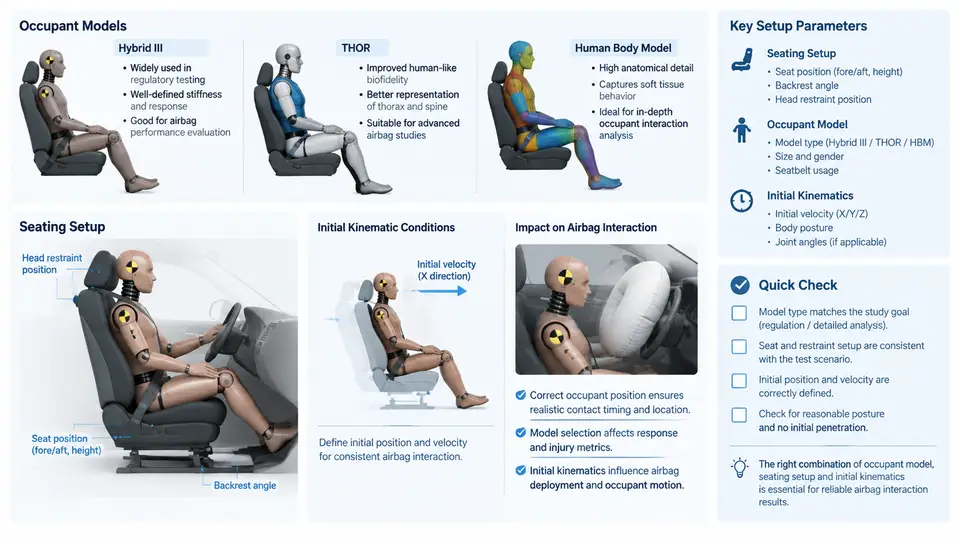
An airbag restraint system is only as good as the occupant it is tuned to protect. Before any deployment simulation can produce meaningful results, the analyst must decide who is sitting in the seat, where they are sitting, and how they are moving at the instant the inflator fires. This chapter covers the three families of occupant representations used in MADYMO airbag studies — Hybrid III, THOR, and human body models (HBMs) — together with the seating setup and initial kinematic conditions that define the interaction scenario.
Choosing the Right Occupant Representation
The three model families answer different questions, and mixing them up is one of the most common sources of misleading results.
| Model family | Structure | Primary use | Key limitation |
|---|---|---|---|
| Hybrid III 50th percentile male | Rigid segmented body, single-chain spine, no rib deflection measurement | Regulatory compliance, baseline restraint tuning, repeatability checks | Stiff, non-biofidelic chest; poor response in oblique and out-of-position loading |
| THOR 50th percentile male | Multi-segment spine, four-point rib deflection, biofidelic pelvis and abdomen | Advanced restraint development, oblique and far-side loading, injury risk prediction | Higher model complexity, longer run times, more calibration-sensitive |
| Human body model (e.g., THUMS, GHBMC) | Deformable FE body with organs, muscles, and detailed skeleton | Injury mechanism research, tissue-level strain, novel restraint concepts | Very high computational cost; validation depends on loading case |
For a standard frontal 56 km/h sled or full-vehicle pulse, the Hybrid III remains the reference because its response corridors are well established and its kinematics are repeatable. When the study involves oblique impact, far-side occupant excursion, or a seat-integrated airbag that loads the chest and abdomen off-axis, THOR is the better choice: its four rib deflection channels and articulated spine capture load paths that the Hybrid III simply cannot represent. HBMs are reserved for cases where the question is about injury mechanism rather than pass/fail — for example, rib strain under a concentrated airbag contact patch, or submarining risk in a reclined posture.
Seating Setup: The Coordinate and Posture Contract
Every MADYMO occupant study begins with an explicit coordinate convention. The standard SAE vehicle coordinate system is used throughout: X forward (positive toward the front of the vehicle), Y to the occupant's left, Z upward. Rotations follow the right-hand rule, so a positive pitch rotation about Y tilts the torso forward. State this convention once and keep it consistent across the dummy, seat, and airbag models — a sign error here will silently invert your entire kinematic result.
The seating setup is defined by a small set of parameters that must be recorded for every run:
- H-point position (X, Y, Z) relative to the vehicle origin, taken from the seat track position.
- Seat back angle (typically 23°–25° from vertical for a nominal posture; 30°–45° for reclined studies).
- Cushion angle and seat pan height, which control pelvis rotation and thigh loading.
- Head restraint position — vertical and horizontal gap to the head, critical for rear and far-side cases.
- Steering wheel / IP position for driver-side studies, including column angle and telescoping.
For an out-of-position (OOP) study, the nominal posture is deliberately perturbed. Typical OOP conditions include the head 100–150 mm forward of the nominal H-point, the torso pitched 10°–20° forward, or the occupant leaned laterally toward the deploying side airbag. These perturbations are applied as initial joint angles on the dummy, not as a pre-simulation motion, so the dummy starts the run already in the target posture.
Initial Kinematic Conditions
Initial conditions define the state of the occupant at t = 0, the moment the pulse or airbag trigger begins. In MADYMO these are set on the occupant's initial state:
INITIAL.CONDITION
  LIN_VEL  = 0.0, 0.0, 0.0      ! m/s, vehicle-fixed frame
  ANG_VEL  = 0.0, 0.0, 0.0      ! rad/s
  LIN_ACC  = 0.0, 0.0, 0.0
  POSITION = HPOINT_X, HPOINT_Y, HPOINT_Z
  ORIENTATION = 0.0, PITCH0, 0.0  ! rad, about Y
END
Two conventions matter here. First, if the simulation is run in the vehicle-fixed frame, the occupant starts at rest and the deceleration pulse is applied to the vehicle structure; the occupant's inertia produces the relative motion. Second, if the simulation is run in the inertial frame, the occupant carries an initial velocity equal to the impact velocity and the vehicle is decelerated. MADYMO supports both, but the airbag model, seat belt anchors, and contact definitions must be built in the same frame. Mixing frames is a frequent cause of an occupant that appears to "float" through the seat.
For a pre-crash or OOP deployment study, the occupant may also carry a small initial velocity relative to the vehicle — for example, 1–3 m/s forward lean during a braking event — which changes the timing of first contact with the deploying airbag. This is specified as a non-zero LIN_VEL in the vehicle-fixed frame.
Worked Example: Driver OOP Frontal Study
Consider a driver-side study where the occupant is 120 mm forward of nominal and the torso is pitched 15° forward, simulating a pre-crash lean. The setup is:
- Occupant: THOR 50th percentile male, because the chest will be loaded by the airbag before the torso has returned to the seat back.
- H-point: nominal X minus 120 mm, Z unchanged, Y = 0.
- Initial pitch: 15° forward about Y, applied at the pelvis and propagated through the spine.
- Initial velocity: 2.0 m/s forward in the vehicle-fixed frame.
- Airbag trigger: 15 ms after t = 0, matching a typical OOP deployment timing.
Expected observable behavior: the airbag membrane contacts the chest earlier than in the nominal case, the chest deflection channel on THOR peaks higher and earlier, and the head may rotate backward as the bag pushes the upper torso. The analyst should plot chest deflection versus time and compare the peak value and time-to-peak against the nominal run. A peak deflection that occurs before the airbag is fully inflated is a strong indicator that the occupant is too close — the restraint is loading the chest with a partially inflated bag, which is exactly the OOP hazard the study is meant to quantify.
Model Selection and Setup Flow
The diagram below summarizes how the choice of occupant model, seating setup, and initial conditions feed into the airbag interaction result, and where the analyst should intervene when the response is not physical.
The dashed feedback path is the part analysts most often skip. When the chest deflection curve shows a peak before the airbag is fully inflated, or the head acceleration exceeds the corridor without a corresponding contact event, the correct action is to revisit the seating setup and initial conditions — not to adjust the inflator. The occupant model, posture, and initial state are the foundation; the airbag is the variable under study.
Key Takeaways
- Match the occupant model to the loading scenario: Hybrid III for nominal frontal, THOR for oblique and OOP, HBM for injury mechanism studies.
- Fix the coordinate convention (SAE X-forward, Y-left, Z-up) and the simulation frame (vehicle-fixed vs inertial) before building anything.
- Record H-point, seat back angle, cushion angle, and head restraint gap for every run — these are the parameters that make results reproducible.
- Initial conditions are applied at t = 0 and must be consistent with the chosen frame; a non-zero initial velocity is required for pre-crash lean studies.
- Validate the settled posture with a gravity-only run before adding the airbag; a drifting dummy invalidates every downstream result.