1. FMVSS occupant protection regulatory fra
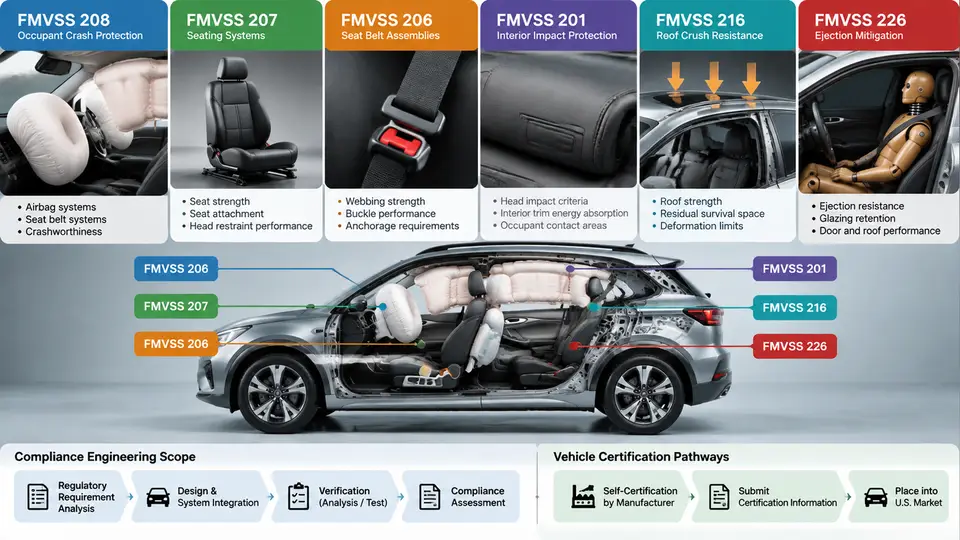
FMVSS occupant protection compliance engineering begins with a precise understanding of which standards apply to a given vehicle, what each standard actually regulates, and how a manufacturer demonstrates conformity. The occupant protection family is not a single regulation but a coordinated set of Federal Motor Vehicle Safety Standards, each targeting a distinct injury mechanism, occupant population, or crash mode. Treating them as one undifferentiated "safety package" is the most common early mistake in compliance programs, because each standard carries its own test procedures, injury criteria, applicability thresholds, and certification obligations.
The Core Occupant Protection Standards
FMVSS 208 — Occupant Crash Protection is the anchor standard. It regulates frontal impact protection through belted and unbelted test configurations, specifies crash test speeds and barrier types, and defines injury assessment reference values (IARVs) for the head, neck, chest, and femur using the Hybrid III 50th percentile male and, in current rulemaking, the THOR-50M dummy. It also governs air bag requirements, occupant classification, and the suppression or low-risk deployment logic for out-of-position occupants. FMVSS 208 is where the majority of restraint system design decisions are validated.
FMVSS 207 — Seating Systems establishes strength and anchorage requirements for seats and their attachment to the vehicle structure. It applies static loads to the seat assembly and its anchorage to verify that seats remain secured under occupant loading. Seat structure integrity is a prerequisite for every downstream restraint function, since belt geometry and dummy positioning depend on the seat staying in place.
FMVSS 206 — Door Locks and Door Retention Components regulates latch strength, hinge strength, and inertial loading to prevent doors from opening during a crash. Ejection mitigation depends heavily on door retention, and FMVSS 206 provides the structural baseline that FMVSS 226 builds upon.
FMVSS 201 — Occupant Protection in Interior Impact addresses head impact protection through upper interior head impact testing at specified target points, and includes requirements for instrument panel, seat back, and interior trim energy absorption. It is fundamentally an injury-mitigation standard for the vehicle interior surface.
FMVSS 216 — Roof Crush Resistance specifies a quasi-static load applied to the roof structure to ensure survival space is maintained during rollover. The standard has been upgraded to FMVSS 216a with a higher force requirement and a two-sided test protocol.
FMVSS 226 — Ejection Mitigation requires side curtain air bags or equivalent countermeasures to reduce partial and complete ejection through side windows during rollover and side impact events. It is evaluated with a linear impactor test against specific window targets.
How the Standards Interlock
These standards are not independent. A seat that passes FMVSS 207 but shifts during FMVSS 208 testing will invalidate the restraint geometry. A door that satisfies FMVSS 206 but allows glass to shatter without retention undermines FMVSS 226. A roof that meets FMVSS 216a but lacks headliner energy absorption may still fail FMVSS 201 targets. Compliance engineering therefore requires a system-level view: the vehicle structure, restraint system, seating, closures, and interior surfaces must be validated as an integrated whole.
Compliance Engineering Scope
Compliance engineering is the discipline of proving conformity, not merely designing for it. The scope includes: interpreting regulatory text and applicable test procedures; defining the vehicle configuration matrix (body styles, seating positions, powertrain variants, optional equipment) that affects certification; planning and executing physical or virtual test programs; managing documentation and records; and interfacing with regulatory agencies during certification and audit.
A practical compliance scope statement for a new vehicle program typically identifies:
- Applicable standards — determined by vehicle type (passenger car, MPV, truck, bus), gross vehicle weight rating, and intended market.
- Test matrix — the specific configurations, dummy sizes, impact speeds, and barrier types required by each standard.
- Certification basis — whether conformity is demonstrated by physical testing, engineering analysis, or a combination, and which party performs the evaluation.
- Documentation set — test reports, analysis reports, drawings, bill of materials, and the manufacturer's certification statement.
Vehicle Certification Pathways
Under the National Traffic and Motor Vehicle Safety Act, manufacturers self-certify that their vehicles comply with all applicable FMVSS. There is no type-approval gatekeeping step equivalent to the European WVTA process. Instead, the manufacturer issues a certification label and maintains a compliance file. NHTSA then enforces through random compliance testing, investigation, and recall authority.
This self-certification model places the burden of proof on the manufacturer. A defensible certification pathway therefore includes:
- Regulatory applicability analysis — a documented determination of every FMVSS that applies to the vehicle, including exemptions and phase-in provisions.
- Design verification — CAE simulations, component-level tests, and sled tests that predict full-vehicle performance before committing to expensive barrier tests.
- Full-vehicle validation — the formal test series that produces the evidence of conformity, conducted at an accredited facility or under an approved quality control program.
- Production conformity — ongoing sampling and audit procedures to ensure that vehicles in series production continue to meet the certified configuration.
- Record retention — maintaining the compliance file for the period required by regulation, typically five years or more depending on the standard.
Building the Compliance Matrix
The compliance matrix is the central working document of a certification program. It maps each applicable standard to the vehicle configuration, the test or analysis method, the responsible engineer, the evidence location, and the current status. A simplified example for a passenger car program might look like this:
| Standard | Applicable Configuration | Evidence Method | Key Parameter | Status |
|---|---|---|---|---|
| FMVSS 208 | All seating positions, belted & unbelted | Full-vehicle barrier test + sled | HIC ≤ 700, chest deflection ≤ 63 mm | In test |
| FMVSS 207 | All seat assemblies | Static pull test | Load retention, no release | Complete |
| FMVSS 206 | All doors with latches | Static + inertial test | Latch strength, hinge strength | Complete |
| FMVSS 201 | Upper interior surfaces | Free-motion headform impact | HIC(d) ≤ 1000 at target points | In test |
| FMVSS 216a | Roof structure | Quasi-static roof crush | Force ≥ 2.5 × curb weight (each side) | Analysis |
| FMVSS 226 | Side windows, all rows | Linear impactor test | No complete ejection, partial ejection limits | In test |
The matrix is not a static document. It evolves as test results arrive, as design changes are proposed, and as regulatory interpretations are clarified. In a mature compliance organization, the matrix is reviewed at every program gate and is the primary artifact presented during regulatory audits.
Where Compliance Engineering Adds Value
The most effective compliance engineers do not simply react to test failures. They shape the design early by translating regulatory requirements into engineering targets, identifying which parameters have the least margin, and proposing countermeasures before tooling is committed. They also maintain a clear distinction between compliance (meeting the minimum regulatory requirement) and performance (achieving a target beyond the minimum for market or internal reasons). Confusing the two leads either to unnecessary cost or to regulatory risk.
In the chapters that follow, each core standard will be examined in detail: its exact test procedures, the injury criteria and pass/fail thresholds, the design parameters that influence performance, and the practical methods used to demonstrate conformity. The framework established here — standards interlock, self-certification, compliance matrix, and evidence management — provides the structure for that work.