4. Test facility requirements
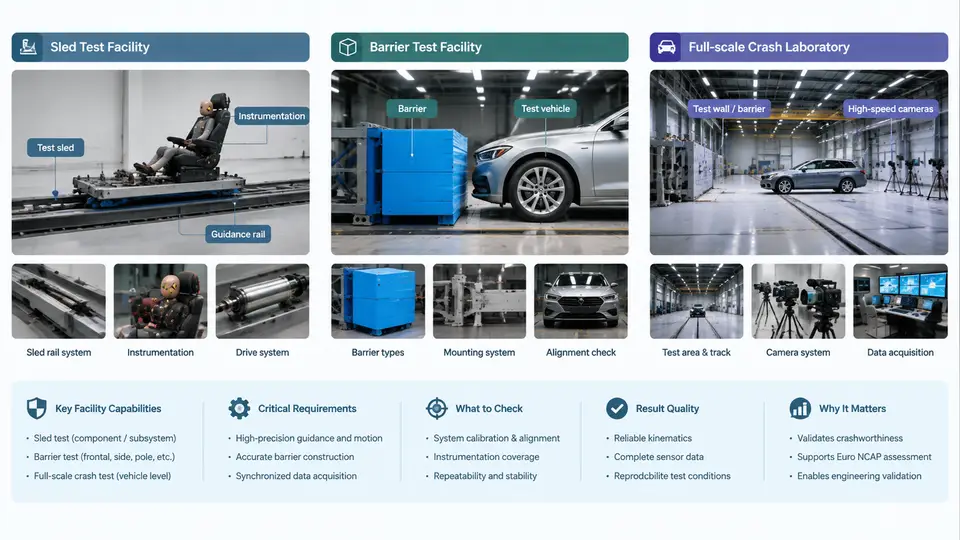
Euro NCAP assessment protocols are only as credible as the facilities that execute them. A frontal offset test at 64 km/h, a side pole impact at 32 km/h, or a far-side occupant-to-occupant scenario each impose distinct demands on the laboratory: propulsion energy, guidance accuracy, barrier geometry, data acquisition bandwidth, and photometric coverage. This chapter examines the three principal facility classes — the sled laboratory, the barrier test rig, and the full-scale crash laboratory — and the capability envelope each must satisfy to produce results accepted by Euro NCAP and, by extension, by type-approval authorities.
Sled Laboratories: Component-Level Deceleration Control
A sled laboratory reproduces a crash pulse without destroying a complete vehicle body. The test article — a seat, a restraint system, a steering column, or a full body-in-white buck — is mounted on a carriage that is accelerated or decelerated along a straight rail. The essential capability is pulse fidelity: the ability to generate a prescribed acceleration-time history within tolerance.
Two propulsion architectures dominate. Catapult sleds store energy in a stretched bungee or a pneumatic accumulator and release it to accelerate the carriage; the pulse is shaped by the energy-release profile. Deceleration sleds accelerate the carriage to a target velocity and then absorb energy through crushable tubes, hydraulic dampers, or a programmable brake, so the pulse is shaped by the energy-absorbing element. For Euro NCAP sled work, deceleration sleds are generally preferred because the pulse shape can be tuned independently of the impact velocity.
A representative configuration for a frontal occupant sled test might specify:
Target velocity:        50 km/h  (13.89 m/s)
Pulse shape:            trapezoidal, 25 g plateau
Rise time:              8 ms
Duration:               90 ms
Tolerance:              ±3 g on plateau, ±1 ms on timing
Carriage mass:          850 kg (buck + fixtures)
Rail length:            18 m
Data channels:          48 (accelerometers, load cells, HBM)
Sampling rate:          20 kHz per channel, anti-alias filtered
The critical verification step is the pulse correlation: the measured carriage acceleration is compared against the target corridor. If the plateau overshoots, the energy-absorbing element is too stiff; if the rise time is too long, the release mechanism is adding compliance. A common failure symptom is a double-hump pulse, which usually indicates the carriage has rebounded against the brake before the energy absorber fully engaged. Troubleshooting begins with a mass check — an unaccounted 20 kg on the carriage shifts the entire pulse by roughly 2–3 g.
Sled facilities must also provide onboard data acquisition with sufficient channel count and bandwidth. Because the carriage is moving, signal transmission is typically via umbilical cable, telemetry, or onboard recording with post-test download. Onboard recording is preferred for high-channel-count setups because it eliminates cable-induced noise and drag.
Barrier Test Rigs: Static and Dynamic Impact Structures
Barrier testing evaluates vehicle structures and restraint systems against fixed or moving deformable barriers. The facility requirement here is less about propulsion and more about barrier geometry, mass calibration, and alignment.
For the Euro NCAP frontal offset test, the deformable barrier (ODB) is a honeycomb aluminium structure mounted on a rigid block. The facility must verify the barrier's force-deflection characteristic before each test campaign. A typical acceptance check involves quasi-static compression of a sample honeycomb block at 0.5 m/s and comparison against the reference curve. If the measured force at 200 mm deflection deviates by more than 10%, the barrier is rejected.
For side impact, the moving deformable barrier (MDB) is a trolley carrying a honeycomb face. The facility must control:
- Impact velocity — typically 50 km/h for the AE-MDB, with ±0.5 km/h tolerance.
- Yaw angle — the barrier must strike at the specified angle (e.g., 90° for side impact, 75° for pole) within ±1°.
- Vertical alignment — the barrier centreline must align with the vehicle's reference line within ±10 mm.
- Honeycomb condition — the face must be inspected for crushing, moisture ingress, and delamination before each run.
Barrier rigs also require high-speed photogrammetry to capture the deformation sequence. A minimum of four cameras — front, side, overhead, and onboard — is typical, with frame rates of 1000 fps or higher and synchronized triggering within ±0.1 ms.
Full-Scale Crash Laboratories: Integrated Capability
The full-scale crash laboratory is the most demanding facility class. It must accommodate a complete vehicle, a propulsion system capable of accelerating the vehicle to the target velocity, a guidance system to maintain trajectory, and a data acquisition and photometric infrastructure that captures the entire event.
The propulsion options are:
| Method | Typical Velocity Range | Key Advantage | Key Limitation |
|---|---|---|---|
| Tow cable + winch | 0–80 km/h | Simple, low cost | Cable stretch affects pulse |
| Linear motor | 0–120 km/h | Programmable velocity profile | High capital cost |
| Pneumatic launcher | 0–100 km/h | Fast reset | Limited energy for heavy vehicles |
| Gravity drop | 0–50 km/h | No external power | Fixed velocity, large footprint |
Guidance is equally critical. The vehicle must track a straight line to within ±50 mm over the run-up distance. Rail-guided systems use a steel rail and a capture shoe; free-running systems rely on the vehicle's own steering, which is only acceptable for low-speed or specific test configurations. For Euro NCAP frontal and side impacts, rail guidance is standard.
The laboratory must also provide a rigid impact wall or fixed barrier with a mass at least 100 times the vehicle mass, anchored to a foundation that can absorb the reaction without displacement. A typical requirement is a wall displacement of less than 2 mm during impact.
Data acquisition in a full-scale test is more complex than in sled testing because the vehicle is moving and the event is short (100–200 ms). A typical channel count is 60–120, including accelerometers, load cells, displacement sensors, and onboard cameras. The sampling rate is typically 10–20 kHz per channel, with anti-alias filtering at 1/3 of the sampling rate. The data must be time-synchronized with the photometric record to within ±0.1 ms.
Facility Capability Matrix and Verification
The following SVG summarizes the relationship between the three facility classes and the Euro NCAP test types they support, including the key capability parameters that must be verified.
Acceptance and Calibration Workflow
Regardless of facility class, Euro NCAP acceptance follows a common logic: define the target, measure the deviation, and document the correction. For a full-scale laboratory, the annual calibration campaign typically includes:
- Velocity calibration — a series of runs at 25, 50, 64, and 80 km/h with a calibrated light gate or radar. The measured velocity must be within ±0.5 km/h of the target.
- Guidance calibration — a run with a laser tracker or total station measuring the vehicle centreline deviation from the reference line. The deviation must be within ±50 mm over the last 10 m before impact.
- Wall rigidity check — a static load test or a low-speed impact with a known mass to confirm the wall displacement is below the threshold.
- Data acquisition verification — a shunt calibration on all strain-gauge channels and a known-acceleration check on all accelerometers.
- Photometric verification — a synchronization check using a flashing LED or a timing pulse visible in all cameras.
The output of this campaign is a facility calibration report that must be available for review by the Euro NCAP secretariat. A facility that cannot produce this report, or whose deviations exceed the protocol tolerances, is not eligible to submit test results for assessment.
In summary, the three facility classes form a capability hierarchy: sled laboratories isolate occupant and restraint performance under controlled pulses; barrier rigs evaluate structural and restraint response against standardized deformable or rigid impacts; and full-scale laboratories integrate propulsion, guidance, barrier, and data acquisition into a single event. Each class has its own acceptance criteria, and each must be verified independently before its results can support a Euro NCAP assessment.