1. Euro NCAP overview
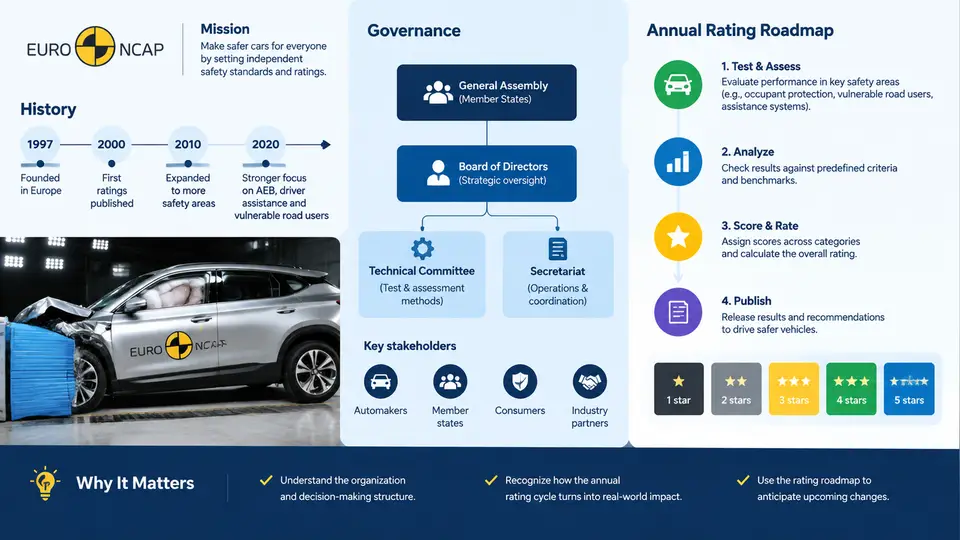
Euro NCAP (European New Car Assessment Programme) is a voluntary vehicle safety performance assessment programme that publishes star ratings for new passenger cars, vans, and — since 2020 — heavy trucks sold in Europe. Unlike type-approval regulation, which sets a legal minimum, Euro NCAP deliberately raises the bar: it tests beyond regulatory requirements, publishes comparative results, and uses consumer pressure to push manufacturers toward faster safety innovation. Understanding its mission, governance, and annual rating cycle is the foundation for every engineering validation activity that follows in this course.
Mission and Operating Principles
Euro NCAP's stated mission is to provide consumers with transparent, independent information about the safety performance of vehicles, and to stimulate manufacturers to improve safety beyond what legislation demands. Three operating principles follow from this:
- Independence: the programme is not a regulator and does not approve vehicles for sale. It purchases vehicles anonymously from the open market, so results reflect series-production configuration rather than hand-built prototypes.
- Comparability: all vehicles are assessed against the same protocol version within a rating year, so a five-star result means the same thing across brands and segments.
- Progressive stringency: protocols are revised roughly every three years, adding new scenarios, tightening thresholds, and introducing new technology categories (e.g., active safety, vulnerable road users, driver monitoring).
A critical consequence for engineers: a vehicle that scored five stars two years ago may not score five stars today, even if nothing about the vehicle changed. Ratings are version-bound, and the protocol version is always published alongside the result.
Historical Development
Euro NCAP was founded in 1997 by a consortium of European governments, motoring organisations, and consumer bodies, with the UK Department for Transport playing a leading role. The first results, published in 1997, covered seven superminis and used a single frontal offset test. The programme expanded rapidly:
| Period | Key development |
|---|---|
| 1997–2000 | Frontal offset and side impact tests; first star ratings published |
| 2002–2009 | Pedestrian protection and child occupant protection added; four-pillar scoring introduced |
| 2009–2015 | Overall rating system with weighted pillar scores; ESC and speed assistance rewarded |
| 2016–2019 | Autonomous emergency braking (AEB) and lane support become mainstream requirements |
| 2020–2022 | New mobile progressive deformable barrier (MPDB) frontal test; far-side occupant protection; AEB for cyclists and pedestrians in darkness |
| 2023 onward | Emphasis on driver monitoring, assisted driving grading, and post-crash safety |
The 2020 update was particularly disruptive: the long-standing 64 km/h offset deformable barrier (ODB) test was replaced by the MPDB test, which uses a moving deformable barrier and evaluates both self- and partner-protection. This single change invalidated many previously validated CAE models and required manufacturers to re-baseline their frontal body structures.
Governance Structure
Euro NCAP is governed by a General Assembly composed of member organisations, including national governments, automobile clubs, consumer associations, and research institutes. Day-to-day technical work is delegated to a Secretariat and a set of technical working groups. The key bodies are:
- General Assembly: sets strategic direction, approves protocol changes, and admits new members.
- Secretariat: manages test scheduling, contracts independent test laboratories, and publishes results.
- Technical Working Groups: develop and revise test protocols in specific domains — frontal impact, side impact, pedestrian protection, active safety, child safety, and heavy vehicles.
- Independent Test Laboratories: accredited facilities that execute the physical tests and submit data to the Secretariat.
Manufacturers do not vote on protocol content, but they participate through consultation phases and can submit data and position papers. This separation is deliberate: it prevents commercial interests from diluting test severity.
The Annual Rating Roadmap
Euro NCAP operates on an annual rating cycle. The roadmap below reflects the typical sequence, though exact dates shift year to year.
- Q4 (previous year): Protocol updates published; manufacturers receive final test procedures and scoring spreadsheets.
- Q1: Test laboratories begin vehicle procurement and preparation; manufacturers finalise build configurations.
- Q2–Q3: Physical testing and data collection; results reviewed by the Secretariat.
- Q4: Results published in batches; star ratings released to the public.
Two practical points matter for engineering planning. First, the protocol version that applies to a vehicle is determined by its test date, not its market launch date. A vehicle launched in December may be tested under the following year's protocol if testing slips into January. Second, manufacturers can request a re-test if a vehicle is modified, but the re-test uses the current protocol version, not the original one.
How the Rating Is Structured
Since 2009, Euro NCAP has used an overall rating built from four assessment areas, each scored separately and then weighted:
| Assessment area | Typical weight | Representative tests |
|---|---|---|
| Adult Occupant Protection | ~40% | Frontal offset (MPDB), side barrier, side pole, whiplash |
| Child Occupant Protection | ~20% | CRS installation, dynamic crash tests, vehicle-based assessment |
| Vulnerable Road User Protection | ~20% | Pedestrian and cyclist head/leg impacts, AEB VRU |
| Safety Assist | ~20% | AEB, lane support, speed assistance, occupant status monitoring |
Weights are indicative and change with protocol revisions. A vehicle must meet minimum thresholds in each area to achieve a given star rating; a strong frontal result cannot compensate for a weak Safety Assist score. This "no weak pillar" rule is why manufacturers now invest heavily in active safety even when passive performance is already strong.
Why This Matters for Validation Engineering
Every engineering validation task in this course — CAE model correlation, sled testing, barrier design, sensor calibration, or AEB scenario testing — exists because Euro NCAP defines a specific, measurable requirement. The protocol documents are the primary reference: they specify impact speeds, barrier geometries, dummy types, instrumentation channels, and pass/fail criteria. Before any test or simulation, the engineer must confirm which protocol version applies, which assessment area is being addressed, and what the minimum threshold is.
Visual Overview of the Rating Framework
The diagram below summarises how the four assessment areas feed into the overall star rating, and where the annual protocol cycle sits relative to vehicle development.
Key Takeaways
- Euro NCAP is an independent, consumer-facing assessment programme, not a regulator. It purchases vehicles anonymously and publishes comparative star ratings.
- Its governance separates strategic direction (General Assembly), technical protocol development (Working Groups), and test execution (accredited laboratories).
- The rating is built from four weighted assessment areas, each with minimum thresholds. A weak pillar cannot be compensated by a strong one.
- Protocols are revised roughly every three years; the applicable version is determined by the test date, not the vehicle's launch date.
- The annual cycle runs from protocol publication in Q4 of the previous year through testing in Q2–Q3 and results publication in Q4.
With this framework in place, the next chapter examines the specific test configurations and dummy instrumentation used in frontal impact assessment — the area with the highest weighting and the most demanding validation requirements.