4. Pedestrian kinematics in vehicle collisi
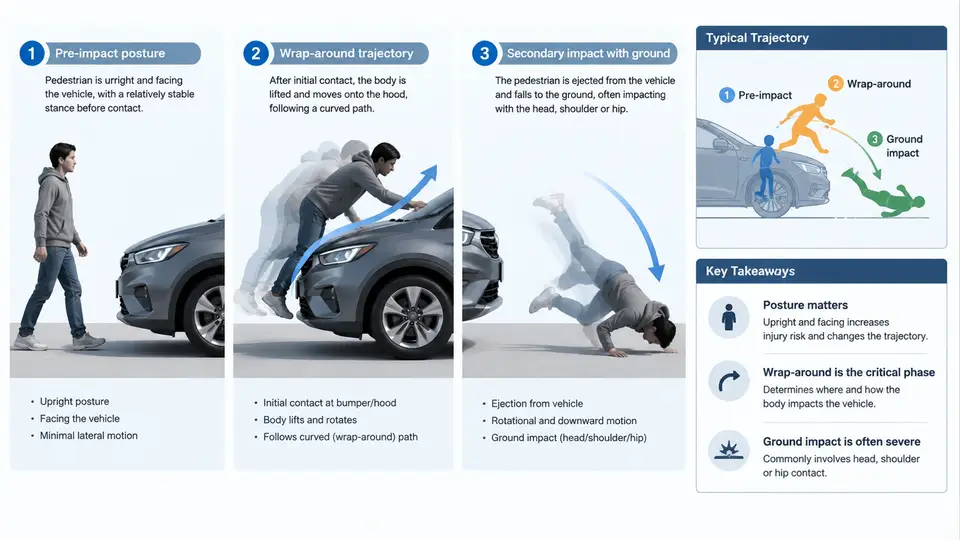
When a vehicle strikes a pedestrian, the body does not simply move backward as a rigid block. Instead, the pedestrian undergoes a rapid, multi-phase kinematic sequence driven by the geometry of the vehicle front end, the impact speed, the pedestrian's pre-impact posture, and the relative position of the center of gravity (CG). Understanding this sequence is essential for reconstructing accidents, designing pedestrian-friendly vehicle fronts, and interpreting injury patterns in forensic and regulatory contexts.
Pre-Impact Posture and Its Influence
Pre-impact posture determines how the pedestrian's body interacts with the vehicle. A walking adult typically presents a lateral or oblique orientation to the vehicle, with one leg forward and arms swinging. A standing pedestrian facing the vehicle presents a frontal profile. A child is shorter, with a higher head-to-vehicle-front ratio, and often presents a more compact, less stable stance.
Key posture variables include:
- Body orientation: frontal, lateral, or oblique relative to the vehicle's travel direction.
- Stride phase: which leg is leading, affecting pelvis rotation and lower-limb loading.
- Arm position: arms may be raised, lowered, or swinging, altering upper-body contact with the hood.
- Head position: forward, neutral, or turned, influencing head-to-windshield or head-to-ground contact.
These variables are not cosmetic. A pedestrian struck while mid-stride may rotate about the vertical axis, converting a frontal impact into an oblique one. A pedestrian with arms raised may contact the hood with the forearms first, reducing direct torso loading but increasing upper-extremity injury risk.
The Wrap-Around Trajectory
The term wrap-around describes the pedestrian's motion after the initial bumper contact. The sequence typically proceeds through four phases:
- Bumper contact: The lower legs or knees are struck first, imparting a horizontal impulse to the lower body.
- Hood contact: As the vehicle continues forward, the upper body rotates forward and downward, contacting the hood or windshield region.
- Rotation and lift: The pedestrian's torso rotates about the vehicle's front edge, and the body may be lifted onto the hood or thrown forward.
- Separation and projection: The pedestrian leaves the vehicle surface, following a ballistic trajectory before ground contact.
The wrap-around trajectory is strongly speed-dependent. At low speeds (below approximately 20 km/h), the pedestrian may be pushed forward and fall to the ground without significant lift. At moderate speeds (30–50 km/h), the body wraps onto the hood and may slide or rotate before falling. At higher speeds (above 60 km/h), the pedestrian can be projected over the vehicle, with a longer airborne phase and higher secondary impact severity.
Example parameter set (illustrative, not measured): Vehicle speed 40 km/h, pedestrian height 1.75 m, mass 75 kg, bumper height 0.45 m, hood leading edge height 0.85 m. Under these conditions, the pedestrian's CG is typically located near the hood surface after initial contact, and the body rotates forward at approximately 200–400°/s before separation.
Secondary Impact with the Ground
After separation from the vehicle, the pedestrian follows a ballistic path and strikes the ground. This secondary impact is often more injurious than the primary vehicle contact, particularly for head and cervical spine injuries. The ground impact velocity depends on the separation height and the vertical component of the pedestrian's velocity at separation.
Ground contact can occur in several configurations:
- Head-first: common when the pedestrian is projected forward and rotates, leading to direct cranial impact.
- Shoulder/thorax-first: occurs when the body rotates less and lands on the side or back.
- Pelvis/lower-limb-first: more common at lower speeds or when the pedestrian is struck laterally.
The ground surface matters. Asphalt, concrete, and grass produce different coefficients of friction and different injury profiles. A head-first impact on asphalt at 30 km/h can produce severe traumatic brain injury, whereas the same impact on grass may result in moderate concussion.
Engineering and Forensic Relevance
For vehicle designers, the wrap-around trajectory informs the placement of energy-absorbing structures. A lower bumper height reduces knee-bending moments; a deformable hood reduces head injury criteria (HIC) values. For accident reconstruction, the trajectory helps estimate impact speed from pedestrian throw distance and rest position. For forensic pathologists, the sequence explains why a pedestrian may have both bumper-level fractures and head injuries from ground contact.
In practice, reconstructing a pedestrian collision involves combining scene evidence (skid marks, debris, blood stains), vehicle damage (bumper deformation, hood dents, windshield fracture patterns), and pedestrian injury data (fracture locations, abrasion patterns). The wrap-around model provides a first-order framework for correlating these observations with impact conditions.
Practical note: When documenting a pedestrian collision scene, record the pedestrian's final rest position relative to the vehicle's initial contact point. This throw distance, combined with vehicle speed and pedestrian mass, provides a useful cross-check against the wrap-around trajectory model.
Summary of Key Kinematic Variables
| Variable | Effect on Trajectory | Typical Range (Illustrative) |
|---|---|---|
| Impact speed | Controls lift, rotation rate, and projection distance | 20–80 km/h |
| Bumper height | Determines lower-limb loading and initial rotation axis | 0.3–0.6 m |
| Pedestrian height | Affects head-to-hood contact and CG location | 1.0–1.9 m |
| Pre-impact orientation | Alters contact sequence and body rotation axis | Frontal / lateral / oblique |
| Ground surface | Influences secondary impact injury severity | Asphalt / concrete / grass |
Understanding these variables allows engineers and investigators to move from a generic description of a pedestrian collision to a specific, physically grounded reconstruction. The wrap-around trajectory is not a single curve but a family of possible paths, each determined by the interaction of vehicle geometry, impact speed, and human posture at the moment of contact.