4. Anthropomorphic Test Devices (ATDs)
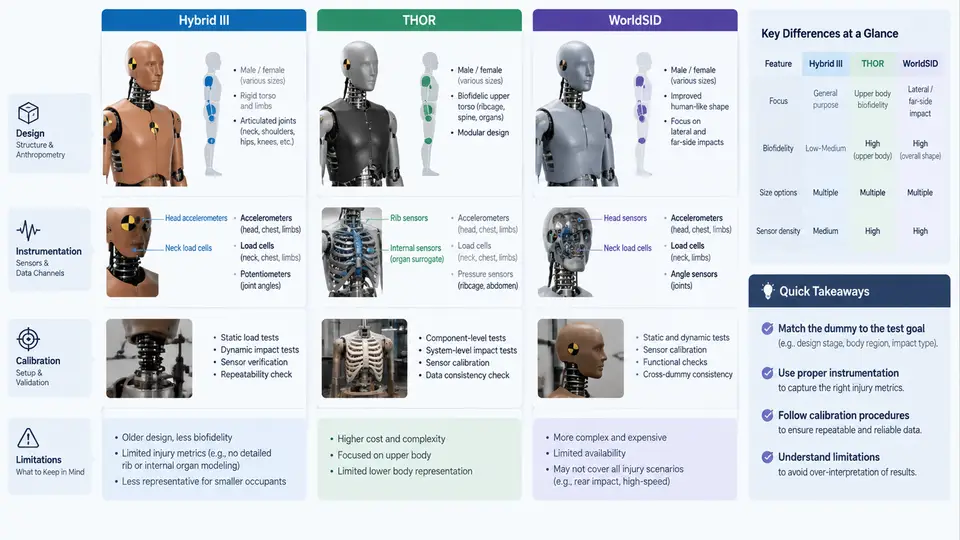
Anthropomorphic Test Devices (ATDs), commonly called crash test dummies, are the physical measurement instruments at the center of occupant safety evaluation. Every restraint tuning decision, every regulatory pass/fail verdict, and every injury criterion value ultimately traces back to what an ATD measured inside a vehicle during a controlled deceleration event. Understanding how these devices are built, what they measure, how they are verified, and where they misrepresent the human body is therefore essential for anyone interpreting crash test data or developing safety countermeasures.
Design Philosophy and Biofidelity Targets
An ATD is a mechanical surrogate designed to reproduce the mass distribution, geometry, joint stiffness, and deformation response of a specific percentile of the human population. The three devices most relevant to current frontal and side impact regulation and consumer testing are Hybrid III (frontal, 50th percentile male and smaller variants), THOR (advanced frontal, 50th percentile male), and WorldSID (side impact, 50th percentile male and 5th percentile female).
Biofidelity is the degree to which a dummy's response matches cadaveric or volunteer data under the same loading. It is not a single number but a family of response corridors — force–deflection, moment–rotation, and acceleration–time envelopes — each with a defined tolerance band. Hybrid III was designed primarily for belt-restrained frontal loading and performs well within that narrow regime. THOR was developed to extend biofidelity to a wider range of frontal loading conditions, including out-of-position and oblique impacts, by adding a flexible thoracic spine, a more human-like ribcage with four to six ribs, and improved face and neck response. WorldSID was designed specifically for lateral loading, with a biofidelic pelvis, a curved ribcage, and shoulder geometry that better represents how a human torso interacts with a door trim or side airbag.
Instrumentation and Measurement Channels
Each ATD carries a defined set of sensors whose locations and orientations are standardized so that data from different laboratories can be compared. The table below summarizes the principal channels for the three devices.
| Device | Primary application | Key instrumentation | Principal injury criteria |
|---|---|---|---|
| Hybrid III 50th | Frontal, belt-restrained | Head triaxial accelerometer, upper/lower neck load cell, chest accelerometers and deflection potentiometer, lumbar load cell, femur load cells | HIC, Nij, chest deflection, chest acceleration (3 ms clip), femur force |
| THOR 50th | Advanced frontal, oblique, out-of-position | Head accelerometers and angular rate sensors, multi-axis neck, four-to-six-rib chest with individual deflection, thoracic and lumbar load cells, iliac and pubic load cells | HIC, Nij, chest deflection, thoracic and abdominal pressure, pelvis force |
| WorldSID 50th | Side impact | Head accelerometers and angular rate sensors, neck load cell, shoulder, thorax and abdomen rib deflection, pelvis load cell and accelerometers | HIC, neck force/moment, rib deflection (upper/middle/lower), abdominal deflection, pelvis force |
Signal conditioning matters as much as sensor placement. Accelerometers are typically piezoresistive or capacitive, with a full-scale range of ±500 g to ±2000 g for head channels and ±100 g to ±500 g for chest channels. Load cells use strain gauges in a Wheatstone bridge, with rated capacities matched to the expected load (for example, a neck load cell rated to ±4 kN axial and ±200 N·m bending). All channels are sampled at a minimum of 10 kHz for acceleration and 20 kHz for load, then filtered according to SAE J211 with the channel class specified by the test protocol — Channel Class 1000 for head acceleration, Class 600 for chest acceleration, Class 180 for chest deflection, and Class 600 for neck and femur loads. Applying the wrong filter class is one of the most common causes of non-comparable results between laboratories.
Calibration and Certification
An ATD is only valid for a test if it has passed its scheduled calibration checks within the required interval. Calibration is not a single procedure but a set of component-level and subsystem-level verifications, each with a pass/fail band.
For Hybrid III, the head is drop-tested from a specified height onto a rigid plate, and the peak resultant acceleration at the head center of gravity must fall within a narrow corridor (typically 225 g to 275 g for the 50th percentile male, with the exact band defined in the calibration manual). The neck is pendulum-tested in flexion and extension, and the peak moment and the decay time must match the reference response. The chest is tested with a pendulum impact to verify deflection and hysteresis. The knee and femur are tested for force transmission. Each check produces a calibration certificate that must accompany the dummy into the test.
THOR adds ribcage and abdominal calibration, and its spine and pelvis have additional checks because of the more complex load paths. WorldSID requires rib module calibration, shoulder calibration, and pelvis calibration, with particular attention to the lateral deflection corridors that define its biofidelity.
Limitations and Interpretation Pitfalls
The most important limitation is that an ATD is a single-percentile, single-posture surrogate. Hybrid III 50th represents a mid-size adult male; it does not represent children, small females, or large males unless the appropriate variant is used. Even then, the scaling relationships between percentiles are approximate and do not capture differences in bone material properties, muscle tone, or injury tolerance.
Second, ATDs are designed for a specific loading direction. Hybrid III's thoracic spine is relatively stiff and its ribcage is optimized for frontal belt loading; in side impact it over-predicts or under-predicts deflection depending on the loading point. WorldSID is the reverse. Using a frontal dummy in a side test, or vice versa, produces data that cannot be interpreted with the corresponding injury criteria.
Third, ATDs lack active musculature and reflex response. A real occupant braces, tenses, and moves before and during impact. An ATD does not. This is particularly significant in low-speed and pre-crash scenarios, where occupant motion before the crash pulse determines position at the time of airbag deployment.
Fourth, injury criteria are statistical constructs derived from cadaver and animal data, not direct measurements of human injury. HIC, Nij, and chest deflection are correlates, not injury itself. A HIC of 700 does not mean a specific injury will occur; it means the probability of a specified injury level is elevated relative to the reference population used to derive the criterion.
Practical Calibration Workflow and Failure Diagnosis
A representative calibration sequence for a Hybrid III 50th percentile head illustrates the level of detail involved. The head assembly is removed from the neck, mounted on the drop tower with the accelerometer at the center of gravity aligned to the impact axis, and released from a height that produces the specified impact velocity. The measured peak resultant acceleration is compared to the corridor. If the peak is low, common causes include a loose accelerometer mount, a damaged head skin, or a misaligned drop axis. If the peak is high, the head skin may have stiffened from age or the accelerometer may be over-range. The decay portion of the curve is equally important: a head that peaks correctly but decays too slowly indicates excessive internal damping or a loose internal mass.
For the neck, the pendulum test is performed in both flexion and extension. The moment–time curve is examined for peak moment, time to peak, and the presence of oscillation. A neck that produces a sharp spike followed by rapid decay often indicates a loose load cell or a damaged neck cable. A neck that produces a broad, low-amplitude response may have degraded elastomer or a mis-set cable tension.
For WorldSID, rib module calibration is the most frequent source of failure. Each rib is tested individually with a pendulum, and the deflection–time response must fall within the corridor. A rib that deflects too much may have a cracked or fatigued rib element; a rib that deflects too little may have a stiffened or contaminated element. Because WorldSID has multiple ribs, a single out-of-corridor rib invalidates the entire thorax for that test.
Choosing the Right ATD for the Question Being Asked
The choice of ATD should follow from the injury mechanism under investigation, not from convenience or availability. For a frontal offset deformable barrier test evaluating belt and airbag performance, Hybrid III remains the regulatory reference and its criteria are well understood. For a frontal oblique or small-overlap test where the occupant loads the airbag asymmetrically and the thorax experiences multi-axis loading, THOR provides more relevant chest and pelvis data. For a side impact or side airbag evaluation, WorldSID is the appropriate device, and its rib deflection channels give a more direct read on thoracic injury risk than any frontal dummy can.
When comparing results across devices, remember that the criteria are not interchangeable. A HIC value from Hybrid III and a HIC value from THOR are computed the same way mathematically but are derived from different head and neck assemblies with different mass and stiffness. Treating them as directly comparable without acknowledging the device difference is a common and consequential error in safety performance analysis.
In summary, ATDs are calibrated instruments with defined validity domains. Their value comes from standardized design, standardized instrumentation, and standardized calibration — and their limitations come from the same standardization, which fixes them to specific percentiles, postures, and loading directions. Reading crash test data responsibly means knowing which device produced it, how it was calibrated, and what it can and cannot tell you about the human occupant it represents.