1. Course overview
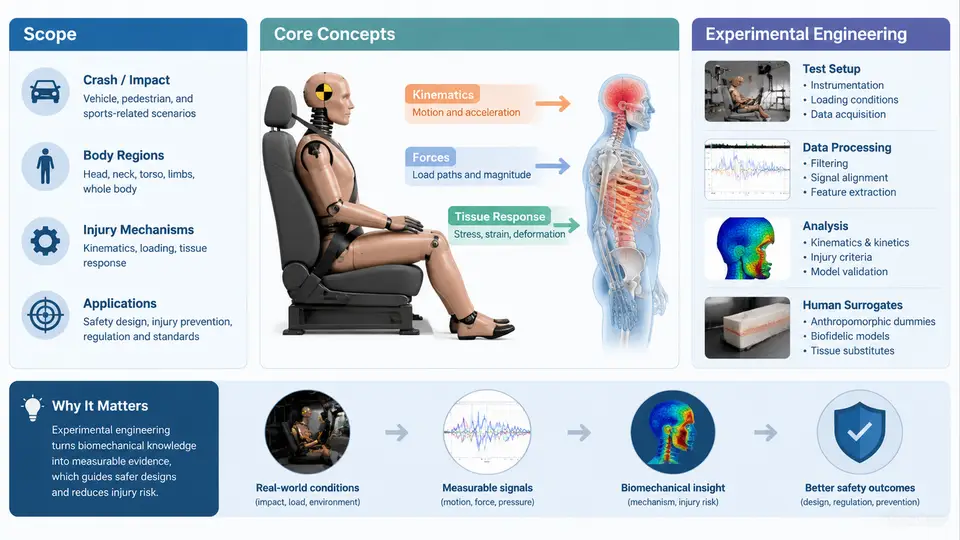
Occupant injury biomechanics is the study of how mechanical loads are transferred through the human body during a collision, and how the resulting stresses and strains produce tissue damage. It sits at the intersection of mechanics, anatomy, physiology, and vehicle safety engineering. Experimental engineering is the discipline that turns this science into measurable, repeatable evidence: it designs the physical tests, instrumentation, and data-reduction methods that quantify injury risk and validate the models used to design safer vehicles and restraints.
This course focuses on the experimental side of that equation. Rather than treating injury biomechanics as a purely analytical subject, we will work through the hardware, procedures, and judgment calls that make an experiment trustworthy — from selecting a cadaver or surrogate specimen, to mounting accelerometers, to deciding whether a measured response is physically plausible or an artifact of the test setup.
Scope of the Course
The scope spans four connected layers. First, injury mechanisms and tolerance: what loading modes (compression, tension, shear, bending, inertial) cause specific injuries, and what thresholds separate reversible from irreversible damage. Second, test platforms: impactors, sleds, drop towers, and full-scale crash tests, each with different control over the input pulse. Third, measurement and instrumentation: accelerometers, load cells, displacement transducers, high-speed imaging, and the signal conditioning that keeps data valid. Fourth, data analysis and validation: filtering per SAE J211, injury criteria computation, and comparison against reference corridors.
A useful way to see how these layers connect is to trace a single test from input to decision. The diagram below shows the experimental chain for a typical frontal impact sled test, including the key measurement points and the feedback loop that determines whether the result is usable.
Core Concepts You Will Use Throughout
Several concepts recur in every chapter, so it is worth fixing their meaning now.
- Injury criterion — a scalar function of measured physical quantities (acceleration, force, deflection, time) that correlates with a specific injury outcome. HIC, Nij, and chest compression are examples. A criterion is only meaningful together with its associated tolerance level and the loading condition under which it was derived.
- Injury Assessment Reference Value (IARV) — the threshold value of a criterion above which a given injury severity (commonly AIS 3+) is expected at a defined probability. IARVs are not universal constants; they depend on specimen type, age, and loading direction.
- Biofidelity — the degree to which a surrogate or model reproduces human response. A test device can be highly repeatable yet poorly biofidelic; both properties matter, and they are evaluated separately.
- Corridor — a response envelope (e.g., force–deflection or acceleration–time) derived from a set of reference tests, used to judge whether a new measurement falls within expected biomechanical behavior.
- Channel filtering class — the low-pass filter specification (CFC 60, 180, 600, 1000) applied to a signal before analysis. Using the wrong class changes peak values and can invalidate a criterion computation.
Why Experimental Engineering Matters
Analytical models and finite element simulations of the human body are only as good as the experimental data used to calibrate and validate them. Every material property in a human body model — cortical bone modulus, ligament failure strain, brain shear modulus — originates from a physical test. Every injury criterion was fitted to experimental measurements. When a vehicle manufacturer runs a sled test to certify a restraint system, that test is an experiment whose validity depends on the same engineering discipline covered in this course.
Experimental engineering also provides the ground truth that regulators and courts rely on. A simulation cannot certify a vehicle; a physical test with documented instrumentation and traceable data can. This is why the field places heavy emphasis on calibration records, channel verification, and documented test setup — not because of bureaucracy, but because an unverifiable measurement has no evidentiary value.
What You Will Actually Do
Across the 30 chapters, you will work with concrete tasks: selecting and preparing specimens, mounting and calibrating transducers, designing a test matrix, acquiring and filtering signals, computing injury criteria, and interpreting results against reference values. The emphasis is on decisions that affect data quality — for example, choosing a sampling rate that avoids aliasing, or recognizing when a load cell reading is contaminated by cross-axis sensitivity.
A Worked Example: From Test to Judgment
Consider a simplified frontal sled test with a Hybrid III 50th percentile male ATD, target Δv = 56 km/h. The test engineer must:
- Verify the sled pulse matches the target corridor (typically a trapezoidal or half-sine acceleration profile with defined peak and duration).
- Confirm all channels are zeroed and calibrated; record pre-test offsets.
- Run the test and acquire raw data at ≥ 10 kHz.
- Apply SAE J211 filtering: CFC 1000 for head acceleration, CFC 600 for chest acceleration, CFC 180 for femur force.
- Compute HIC₃₆ from the filtered head acceleration. For a typical belted occupant in this condition, HIC₃₆ might fall in the range of 300–700 (example values, not a guaranteed result).
- Compare each criterion against its IARV. If HIC₃₆ exceeds the reference value, the restraint system or test condition requires review.
The judgment step is not purely numerical. The engineer also checks whether the acceleration trace shows a plausible single peak or an artifact spike, whether the chest deflection channel saturated, and whether the test pulse was within tolerance. A criterion value computed from a corrupted signal is worse than no value at all, because it creates false confidence.
How to Approach This Course
Treat each chapter as a combination of principle and procedure. When a new criterion or test method appears, ask three questions: What physical quantity is being measured? What assumption connects that quantity to injury? What could invalidate the measurement? These questions will carry you through the more specialized material on head, chest, spine, and extremity testing that follows.
The goal is not to memorize thresholds, but to develop the judgment to design, execute, and interpret an experiment that produces defensible biomechanical evidence.