1. Anthropomorphic test devices in crash sa
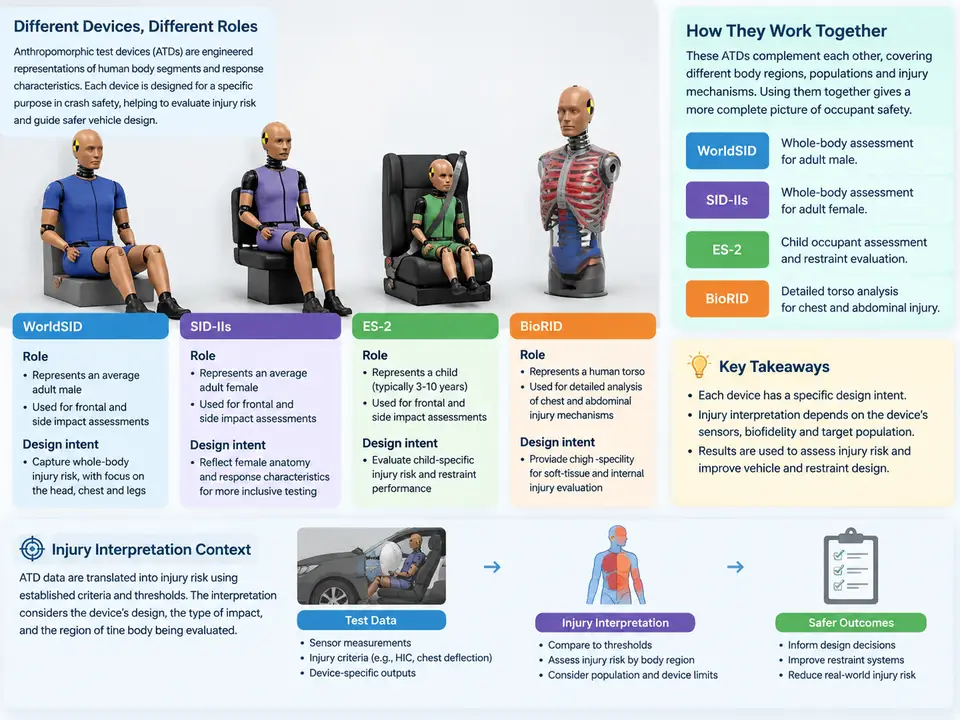
Anthropomorphic test devices (ATDs), commonly called crash test dummies, are calibrated mechanical surrogates for the human body. They do not measure injury directly; they measure physical responses—accelerations, forces, moments, deflections—that are then mapped to injury risk through empirical criteria derived from cadaver, animal, and volunteer testing. Understanding which ATD is used, why it was designed the way it was, and what its instrumentation can and cannot represent is the foundation for every subsequent interpretation task in this course.
The four devices covered here occupy distinct niches. WorldSID is a mid-sized adult male side-impact ATD developed through international harmonization (ISO/SAE). SID-IIs is a small adult female side-impact ATD, originally developed by NHTSA to represent the 5th-percentile female occupant. ES-2 is the European side-impact ATD, a mid-sized adult male derived from the earlier EuroSID-1 and used extensively in Euro NCAP and UN R94/R95 regulatory testing. BioRID (Biofidelic Rear Impact Dummy) is a rear-impact ATD designed specifically to reproduce the cervical spine kinematics associated with whiplash injury. The first three are lateral-impact tools; the fourth is a rear-impact tool. Mixing them up—or assuming their outputs are interchangeable—is one of the most common interpretive errors in occupant safety work.
Design intent: what each device was built to capture
WorldSID was designed around biofidelity in lateral loading. Its key architectural features are a segmented, deformable ribcage with independent rib modules, a pubic symphysis load cell, and a laterally compliant shoulder and pelvis. These allow it to measure rib deflection at multiple heights and to capture the load path through the pelvis, which is where much side-impact injury originates. WorldSID is instrumented to a high channel count and is the reference ATD in many modern side-impact protocols, including UN R135 and several consumer rating programs.
SID-IIs shares the general side-impact architecture but is scaled to a smaller occupant. Its smaller mass and geometry mean that, for the same vehicle structure and impact pulse, it will experience different accelerations and deflections than WorldSID. This is not a defect—it is the point. A restraint system tuned only to a mid-sized male may under-protect or over-load a smaller occupant, and SID-IIs exists to expose that.
ES-2 uses a different rib design (a single deformable rib unit with a deflection-measuring system) and a distinct pelvis and abdomen configuration. Its instrumentation set and its injury criteria (particularly the viscous criterion for the abdomen and the rib deflection criteria) are calibrated to European regulatory practice. ES-2 and WorldSID are not numerically interchangeable: the same physical event will produce different deflection readings because the rib structures and measurement locations differ.
BioRID addresses a different injury mechanism entirely. Rear impacts produce a characteristic S-shaped cervical spine curve as the torso is accelerated forward under the seatback while the head lags. BioRID reproduces this with a articulated, biofidelic cervical spine, a flexible thoracic spine, and a head-neck assembly tuned to match volunteer and cadaver kinematics. Its primary outputs are upper and lower neck forces and moments, from which the NIC (Neck Injury Criterion) and Nij (neck injury criterion) are computed.
From channels to criteria: the interpretation chain
Every injury interpretation follows the same chain: physical event → ATD response channel → filtered/processed signal → injury criterion → risk assessment. The ATD determines the first two links. For example, a lateral impact produces rib deflection in WorldSID, SID-IIs, and ES-2, but the deflection is measured at different locations with different sensor designs. The criterion applied (e.g., a rib deflection limit expressed in millimetres) is therefore device-specific. Applying a WorldSID-derived limit to an ES-2 deflection trace is a category error, even though both are "rib deflection."
Signal processing matters as much as the device. Acceleration channels are typically filtered per SAE J211 (channel frequency class 60 for head, 180 for some neck channels, 1000 for force channels), and the choice of CFC changes peak values. Deflection channels are filtered at lower classes. When you read a reported peak, always confirm the filter class and the processing standard; a peak quoted without its CFC is not reproducible.
Practical selection and verification workflow
In a test program, ATD selection is driven by the regulatory or rating protocol, the occupant of interest, and the impact direction. A reproducible selection and verification sequence looks like this:
- Identify the protocol and occupant. For a UN R95 lateral test, ES-2 is the regulatory device. For a consumer side-rating program using WorldSID, the mid-sized male is the reference. For a small-occupant robustness study, SID-IIs is added.
- Confirm the ATD build and calibration status. Check the device part number, firmware/calibration certificate date, and that all channels are within calibration tolerance. A mis-calibrated rib module will bias every deflection reading.
- Verify channel mapping and filter classes against the test specification before the run. Log the CFC per channel in the test record.
- Run the test and inspect raw traces for clipping, dropouts, or saturation before computing criteria. A saturated accelerometer produces a falsely low HIC.
- Compute criteria with the device-specific formulation and compare against the correct limit for that device and protocol.
As a concrete example, consider a lateral sled or full-vehicle test where the goal is to check rib deflection against a protocol limit. The input is the WorldSID rib deflection channel (say, the mid-rib module), filtered at the specified CFC. The observable is the peak deflection and its time of occurrence. If the peak exceeds the limit, the interpretation is not simply "injury"—it is "the rib load path exceeded the calibrated threshold for this device under this pulse." The next step is to examine the intrusion profile and the restraint interaction at that rib height, because the deflection is a consequence of the local loading, not an independent property of the occupant.
For BioRID, the workflow differs. The key outputs are neck forces and moments, from which NIC (based on relative horizontal acceleration between head and T1) and Nij (a combination of axial force and bending moment) are derived. NIC is sensitive to the relative acceleration signal and its filtering; Nij requires correct sign conventions for tension/compression and flexion/extension. A sign error in the moment channel will invert the interpretation of flexion versus extension, which is a serious error in whiplash assessment. Always confirm the sign convention against the ATD user manual before computing Nij.
What the ATD cannot tell you
An ATD is a measurement instrument, not a patient. It does not capture muscle tension, active bracing, occupant size variation beyond its design point, or injury mechanisms not represented in its calibration data. Its injury criteria are statistical mappings from controlled experiments to risk, with confidence intervals. A criterion value near a limit means "risk in the range associated with that response level," not "this occupant will be injured." Interpreting ATD output responsibly means reporting the device, the channel, the filter class, the criterion formulation, and the applicable limit together—never a bare number.
With this foundation—device roles, design intent, the channel-to-criterion chain, and the limits of each surrogate—the subsequent chapters can move into device-specific measurement details, criterion formulations, and worked interpretation cases without ambiguity about which tool produced which number.