1. Decode Euro NCAP Frontal Offset Test Pro
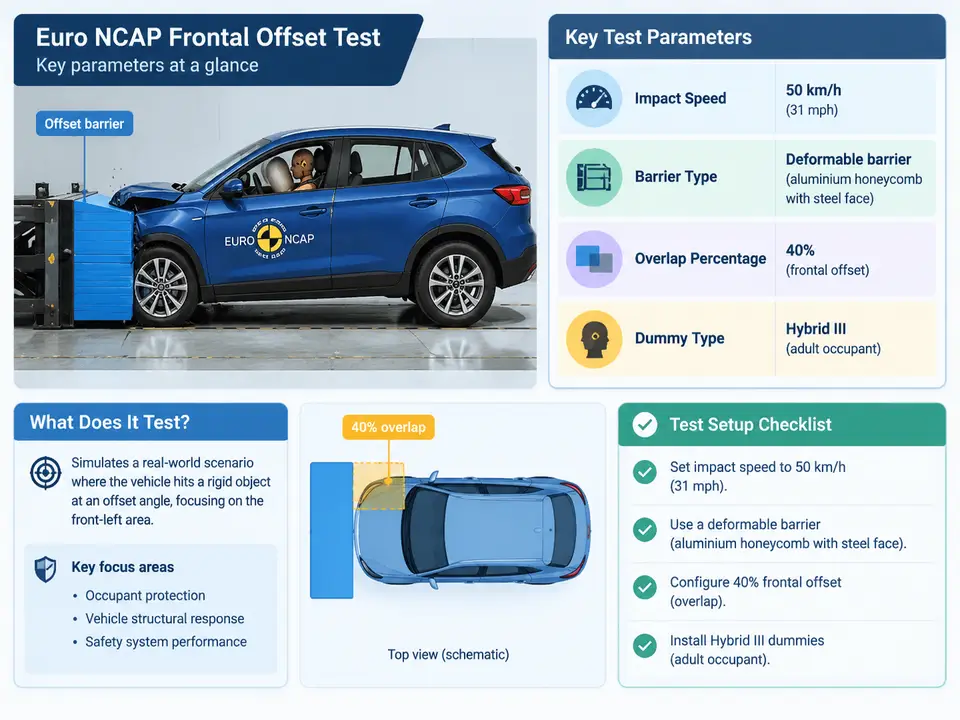
Why the Euro NCAP Frontal Offset Protocol Matters
The Euro NCAP frontal offset test is the workhorse of occupant-protection assessment. Unlike a full-width rigid-barrier impact, it concentrates crash energy into roughly half the vehicle's front structure, forcing the load path through the longitudinal rail, subframe, and lower A-pillar on the struck side. That asymmetry is what makes the test demanding: the vehicle must manage a large yaw moment while the restraint system protects two differently positioned occupants. Before you can plan a test, instrument a vehicle, or interpret a star rating, you need the exact setup parameters locked down. This chapter extracts those parameters from the official protocol and turns them into a reference checklist you can hand to a test engineer.
The Four Governing Parameters
Every frontal offset test setup reduces to four decisions: how fast the vehicle travels, what it hits, how much of the vehicle overlaps the barrier, and which Anthropomorphic Test Devices (ATDs) are seated inside. Get any one wrong and the resulting data is not comparable to the Euro NCAP reference database — and therefore not usable for rating.
| Parameter | Euro NCAP Frontal Offset Value | Engineering significance |
|---|---|---|
| Impact speed | 64 km/h (17.8 m/s) at barrier contact | Sets the kinetic energy budget; tolerance is typically ±1 km/h at the moment of impact |
| Barrier type | Offset Deformable Barrier (ODB) — aluminium honeycomb face on a rigid backing | Represents a deformable opposing vehicle front; crush behaviour is repeatable and certified |
| Overlap | 40% of vehicle width, driver side | Drives asymmetric loading and yaw; measured to the vehicle centreline reference |
| Dummy type | Hybrid III 50th percentile male (driver) and Hybrid III 5th percentile female (front passenger) | Two occupant sizes capture the range of restraint performance across the population |
These four values are the non-negotiable core. Everything else — seat position, steering wheel angle, fuel load, tyre pressure, temperature — is a supporting condition that must also be controlled, but the four above define whether the test is a Euro NCAP frontal offset test at all.
Reading the Protocol Correctly
The impact speed of 64 km/h is specified as the vehicle speed at the instant of barrier contact, not the tow speed at release. On a typical catapult system the vehicle is accelerated along a track and released before impact, so the coast-down distance and rolling resistance must be accounted for during setup. A practical check: log the vehicle speed with an on-board accelerometer or optical sensor and confirm the contact speed falls within the protocol tolerance before accepting the run.
The ODB is not a generic deformable block. It is a certified assembly with a defined honeycomb grade, cell size, and face geometry, mounted on a rigid block. The barrier must be inspected for prior damage and its certification record checked before each test — a crushed or moisture-affected barrier changes the deceleration pulse and invalidates comparison with reference data.
The 40% overlap is measured from the vehicle centreline to the barrier edge on the driver side. Because vehicle widths differ, the absolute overlap distance varies between models; the percentage is what stays constant. The setup engineer must confirm the overlap using the vehicle's declared width and the barrier's fixed position, not by eye.
Visualising the Setup Geometry
The diagram below shows the plan-view geometry of the test: the vehicle approaching the ODB, the 40% overlap on the driver side, and the two ATD positions. It is the mental model a setup engineer should carry onto the test floor.
Building the Reference Checklist
The checklist below is the deliverable of this chapter: a compact, fillable setup record that captures the four governing parameters plus the supporting conditions that most often cause a run to be rejected. Copy it into your test documentation and complete one per run.
| # | Check item | Required value / condition | Recorded |
|---|---|---|---|
| 1 | Impact speed at barrier contact | 64 km/h ±1 km/h | ______ |
| 2 | Barrier type | Certified ODB, honeycomb face intact | ______ |
| 3 | Barrier certification date | Within validity window | ______ |
| 4 | Overlap | 40% of declared vehicle width, driver side | ______ |
| 5 | Driver ATD | Hybrid III 50th percentile male | ______ |
| 6 | Passenger ATD | Hybrid III 5th percentile female | ______ |
| 7 | ATD calibration | Current, within channel limits | ______ |
| 8 | Seat position | Per protocol reference setting | ______ |
| 9 | Steering wheel angle | Straight-ahead, per protocol | ______ |
| 10 | Fuel load | Per protocol (typically full or specified) | ______ |
| 11 | Tyre pressure | Manufacturer specification | ______ |
| 12 | Ambient temperature | Within protocol range | ______ |
Verification and Common Failure Symptoms
After the run, verify the setup by checking the recorded contact speed against the tolerance, confirming the barrier crush pattern matches the expected honeycomb deformation, and reviewing the high-speed video for the correct overlap. If the contact speed is out of tolerance, the run is not a valid Euro NCAP frontal offset test — re-run rather than extrapolate. If the barrier shows asymmetric or excessive crush beyond its certification envelope, replace it before the next test. If the ATD head or knee excursion looks anomalous, check seat and steering settings against the protocol before blaming the restraint system.
With the four parameters and the supporting checklist in hand, you can set up a Euro NCAP frontal offset test that is directly comparable to the reference database — which is the precondition for any rating work that follows.