1. Q-Series child dummy family overview
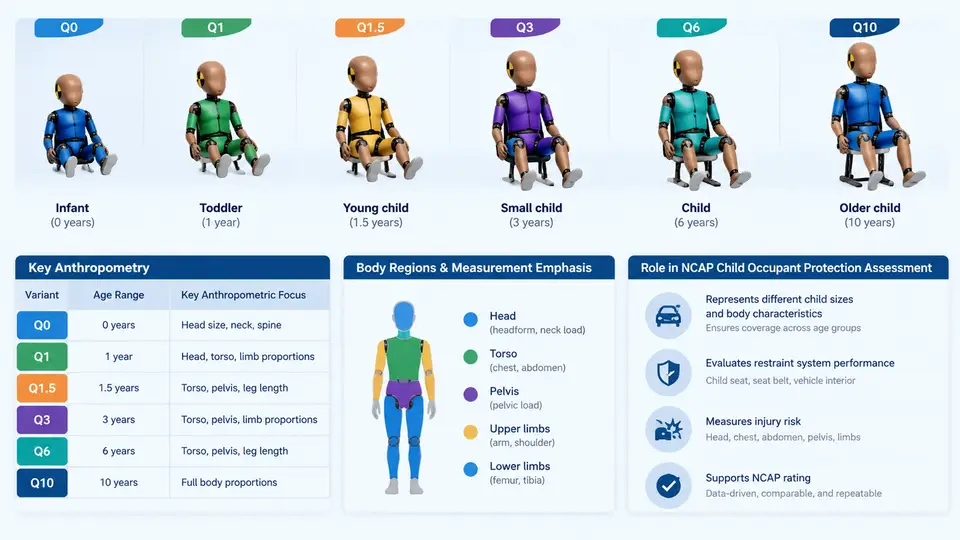
The Q-Series is a family of child anthropomorphic test devices (ATDs) developed by Humanetics (formerly FTSS) under a European research programme and standardized through UN ECE Regulation 44 and, more recently, Regulation 129 (the "i-Size" regulation). Unlike the older P-Series dummies, which were essentially scaled-down adult surrogates, the Q-Series was designed from the outset as a biofidelic child surrogate with instrumentation channels that map directly onto the injury criteria used in regulatory and consumer testing. For an NCAP child occupant protection assessment, the Q-Series is the reference tool: the dummy you choose determines which body regions you can measure, which injury criteria you can compute, and therefore which protection questions your test can actually answer.
The six variants and what distinguishes them
The family spans six sizes: Q0, Q1, Q1.5, Q3, Q6 and Q10. The numeric suffix denotes the nominal age in years, with Q1.5 representing an 18-month-old. Each variant is a distinct physical article with its own mass, stature, segment geometry and sensor set — they are not interchangeable, and a test performed with the wrong variant is not simply "less accurate", it is invalid against the target protocol.
| Variant | Nominal age | Approx. mass (kg) | Approx. stature (mm) | Typical restraint context |
|---|---|---|---|---|
| Q0 | Newborn / 0 yr | ~3.4 | ~510 | Rearward-facing infant carrier |
| Q1 | 1 yr | ~10 | ~760 | Rearward-facing infant carrier / CRS |
| Q1.5 | 1.5 yr | ~11 | ~820 | Rearward-facing CRS |
| Q3 | 3 yr | ~15 | ~980 | Forward-facing CRS with harness |
| Q6 | 6 yr | ~23 | ~1160 | Booster seat, belt-guided |
| Q10 | 10 yr | ~35 | ~1380 | Booster cushion / adult belt |
The mass and stature values above are nominal design targets; the controlled dimensions that matter for setup are the sitting height, shoulder height, hip breadth and the position of the H-point relative to the seat, all of which are specified in the regulation and reproduced in the dummy's calibration documentation. When you install a Q-Series dummy, you are not "placing a child in a seat" — you are positioning a calibrated instrumented body so that its reference points coincide with the CRS manufacturer's declared test position.
Anthropometry: why the sizes are not linearly scaled
A common misconception is that Q6 is "Q3 scaled up by two". In reality, child anthropometry changes proportions non-uniformly: an infant's head is roughly a quarter of total stature, while a 10-year-old's head is closer to one-sixth. The Q-Series reflects this. The Q0 and Q1 have proportionally large heads and short, relatively stiff necks, which is precisely why their dominant injury mode is head and neck loading rather than chest deflection. By Q6 and Q10, the head-to-body ratio has fallen and the chest and abdomen become the primary load paths through the adult belt.
This has a direct consequence for channel selection. The Q0, Q1 and Q1.5 carry head acceleration (triaxial), upper-neck load and moment, and chest acceleration channels, but no chest deflection measurement — the ribcage is too small and too compliant for a reliable deflection transducer. From Q3 upward, chest deflection becomes available and is the headline channel. From Q6 upward, abdominal pressure or penetration sensing becomes meaningful because the belt path crosses the abdomen. If your NCAP protocol asks for a chest deflection criterion, you cannot satisfy it with a Q1.5; the channel does not exist.
Instrumentation channels and the injury criteria they feed
The Q-Series is built around a common sensor architecture, with channel availability varying by size:
- Head: triaxial accelerometers at the head CG, used to compute HIC (Head Injury Criterion) over the 15 ms window, and in some variants angular rate sensors for rotational criteria.
- Neck: upper-neck load cell measuring axial force (tension/compression), shear force and bending moment in flexion/extension — the basis of Nij and neck moment criteria.
- Chest: triaxial accelerometers (all variants) and, from Q3, a chest deflection transducer measuring sternal-to-spine compression.
- Abdomen: pressure or penetration sensors on larger variants, relevant to belt loading in booster configurations.
- Pelvis / lumbar: load cells and accelerometers for belt-path and submarining assessment.
Each channel is sampled at a rate defined by the test protocol — typically 10 kHz or higher for accelerometers and load cells, with anti-alias filtering applied before the data is used for criterion calculation. The filter class matters: HIC computed from a 1000 Hz-channel-class filtered signal will not match the value computed from a 1650 Hz-channel-class signal, and NCAP protocols specify the class explicitly. Always record the filter class alongside the raw data.
Where the Q-Series sits in an NCAP child occupant assessment
In a frontal or side impact NCAP test, the child occupant score is built from the readings of the Q-Series dummies installed in the CRS positions defined by the protocol. The typical workflow is: select the variant that matches the CRS size group under evaluation, install it in the CRS, mount the CRS on the test seat using the prescribed ISOFIX or belt routing, position the dummy to the reference H-point and set the head and limb posture, then run the sled or full-scale impact and reduce the channels into the protocol's criteria.
The choice of variant is therefore a scoring decision, not a convenience decision. A protocol that evaluates a rearward-facing infant carrier will call for Q0, Q1 or Q1.5 depending on the carrier's declared size range; a forward-facing harnessed seat will call for Q3; a booster evaluation will call for Q6 or Q10. Using a Q3 in a booster test, or a Q6 in a harnessed seat, produces numbers that cannot be compared against the protocol's limits.
Practical implications for test setup
Three setup details recur across the family and are worth stating explicitly because they are frequent sources of invalid runs. First, the dummy must be conditioned to the specified temperature and humidity before the test; the Q-Series uses PVC skin and polyurethane flesh whose stiffness is temperature-sensitive, and an unconditioned dummy will produce chest deflection values that drift from the calibration baseline. Second, the joint friction settings — particularly neck, lumbar and knee — must be set to the values in the calibration manual, because a loose neck changes the head excursion and therefore the HIC. Third, the dummy's posture must be set to the reference position defined by the protocol, not to a "natural-looking" position; the difference between a head tilted 5° forward and one set vertical is measurable in the neck moment channel.
A useful sanity check before committing to a full sled run is a static installation audit: verify that the CRS belt path does not contact the dummy's abdomen in a booster configuration, that the harness lies flat on the Q3's shoulders without riding onto the neck, and that the Q0/Q1 head is fully supported by the carrier shell. These checks catch the majority of installation errors that would otherwise appear as anomalous channel data after the impact.
In summary, the Q-Series is not a single dummy but a calibrated family whose members differ in mass, stature, proportion and — critically — in which injury channels they can measure. Selecting the correct variant is the first decision in any NCAP child occupant assessment, and it determines the entire downstream chain of criteria, limits and reported scores. The remaining chapters build on this foundation by examining how each channel is calibrated, how the criteria are computed, and how the resulting data is interpreted against the protocol.