1. Automotive CAE workloads on HPC
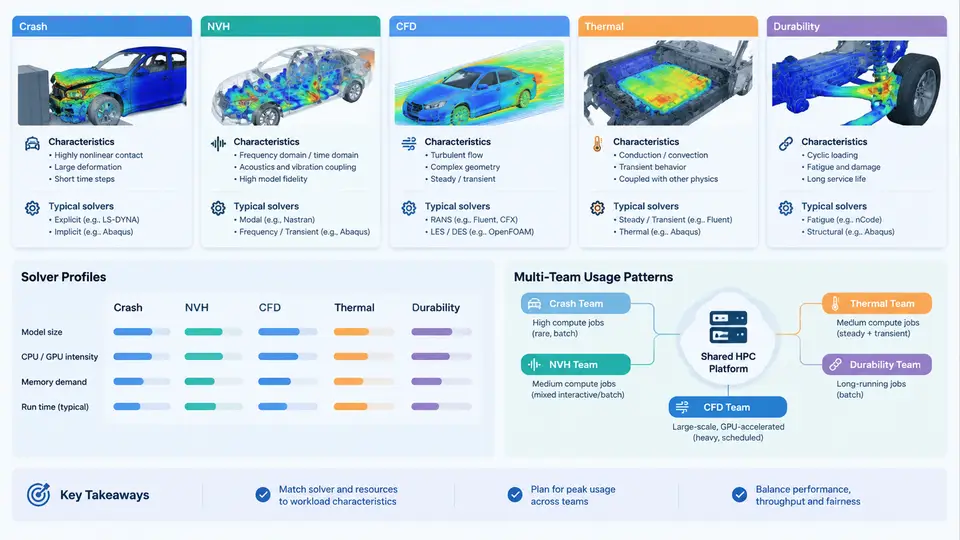
Automotive CAE is not a single workload. It is a portfolio of physics solvers, each with its own numerical kernel, memory behavior, I/O profile, and licensing model, all competing for the same HPC cluster. Before designing a secure multi-team platform, you must understand what each solver actually does to the hardware and how different engineering groups consume it. This chapter establishes that baseline.
The Five Dominant Solver Families
Crash and explicit dynamics. Tools such as LS-DYNA, Radioss, and Abaqus/Explicit integrate the equations of motion with a central-difference scheme. The stable time step is governed by the Courant condition, Δt ≈ Lmin/c, where Lmin is the smallest element edge and c is the wave speed in the material. A typical full-vehicle model has 10–30 million elements, and a 150 ms frontal impact may require 1–3 million explicit steps. These jobs are extremely MPI-sensitive: they scale well to 500–2000 cores but degrade sharply if interconnect latency rises. Memory per rank is modest (1–4 GB), but contact detection creates bursty communication. Restart files are large and written frequently, so parallel filesystem write bandwidth matters as much as CPU count.
NVH and modal analysis. Nastran, OptiStruct, and Abaqus/Standard solve large sparse eigenvalue problems and frequency-response systems. The dominant cost is factorization of a stiffness matrix, which is memory-bound rather than compute-bound. A 20-million-DOF body-in-white model may need 200–600 GB of aggregate RAM and scales poorly beyond 64–128 cores because the sparse direct solver becomes communication-dominated. NVH jobs are long-running (hours to days), few in number, and often run at low core counts with high memory per node.
CFD and aerodynamics. Fluent, STAR-CCM+, and OpenFOAM solve the Navier–Stokes equations on unstructured meshes. A full-vehicle external aero case with 200–500 million cells is now routine. These are the most scalable workloads, often reaching 2000–8000 cores, but they are also the most memory-hungry per cell and generate continuous checkpoint I/O. Transient cases with moving mesh or overset grids add load-imbalance problems that change every time step.
Thermal and conjugate heat transfer. Thermal management models couple solid conduction with coolant flow. They are typically smaller than CFD (5–50 million cells) but run for long physical times, producing many time steps. They are often coupled to CFD or structural solvers, creating co-simulation workflows that require two solvers to run concurrently and exchange boundary data at runtime.
Durability and fatigue. Fatigue life prediction (FE-safe, nCode, Femfat) post-processes stress histories from multiple load cases. The solver itself is lightweight, but a single durability study may launch hundreds of short jobs, each reading a large results file. This creates a many-small-jobs pattern that stresses the scheduler and license server more than the compute fabric.
Solver Profiles at a Glance
| Workload | Typical cores | Memory per rank | Scaling limit | I/O pattern | Job duration |
|---|---|---|---|---|---|
| Crash / explicit | 500–2000 | 1–4 GB | Interconnect latency | Frequent restarts | 4–24 h |
| NVH / modal | 32–128 | 8–32 GB | Direct solver memory | Large scratch files | 6–48 h |
| CFD / aero | 2000–8000 | 2–8 GB | Load imbalance | Continuous checkpoints | 12–72 h |
| Thermal / CHT | 200–1000 | 4–16 GB | Coupling overhead | Time-step dumps | 8–36 h |
| Durability | 8–64 | 2–8 GB | License count | Many small reads | 0.5–4 h |
Multi-Team Usage Patterns
In a real automotive OEM or Tier-1, these workloads are not run by one group. Crash, NVH, CFD, thermal, and durability engineers sit in different departments, often in different countries, and they have conflicting resource needs. Crash teams want thousands of cores for a few hours. NVH teams want a few hundred cores for days. CFD teams want the largest possible allocation and will hold it for a week. Durability teams want to flood the queue with hundreds of short jobs.
This creates four recurring contention patterns:
- Peak overlap. Crash and CFD both peak near vehicle program milestones. Without reservation or fair-share policy, one group starves the other.
- License contention. Solver licenses are often more scarce than cores. A 2000-core CFD job may be blocked because only 50 STAR-CCM+ tokens are free.
- Memory fragmentation. NVH jobs need whole nodes with 512 GB–1 TB RAM. If CFD jobs have scattered small allocations across those nodes, the NVH job cannot start.
- Data gravity. A single crash model may reference 2–5 TB of mesh, material, and result data. Moving it between sites or storage tiers is often slower than the simulation itself.
Workload-to-Resource Mapping
The following diagram maps each solver family to its dominant resource demand and the multi-team contention it creates. Use it as a reference when defining queue policies, node pools, and isolation boundaries in later chapters.
Why This Matters for Platform Design
The practical consequence is that a secure multi-team HPC platform cannot treat all CAE jobs as interchangeable. A queue policy that works for crash (short, wide, latency-sensitive) will fail for NVH (long, narrow, memory-sensitive). A storage layout optimized for CFD checkpoints may be wrong for durability's many-small-read pattern. And a security boundary that isolates teams by project directory must still allow controlled data exchange for co-simulation workflows where thermal and CFD solvers run concurrently.
In the chapters that follow, we will translate these workload characteristics into concrete platform decisions: node pool partitioning, scheduler fair-share and reservation policies, parallel filesystem tiering, license-aware scheduling, and per-team isolation that does not break legitimate cross-functional collaboration. The key takeaway from this chapter is that workload diversity is the root driver of platform complexity, and any security or resource-control mechanism must be evaluated against the full solver portfolio, not just the most demanding one.