1. Enterprise CAE data science platform lan
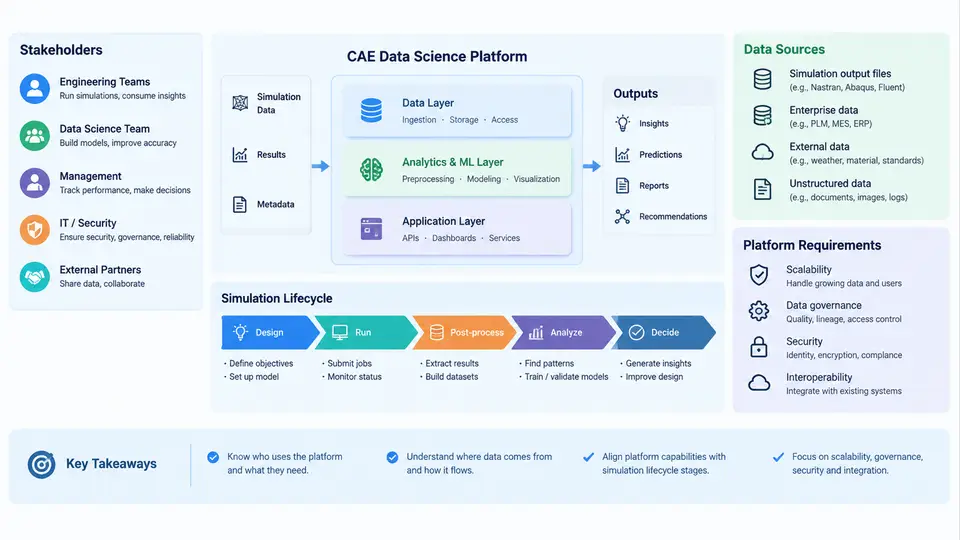
Computer-aided engineering (CAE) has always produced data. What has changed is the volume, variety, and velocity of that data, and the fact that it is now economically viable to treat simulation output as a first-class analytical asset rather than a disposable by-product of a single design review. An enterprise CAE data science platform is the infrastructure layer that makes this shift possible: it ingests simulation and test data from many sources, stores it in queryable form, connects it to physics-aware analytics and machine-learning workflows, and serves results back to engineers, analysts, and decision-makers. This chapter maps the landscape before any code is written, because platform requirements that ignore stakeholder reality or lifecycle structure tend to produce systems that are technically elegant and operationally unused.
Stakeholders and Their Conflicting Requirements
A CAE data science platform serves several distinct groups, and their needs are not naturally aligned. Understanding the tension is the first design task.
- Simulation analysts (CAE engineers) care about fidelity, solver version traceability, and the ability to reproduce a run exactly. They want metadata captured automatically, not typed into a form after a 14-hour job finishes.
- Design engineers want fast answers to "what if" questions — often through surrogate models or reduced-order models — without learning a solver deck format.
- Data scientists and ML engineers need clean, denormalized, versioned datasets with stable schemas, plus compute for training. They are usually not CAE domain experts and will misinterpret fields unless semantics are documented.
- IT and platform operations own storage cost, access control, network policy, and uptime. They will resist ungoverned petabyte growth and ad-hoc credential sharing.
- Engineering management and program leadership want portfolio-level visibility: which designs are converging, where margin is being consumed, and what historical data can be reused.
- Quality, certification, and compliance functions require audit trails — who ran what, with which solver build, on which geometry revision, and what the result was.
The practical consequence is that a platform cannot be optimized for one group. A common failure mode is a data-science-first platform that analysts abandon because ingestion is manual, or an analyst-first archive that data scientists cannot query because results are locked in binary solver formats.
The Simulation Lifecycle as a Data Pipeline
To design ingestion and storage, it helps to view the simulation lifecycle as a sequence of data-producing stages, each with different structure and retention value.
- Requirements and load-case definition — produces structured specifications: load cases, boundary conditions, safety factors, target metrics.
- Geometry and CAD preparation — produces geometry revisions, defeaturing logs, and mesh-ready models. Version identity here is critical; a mesh is meaningless without the exact geometry revision it came from.
- Meshing — produces mesh files, element counts, quality metrics (aspect ratio, skewness, Jacobian), and meshing parameters.
- Solver setup and execution — produces solver decks, solver version, hardware configuration, wall-clock time, convergence history, and license consumption.
- Post-processing — produces field results (stress, displacement, temperature, pressure), scalar KPIs (max stress, mass, drag coefficient), and derived plots.
- Physical testing and validation — produces experimental measurements, instrumentation metadata, and correlation results.
- Design decisions and change requests — produces the human judgment layer that connects simulation results to program outcomes.
Each stage emits both bulk data (large binary field files) and metadata (small, structured, highly queryable). The platform's central architectural bet is usually that metadata should be captured exhaustively and cheaply, while bulk data is stored once and referenced by content hash or URI.
Data Sources and Their Characteristics
Enterprise CAE data arrives from sources with very different reliability and structure. A realistic inventory for a mid-size automotive or aerospace group might look like this:
| Source | Typical Format | Structure | Key Challenge |
|---|---|---|---|
| Structural FEA (Nastran, Abaqus, Ansys) | .op2, .odb, .rst, .h5 | Semi-structured, binary | Proprietary readers; large field files |
| CFD (Fluent, STAR-CCM+, OpenFOAM) | .cas/.dat, .ccm, OpenFOAM case dirs | Directory-based, binary | Case directory semantics vary by solver |
| Multibody / dynamics | .adm/.acf, Adams .bin | Structured text + binary | Time-series alignment across subsystems |
| Physical test (DAQ, strain gauges, accelerometers) | CSV, TDMS, HDF5 | Time series | Sampling rate, units, channel naming inconsistency |
| PLM / PDM systems | REST API, SQL | Structured | Revision and BOM linkage |
| Job schedulers (Slurm, PBS, LSF) | Logs, accounting DB | Semi-structured | Correlating job ID to simulation case |
| Manual spreadsheets | XLSX | Unstructured | No schema, high error rate, but often the real KPI source |
The spreadsheet row deserves emphasis. In most organizations, the authoritative record of "which design passed which load case" lives in a human-maintained workbook, not in the solver output. A platform that ignores this will be contradicted by the spreadsheet and lose credibility.
Platform Requirements Derived from the Landscape
From the stakeholder map, lifecycle stages, and source inventory, a set of non-negotiable platform requirements emerges. These are stated as capabilities, not technologies, because technology choices should follow.
- Automated metadata capture at job submission and completion. If capture depends on analyst discipline, coverage will decay within months.
- Immutable, content-addressed bulk storage. Results must be reproducible and deduplicable; identical files should not be stored twice.
- A queryable metadata catalog with stable identifiers. Every simulation case needs a durable ID linking geometry revision, mesh, solver setup, and results.
- Schema governance with domain semantics. Field names like
max_stressmust carry units, location, and extraction method. - Access control aligned to program and export-control boundaries. CAE data is frequently export-controlled; per-project isolation is a hard requirement, not a feature.
- Compute integration for ML training and surrogate generation. The platform must reach the same HPC or cloud resources that run the solvers.
- Lineage and auditability. Any KPI on a dashboard must be traceable back to the exact solver run that produced it.
Reference Architecture at a Glance
The diagram below shows how the landscape components connect. It is deliberately a data-flow and integration view rather than a deployment diagram: the point is to make visible where metadata separates from bulk data, and where the platform must reach into existing enterprise systems rather than replace them.
The separation between the metadata catalog and bulk storage is the single most consequential design decision in this landscape. It determines query latency, storage cost, and whether data scientists can work without CAE-specific tooling. The governance layer is drawn as cross-cutting because access control and audit requirements apply to every component, not just the catalog.
What This Means for the Rest of the Course
Every subsequent chapter builds on the distinctions established here. Ingestion pipelines must handle the format diversity in the source table. The metadata catalog must carry the semantics that make cross-project queries meaningful. Analytics must respect the lineage guarantees that compliance requires. And the platform must integrate with, rather than replace, the PLM, scheduler, and spreadsheet systems that already hold authoritative data. The landscape is not a prelude to the technical work — it is the specification that the technical work must satisfy.