1. Course overview
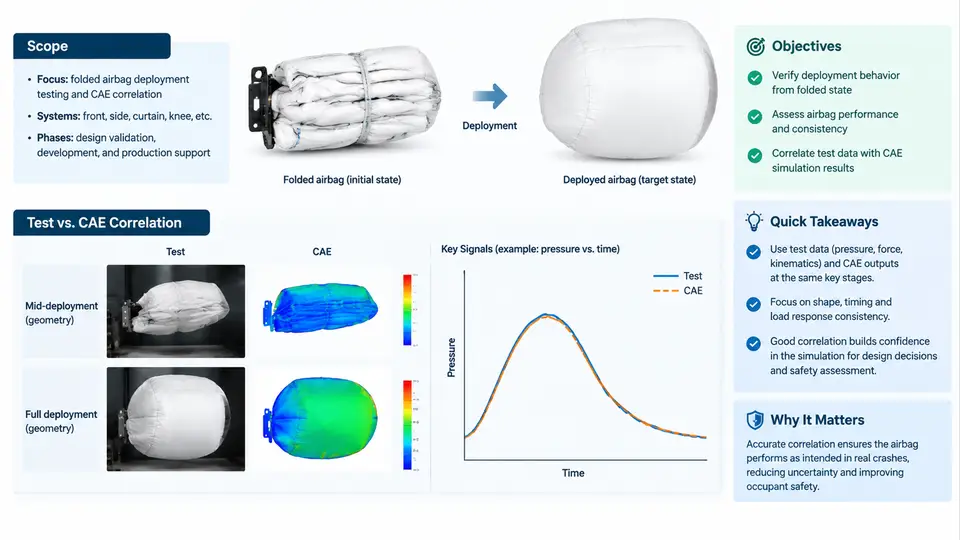
An airbag that performs flawlessly in a flat, unfolded coupon test can still injure an occupant in a real vehicle. The reason is that production airbags are never flat: they are compressed, folded, and packed into a module, and that folded geometry governs how the cushion unfolds, where the fabric travels, how internal pressure builds, and whether the bag contacts the occupant early or late. Folded airbag deployment testing exists to capture this reality, and CAE correlation exists to make the resulting physics predictable enough to design against. This course teaches both halves of that problem and, most importantly, the discipline that connects them.
Why the Folded State Is the Real Design Problem
A driver-side airbag module contains a folded cushion, an inflator, a housing, and a cover or tear seam. When the inflator fires, gas enters the cushion and the fabric must unfold along a path determined by the fold pattern, the fabric's bending and friction behavior, the tether arrangement, and the venting strategy. The cushion does not simply "inflate" — it unfolds, and the sequence of that unfolding controls:
- Deployment kinematics — the trajectory of the cushion face and the timing of contact with the occupant.
- Internal pressure history — the pressure rise and decay that determine restraint force.
- Occupant loading — head and chest acceleration, neck force, and injury criteria such as HIC and chest deflection.
- Out-of-position (OOP) risk — the hazard when an occupant is close to the module at deployment.
Because these outcomes depend on the folded geometry, a test or simulation that ignores the fold is not a validation of the real system. This is the central premise of the course.
What "Deployment Testing" Actually Covers
Deployment testing is not a single experiment. It is a family of tests that isolate different physics and are used at different stages of development:
| Test type | Primary purpose | Typical instrumentation |
|---|---|---|
| Static deployment (tank / open air) | Verify fold pattern, cushion shape, and seam integrity | High-speed video, pressure transducer |
| Static deployment in module fixture | Measure cover opening and cushion breakout | High-speed video, load cells |
| Sled test with folded module | Occupant loading under crash pulse | Accelerometers, load cells, HIC |
| OOP / static deployment near ATD | Assess injury risk at close range | ATD instrumentation, high-speed video |
| Component-level fabric / seam tests | Characterize material inputs for CAE | Universal test machine, pressure rig |
Each test produces data that feeds the model. The high-speed video gives the fold unfolding sequence; the pressure transducer gives the internal pressure history; the sled test gives the occupant response. Correlation means the CAE model reproduces all three, not just the final injury number.
The Role of CAE Correlation
CAE correlation is the process of adjusting and validating a simulation model until its predictions match measured test data within an agreed tolerance. In airbag work, the model has several coupled domains:
- Folded geometry — the mesh of the folded cushion, which is often the largest source of error.
- Fabric material — orthotropic stiffness, bending, and permeability.
- Gas dynamics — inflator mass flow rate and temperature, often supplied as a tank pressure curve.
- Contact and friction — fabric-to-fabric and fabric-to-occupant interaction.
- Venting — vent hole area and pressure-dependent flow.
Correlation is not "making the curve match." It is a structured comparison: first the pressure history, then the cushion shape at discrete times, then the occupant response. If the pressure matches but the shape does not, the fold or fabric model is wrong. If the shape matches but the pressure does not, the inflator or venting model is wrong. This diagnostic logic is a core skill the course develops.
Course Scope and Objectives
This course is organized around the complete workflow from folded cushion to correlated model. By the end, you should be able to:
- Describe how fold patterns, tethers, and vents influence deployment kinematics and occupant loading.
- Plan a deployment test matrix that produces correlation-grade data.
- Build and set up a folded airbag CAE model, including fold generation and material definition.
- Run explicit dynamic simulations and extract pressure, shape, and occupant response.
- Correlate model to test using a defined metric and tolerance, and diagnose mismatch sources.
- Document correlation results and judge whether a model is fit for design use.
The course covers driver and passenger airbags, with side airbag examples where the physics differs meaningfully. It assumes familiarity with explicit finite element analysis and basic occupant safety terminology.
How Test and CAE Interact
The relationship between physical testing and simulation is iterative, not linear. A typical loop looks like this:
The loop is deliberately ordered. Test data defines the target; the model is adjusted until it reproduces the target within tolerance; only then is the model used to predict configurations that were not tested. A model that has not been correlated is a hypothesis, not a design tool.
What "Good Correlation" Looks Like
Correlation quality is judged against explicit criteria, not visual similarity. A practical acceptance set for a folded airbag deployment model might be:
| Quantity | Metric | Typical tolerance |
|---|---|---|
| Internal pressure | Peak value | ±10% |
| Internal pressure | Time of peak | ±2 ms |
| Cushion face position | Time to full deployment | ±3 ms |
| Head acceleration | Peak resultant | ±15% |
| HIC | Absolute value | ±15% |
These numbers are illustrative and must be agreed with the program before correlation begins. The important point is that tolerances are defined before the comparison, so the result is not rationalized after the fact.
Common Failure Modes You Will Learn to Diagnose
Most correlation failures trace to a small set of root causes. Recognizing them early saves weeks of iteration:
- Fold geometry mismatch — the CAE fold does not reproduce the production fold, so the cushion unfolds along the wrong path. Symptom: pressure matches, shape does not.
- Fabric permeability error — gas leaks through the fabric faster or slower than reality. Symptom: pressure decays too quickly or too slowly after peak.
- Inflator input error — the tank curve or mass flow rate is wrong. Symptom: pressure peak is off in both magnitude and timing.
- Contact / friction error — fabric-to-fabric friction is mischaracterized. Symptom: cushion shape is close but timing of breakout is off.
- Vent modeling error — vent area or discharge coefficient is wrong. Symptom: pressure decay slope is wrong.
Each of these is treated in detail in later chapters, with the diagnostic procedure and the model parameters that resolve it.
How This Course Is Organized
The course moves from the physical system to the model to the correlation decision. Early chapters establish fold patterns, module architecture, and deployment physics. Middle chapters cover test methods, instrumentation, and data reduction. Later chapters build the CAE model, run explicit simulations, and perform correlation. The final chapters address documentation, acceptance, and the use of correlated models in design. Throughout, the emphasis is on the specific inputs, operations, and judgment criteria that make the work reproducible.
By the end of this course, you should be able to take a folded airbag module, plan and execute a deployment test, build a matching CAE model, correlate the two against defined tolerances, and defend the result as a basis for design decisions. That is the standard this course is built to meet.