3. Impact test facility setup
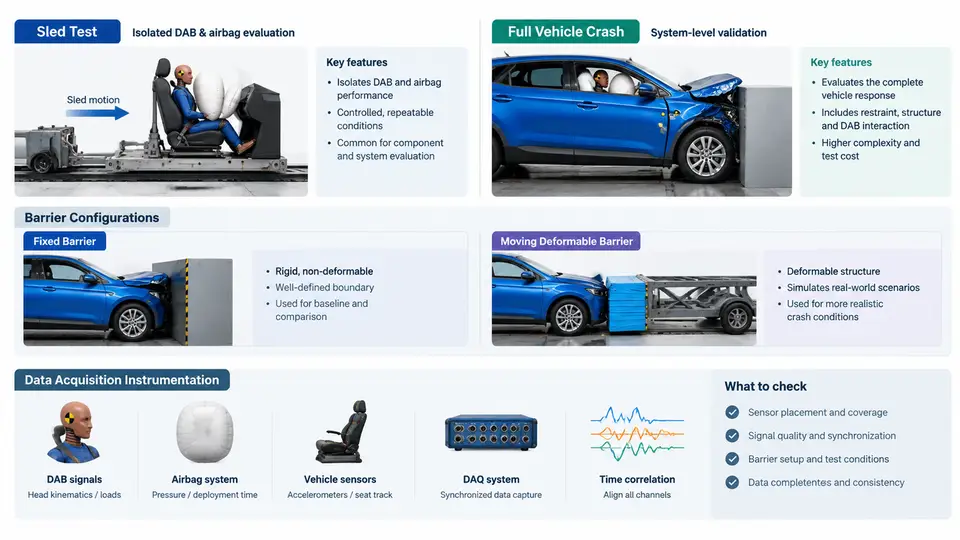
Driver airbag (DAB) performance is validated through two complementary physical test platforms: the sled test and the full vehicle crash test. Both are used for CAE correlation, but they answer different questions. The sled isolates the occupant-restraint system—seat, belt, steering column, and DAB module—under a prescribed deceleration pulse, while the full vehicle test captures the complete structural crush signature that generates that pulse in the first place. Understanding how each facility is configured, and how the barrier type and instrumentation set change the data you get, is essential before any correlation work begins.
Sled Test vs. Full Vehicle Crash
A sled test mounts the body-in-white front section, or a simplified buck carrying the seat and steering system, on a deceleration sled. A hydraulic or servo-pneumatic propulsion system accelerates the sled to a target velocity, then a programmable braking profile decelerates it to reproduce a crash pulse measured from a real vehicle or defined by regulation (for example, a 56 km/h frontal rigid barrier pulse). The key advantage is repeatability: pulse shape, velocity, and timing are controlled to tight tolerances, so run-to-run variation is small and the DAB deployment environment is highly reproducible. This makes the sled the preferred platform for parametric studies—airbag pressure, vent size, tether length, and clocking angle can be swept with confidence that the pulse is not the variable.
The full vehicle crash test drives or tows an entire vehicle into a barrier. Here the deceleration pulse at the seat track is an output of the vehicle structure, not an input. It reflects real load paths through the rails, cradle, and firewall, and it includes pitch, yaw, and vertical motion that a sled cannot fully reproduce. For DAB evaluation, the full vehicle test is the reference for occupant kinematics in the real installation, but it is expensive, destructive, and subject to structural build variation. In practice, the sled is used to develop and tune the restraint, and the full vehicle test confirms the integrated result.
Barrier Configurations
Two barrier families dominate frontal DAB testing:
- Fixed rigid barrier (FRB): A non-deforming concrete or steel wall, typically with a 0° or 30° angled face. It produces the most severe, repeatable structural loading and is the standard for regulatory frontal tests. The pulse is dominated by vehicle crush and is highly reproducible.
- Moving deformable barrier (MDB): A trolley carrying a deformable honeycomb or aluminum element that strikes the vehicle (or is struck by it). The MDB is used for offset and oblique configurations, where the deformable face distributes load and produces a different, often more localized, intrusion pattern. The honeycomb stiffness and the impact overlap percentage are the controlling parameters.
The choice of barrier changes the pulse shape, the timing of airbag deployment relative to occupant forward motion, and the loading on the steering column. A DAB tuned on an FRB pulse may deploy too late or too early when the pulse is generated by an MDB, because the MDB pulse typically has a lower peak and longer duration. This is why the barrier configuration must be recorded as a first-class parameter in any correlation database.
Data Acquisition Instrumentation for DAB Evaluation
The instrumentation set determines what you can actually correlate. For DAB work, the minimum channel list includes:
| Channel | Sensor / Location | Purpose |
|---|---|---|
| Vehicle / sled acceleration | Triaxial accelerometer at seat track or tunnel | Defines the crash pulse; primary CAE boundary condition |
| Occupant head acceleration | Triaxial accelerometer in Hybrid III head CG | Head injury criteria (HIC) and airbag interaction |
| Chest acceleration / deflection | Chest accelerometer and deflection sensor | Chest injury and belt-airbag load sharing |
| Steering column force / displacement | Load cell and string potentiometer on column | Column stroke and energy absorption |
| Airbag pressure | Pressure transducer in inflator or bag | Deployment timing and internal pressure history |
| High-speed video | Phantom cameras, 1000–2000 fps | Deployment sequence, bag-seat and bag-head contact |
Sampling rates matter: accelerometers are typically sampled at 10–20 kHz with anti-alias filtering per SAE J211, while pressure and displacement channels can run at 10 kHz. All channels must be time-aligned to a common trigger—usually the sled or vehicle zero-time defined by the first barrier contact or a break-beam signal. Misalignment of even a few milliseconds between the pulse channel and the airbag pressure channel will corrupt the correlation.
Facility Setup Workflow and Verification
A reproducible DAB sled setup follows a defined sequence. First, the pulse is programmed from the target seat-track acceleration and verified with a dry run using a non-instrumented buck. Second, the DAB module, steering column, and seat are installed to the same geometry as the vehicle, with the column angle and bag clocking recorded. Third, instrumentation is mounted, zeroed, and checked with a shunt calibration. Fourth, the high-speed cameras are framed to capture the bag deployment and head contact zone. After the run, the data is checked for saturation, dropouts, and trigger alignment before any correlation is attempted.
A useful verification criterion is the pulse repeatability check: run the same sled configuration twice and compare the seat-track acceleration. A peak difference within 5% and a timing difference within 2 ms indicates the facility is stable enough for correlation. If the difference is larger, inspect the braking profile, the sled mass, and the mounting torque before proceeding.
Practical Notes on Correlation Readiness
Before a sled or full vehicle run is used for CAE correlation, confirm three things. First, the pulse channel is clean and correctly filtered; a saturated or clipped accelerometer invalidates the boundary condition. Second, the DAB deployment time is captured on the same time base as the pulse; a separate trigger source introduces offset. Third, the barrier type and overlap are documented, because an FRB pulse and an MDB pulse are not interchangeable inputs to the same model. When these are controlled, the sled provides the repeatable, low-variation data needed to tune the DAB model, and the full vehicle test provides the integrated reference that confirms the model behaves correctly in the real installation.
In practice, a well-run facility will produce a sled pulse repeatability within a few percent and a full vehicle pulse that matches the CAE prediction in peak magnitude and timing to within the tolerance agreed for the program. When those conditions hold, the remaining differences between test and simulation can be attributed to the DAB model itself—inflator mass flow, bag fabric permeability, venting, and contact—rather than to the facility or the boundary condition.