1. CEAB center airbag impact test and CAE c
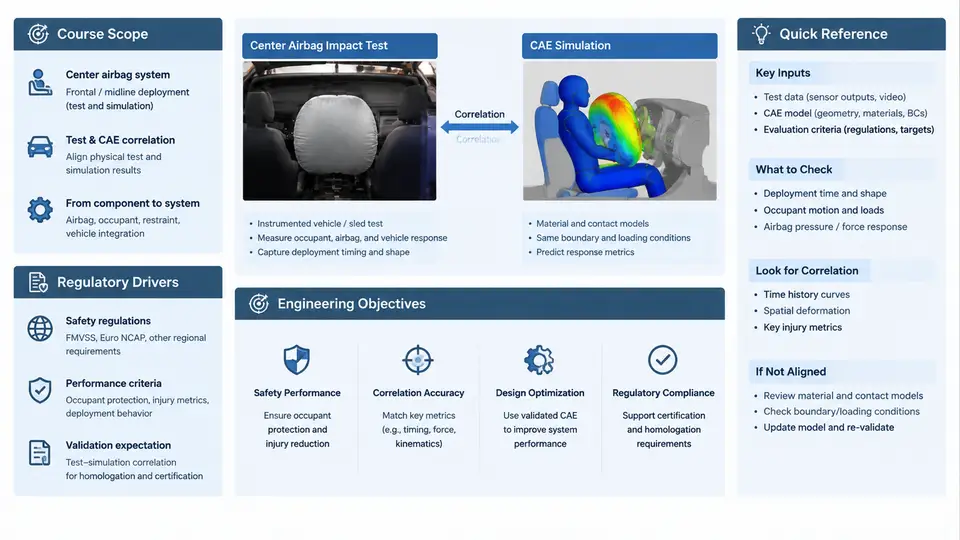
Center airbags — the inflatable restraint mounted in the steering wheel hub or instrument panel to protect the driver and front passenger — are among the most safety-critical components in a modern vehicle interior. Their deployment must be fast, repeatable, and correctly timed relative to the occupant's forward excursion. Because the airbag, the seat belt, the seat, and the vehicle structure all interact within a few tens of milliseconds, engineers cannot rely on physical testing alone to explore the full design space. This is where CEAB — Center airbag impact testing combined with CAE correlation — becomes the backbone of restraint-system development.
This chapter establishes the scope of the course, explains the regulatory and consumer-rating drivers that force a rigorous test-and-simulation workflow, and defines the engineering objectives that every subsequent chapter will build upon. It is deliberately foundational: before we can calibrate a material model or tune a firing threshold, we must agree on what "correlation" actually means and why the industry treats it as a formal deliverable rather than a nice-to-have.
What CEAB Covers
CEAB is not a single test. It is a discipline that links three activities:
- Physical impact testing — sled tests, static deployment tests, and full-vehicle barrier tests in which the center airbag is triggered and its interaction with instrumented occupants is measured.
- CAE modeling — explicit finite-element simulation of the same event, typically in LS-DYNA or a comparable explicit solver, using a validated airbag model, occupant dummy model, and seat/structure model.
- Correlation — the quantitative and qualitative comparison of simulation output against test measurements, followed by model adjustment until the simulation reproduces the test within agreed tolerances.
The scope of this course follows that chain: from test setup and instrumentation, through model construction and material calibration, to correlation metrics and sign-off criteria. Each chapter addresses one link, but the objective is always the same — a simulation that can be trusted to predict a test that has not yet been run.
Regulatory and Rating Drivers
The reason CEAB exists as a formal engineering process is that regulators and consumer-rating programs demand demonstrable occupant protection, and they increasingly accept simulation as supporting evidence only when it is correlated to physical test data.
| Driver | Typical Requirement | Implication for CEAB |
|---|---|---|
| FMVSS 208 (US) | Occupant protection in frontal impact, unbelted and belted configurations | Airbag must deploy and manage occupant kinematics across a range of speeds and sizes |
| ECE R94 / R137 (EU) | Frontal impact protection; R137 addresses airbag system performance | Deployment timing and bag pressure must be validated against test corridors |
| GB 11551 (China) | Frontal occupant protection requirements | Local market homologation requires test evidence; CAE supports design iteration |
| C-NCAP / Euro NCAP | Star rating based on dummy injury criteria (HIC, chest deflection, etc.) | Rating targets are stricter than regulation; correlation accuracy directly affects rating prediction |
Two consequences follow. First, the airbag must be evaluated in multiple configurations — different impact speeds, occupant sizes (5th percentile female through 95th percentile male), and belt usage states. Second, because physical testing is expensive and destructive, the industry uses CAE to screen designs, then confirms the final design with a reduced but sufficient test matrix. That economy only works if the CAE model is correlated.
Key point: Correlation is not "the simulation looks similar to the test." It is a documented, metric-based demonstration that the model reproduces specified test responses within defined tolerances, for a defined set of configurations.
Engineering Objectives of the Course
By the end of this course, you should be able to:
- Design a center airbag impact test matrix that covers the regulatory and rating configurations relevant to a given vehicle program.
- Build or adapt a CAE model of the center airbag, occupant, and surrounding structure using appropriate element types, material models, and contact definitions.
- Calibrate the airbag model — mass flow rate, pressure, fabric permeability, and venting — against static deployment and sled test data.
- Compute correlation metrics (peak value, time-to-peak, pulse shape, and integrated injury criteria) and judge whether the model meets sign-off tolerances.
- Diagnose common correlation failures — timing offsets, pressure mismatches, contact penetration — and apply targeted corrections.
These objectives are cumulative. A model that is not correlated at the component level will not correlate at the full-vehicle level, and a full-vehicle model that is not correlated cannot be used to predict rating performance with confidence.
The Test-to-CAE Correlation Workflow
The figure below shows the core workflow that this course follows. It is a closed loop: test data feeds model calibration, simulation output is compared against test, and the comparison drives either model refinement or, if the model is already adequate, design decisions. The loop is repeated until correlation criteria are met.
The loop has two exit conditions. The primary exit is correlation sign-off: the model matches the test within tolerance, and the model is then used for design exploration. The secondary exit is a test gap: if the correlation cannot be achieved because the test data is insufficient or the test itself is not representative, additional physical testing is required before the model can be trusted. Recognizing which exit applies is a core engineering judgment that this course develops.
Why Correlation Is Treated as a Formal Deliverable
In practice, correlation is documented in a CAE correlation report that accompanies the design release. The report typically contains the test matrix, the model description, the comparison plots, the correlation metrics, and a statement of the tolerance achieved. This is not bureaucracy — it is the evidence that allows a program to reduce physical test count, accelerate iteration, and still satisfy regulators and rating bodies.
Practical note: Start correlation at the component level. Correlate the airbag deployment (pressure and bag shape) and the dummy response separately before attempting full-vehicle correlation. A full-vehicle model built on an uncorrelated airbag model will produce misleading injury criteria, and the root cause will be difficult to isolate.
What Comes Next
The remaining chapters move through the workflow in order: test setup and instrumentation, airbag model construction, material and gas-dynamics calibration, occupant and seat modeling, correlation metrics, and finally case studies of successful and failed correlations. Each chapter assumes the vocabulary and objectives defined here. The single most important idea to carry forward is that test and CAE are not separate activities — they are two halves of one validation argument, and the correlation between them is the deliverable that makes the argument credible.