3. Airbag module fundamentals
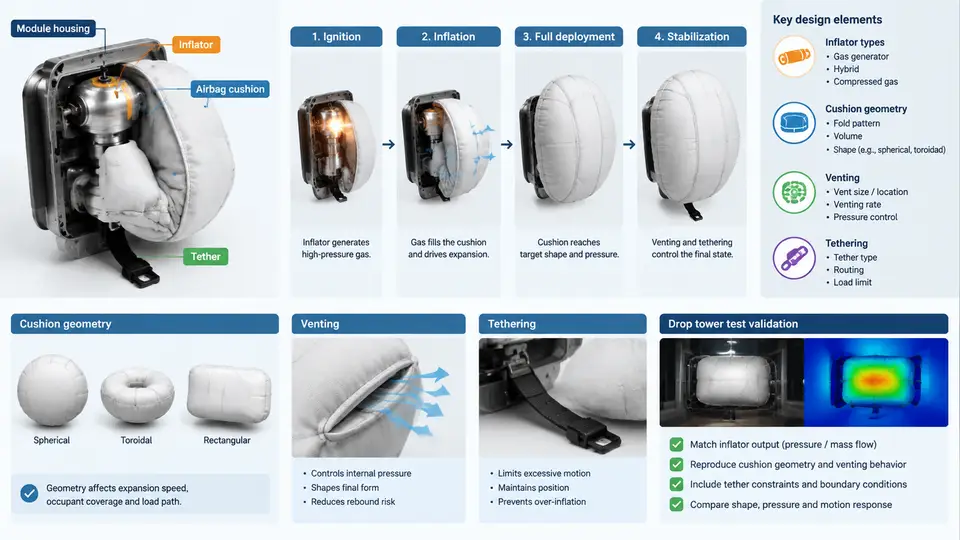
An airbag module is a small, self-contained gas generator with a precisely folded fabric structure attached to it. Drop tower testing exists to reproduce the mechanical environment that this module experiences during a real crash, so that the deployment sequence, cushion pressure history, and restraint performance can be measured under repeatable conditions. To design a meaningful drop tower test, you must first understand what the module actually does and which physical quantities the test must control.
Inflator Types and Their Output Characteristics
Inflators fall into three broad families, each with a distinct gas-generation mechanism and therefore a distinct pressure-time signature.
- Pyrotechnic inflators burn a solid propellant (typically sodium azide or a non-azide formulation) to produce gas directly. They deliver a fast pressure rise, often reaching peak cushion pressure within 20–40 ms, but the gas is hot and contains particulates. The burn rate is strongly temperature-dependent, which is why drop tower tests are usually run at hot (+85 °C), ambient (+23 °C), and cold (−35 °C) soak conditions.
- Hybrid inflators combine a small pyrotechnic charge with a stored compressed gas (argon or helium). The pyrotechnic charge heats the stored gas, which then expands through the cushion. Hybrids produce a more sustained pressure plateau and lower peak temperature than pure pyrotechnics.
- Cold-gas inflators release only stored compressed gas, usually via a pyrotechnic-actuated burst disc or a solenoid valve. They are common in side airbags and pedestrian protection systems where a gentler, longer inflation is desired.
The key output parameters for any inflator are mass flow rate ṁ(t), gas temperature T(t), and total gas mass delivered. These determine the cushion pressure history, which in turn determines the force applied to the occupant. A drop tower test must reproduce the same ṁ(t) and T(t) boundary conditions that the inflator would see in a vehicle, or the measured cushion pressure will not match the vehicle-level result.
Cushion Geometry and Folding
The cushion is not a simple balloon. Its geometry is defined by the cut pattern of the fabric panels, the seam layout, and the folding pattern used to pack it into the module housing. The folded volume must fit within the module envelope, but the unfolded shape must match the vehicle interior surface it is designed to protect.
Two geometric parameters dominate the deployment physics:
- Unfolded volume — the volume the cushion would occupy if fully inflated without restraint. This sets the total gas requirement.
- Projected area — the area of the cushion face that contacts the occupant. This, combined with internal pressure, determines the restraint force.
Folding patterns are typically classified as accordion, roll, or combined. Accordion folds deploy outward in a controlled sequence; roll folds deploy in a spiral that can be tuned to direct the cushion along a specific trajectory. The fold pattern affects the initial deployment direction and the time at which the cushion first contacts the occupant, both of which are critical for drop tower repeatability.
Venting and Tethering
Venting and tethering are the two primary mechanisms for tuning cushion pressure and shape after deployment.
Venting is the controlled release of gas from the cushion through one or more vent holes. Vent area A_vent and vent location determine the pressure decay after peak. A larger vent area produces a lower peak pressure and a faster decay, which reduces occupant loading but may allow the occupant to "bottom out" against the cushion. Vent holes are often placed on the side of the cushion facing away from the occupant to avoid direct gas impingement.
Tethering uses internal fabric straps to limit the cushion's expansion in specific directions. A tether anchored between two internal seams restricts the distance between them, which changes the cushion's deployed shape without changing its gas volume. Tethers are used to prevent the cushion from wrapping around the occupant's head, to control the cushion's interaction with the steering wheel or instrument panel, and to maintain a consistent deployed geometry across temperature extremes.
Deployment Physics That Drop Tower Tests Must Reproduce
The deployment of an airbag is a coupled fluid-structure interaction problem. The inflator generates gas, the gas pressurizes the cushion, the cushion expands against the occupant and the vehicle interior, and the occupant moves in response. Drop tower tests simplify this by replacing the vehicle with a rigid fixture and the occupant with a calibrated impactor or a sled-mounted dummy.
The physical quantities that must be reproduced are:
- Inflator output — the mass flow rate and gas temperature history, which are set by the inflator itself and the soak temperature.
- Cushion back-pressure — the pressure against which the cushion inflates, which depends on the vent area and the volume of the enclosure into which the cushion deploys.
- Impact energy — the kinetic energy of the impactor or sled at the moment of cushion contact, which is set by the drop height and the mass.
- Contact timing — the time between inflator initiation and cushion-occupant contact, which is set by the deployment distance and the cushion expansion rate.
If any of these four quantities is not matched, the measured cushion pressure and occupant deceleration will diverge from the vehicle-level result, and the CAE model validated against the drop tower data will not predict the vehicle behavior correctly.
Practical Implications for Drop Tower Test Design
When you design a drop tower test for an airbag module, you are essentially defining the boundary conditions for the deployment. The inflator is fixed by the module specification, but the cushion back-pressure, impact energy, and contact timing are all set by the test fixture.
Consider a driver-side airbag module with a pyrotechnic inflator. The module is mounted on a rigid steering-wheel fixture. The impactor is a 50th-percentile male headform with a mass of 4.5 kg. The drop height is set to produce an impact velocity of 24 km/h at the moment of cushion contact. The soak temperature is +85 °C.
From the inflator specification, you know that at +85 °C the inflator delivers 95 % of its total gas mass within 35 ms. The cushion has a vent area of 2 × 800 mm² and a tether length of 180 mm. The deployment distance from the module face to the impactor contact point is 250 mm.
During the test, you measure the cushion pressure with a flush-mounted piezoelectric transducer and the impactor deceleration with an accelerometer. The expected pressure history shows a peak of approximately 180 kPa at 28 ms, followed by a decay to 40 kPa at 80 ms. The impactor deceleration should peak at approximately 35 g at 32 ms.
If the measured peak pressure is significantly higher than expected, the most likely causes are a blocked or undersized vent, a tether that is too short (restricting the cushion volume), or an inflator that is delivering more gas than specified. If the peak pressure is lower than expected, check for a torn cushion seam, a vent that is too large, or an inflator that has been degraded by moisture ingress.
Summary
The airbag module is a gas generator with a precisely engineered fabric structure. The inflator type determines the gas output; the cushion geometry and folding determine the deployed shape; venting and tethering tune the pressure and shape after deployment. Drop tower tests must reproduce four quantities: inflator output, cushion back-pressure, impact energy, and contact timing. When these four are matched, the measured cushion pressure and occupant deceleration can be used to validate the CAE model with confidence.