1. Airbag correlation robustness and uncert
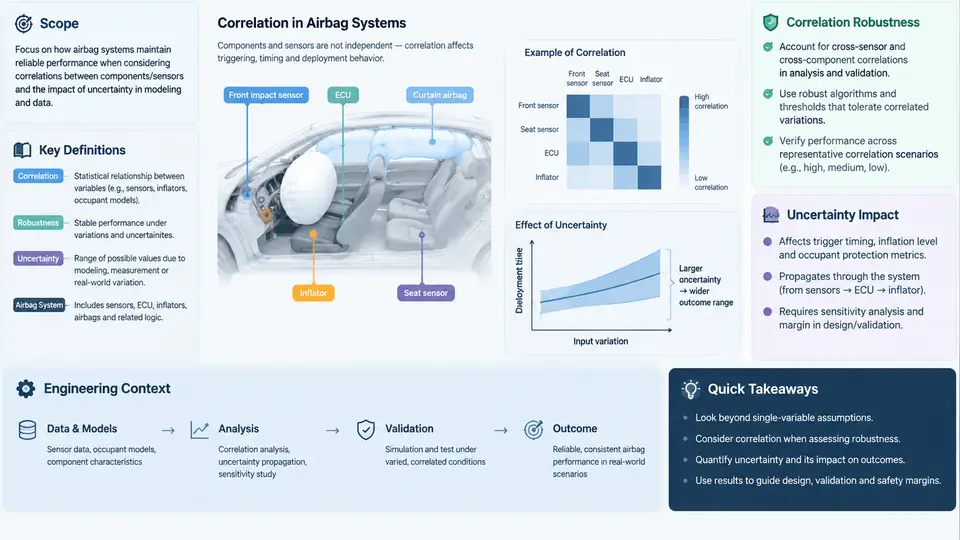
Occupant safety simulation is only useful when its predictions can be trusted. In airbag restraint engineering, that trust is built through correlation: the systematic process of aligning a CAE model with physical test evidence so that the model reproduces the observed occupant response within an acceptable tolerance. Once a model is correlated, the next question is whether it stays valid when inputs vary — material properties, inflator output, deployment timing, seating position, ambient temperature. That question belongs to robustness and uncertainty studies. This course addresses the full chain: how correlation is established, how uncertainty is quantified, how robustness is designed in, and how all of it is documented for regulatory and internal decision-making.
Why Correlation Is Not a One-Time Event
A common misconception is that correlation is a milestone — a model is "correlated" and then used indefinitely. In practice, correlation is a state of validated applicability. A model correlated for a 50th-percentile male dummy in a 56 km/h frontal rigid-barrier test at 23 °C is not automatically valid for a 5th-percentile female occupant in a 32 km/h oblique pole impact at −35 °C. The correlation domain must be explicitly bounded, and any extrapolation outside that domain is an uncertainty that must be quantified or tested.
This distinction matters because airbag systems are increasingly adaptive. Dual-stage and multi-chamber inflators, venting strategies, and out-of-position (OOP) suppression logic all introduce configuration-dependent behavior. A model that matches one deployment stage may diverge significantly in another. Correlation robustness therefore means the model's predictive fidelity is maintained across the configuration space, not just at a single operating point.
Key Definitions Used Throughout This Course
The following terms are used with specific, consistent meanings in all 30 chapters. Establishing them now prevents ambiguity later.
| Term | Definition | Typical Metric |
|---|---|---|
| Correlation | Quantitative agreement between simulation and physical test for a defined response channel and event | CORrelation factor (COR), peak magnitude error, phase error |
| Robustness | Insensitivity of a response to controlled input variation within a specified range | Response spread (σ, range), Cpk, signal-to-noise ratio |
| Uncertainty | Quantified lack of knowledge about a parameter, model form, or boundary condition | Confidence interval, probability density, sensitivity index |
| Aleatory uncertainty | Irreducible variability inherent in the physical system (e.g., lot-to-lot inflator output) | Standard deviation, distribution type |
| Epistemic uncertainty | Reducible uncertainty due to limited data or model form error | Bayesian posterior, model-form error bound |
| Validation domain | The set of conditions (speed, angle, temperature, occupant, configuration) for which correlation has been demonstrated | Domain boundary matrix |
| Margin | Difference between a response and its limit, expressed in physical or statistical terms | Absolute margin, margin ratio |
Two conventions are fixed for the entire course. First, time zero is defined as the moment of first contact between the vehicle and the barrier (or the firing signal for sled tests), and all timing references are relative to this instant. Second, positive occupant displacement is defined as forward motion relative to the vehicle interior, consistent with the SAE J211 sign convention for occupant kinematics. Any deviation from these conventions in a specific chapter will be stated explicitly.
The Engineering Context: Where This Work Sits
Airbag correlation and robustness studies sit at the intersection of three engineering domains: restraint system design, occupant safety simulation, and statistical methods. The diagram below shows the information flow from physical testing through correlation, uncertainty quantification, and robustness assessment, and how each stage feeds the next.
The workflow is deliberately iterative. If robustness assessment reveals insufficient margin, the response is not simply to add more material or increase inflator output — it is to return to the correlation stage, refine the model where sensitivity is highest, and re-evaluate. This loop is what distinguishes a correlation robustness study from a simple model-tuning exercise.
What Makes This Problem Hard
Three characteristics make airbag correlation and robustness uniquely challenging compared to other CAE domains.
First, the response channels are highly nonlinear and coupled. Airbag pressure, membrane stress, vent flow, and occupant contact interact over a 30–120 ms window. A small change in inflator mass flow rate can shift peak chest deflection by several millimeters, but the same change may have negligible effect on head acceleration. Sensitivity is channel-dependent and time-dependent.
Second, the input uncertainties are not all well-characterized. Inflator output varies with propellant lot, temperature, and aging. Fabric permeability varies with weave and coating. Dummy response varies with certification cycle and instrumentation. Some of these have historical data; others require assumptions. The course will show how to handle both cases — using frequentist methods where data exists and Bayesian or expert-elicitation methods where it does not.
Third, the acceptance criteria are regulatory and binary. A model that predicts a 5% probability of exceeding a injury threshold is not useful if the regulation requires demonstration of compliance with a fixed margin. The course therefore treats robustness not as a purely statistical exercise but as a decision-support tool that must connect to pass/fail criteria.
Scope of This Course
Across 30 chapters, the course progresses from foundational definitions (this chapter) through correlation methodology, uncertainty characterization, DOE and surrogate modeling, sensitivity analysis, robustness metrics, and finally to documentation and regulatory submission. The emphasis throughout is on engineering decisions: what to measure, what to vary, how much variation is acceptable, and how to defend the conclusion.
By the end of the course, you should be able to take a validated airbag model, define its uncertainty space, run a structured robustness study, interpret the results in terms of occupant safety margin, and produce documentation that supports both internal design reviews and external regulatory inquiries. The next chapter begins with the physical test data that anchors the entire process.