1. Knee airbag system overview
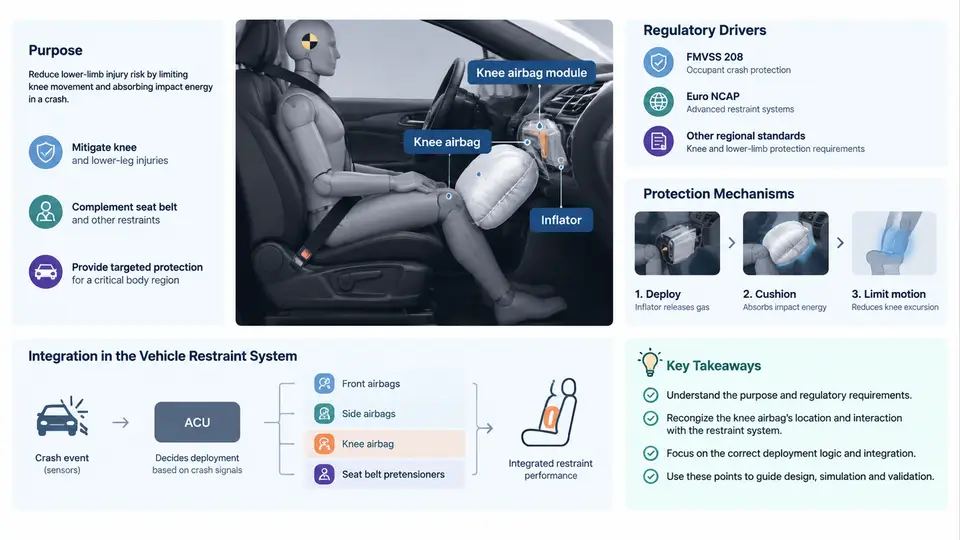
A knee airbag (KAB) is a supplemental restraint deployed from the lower instrument panel or steering column area to control the occupant's lower extremities and pelvis during a frontal impact. Unlike the driver frontal airbag, which primarily manages head and chest kinematics, the KAB targets a region that conventional belt-and-bag systems address only indirectly: the knee-thigh-hip (KTH) complex, the tibia, and the femur. Its purpose is threefold — reduce lower-extremity injury metrics, improve occupant kinematics by coupling the pelvis earlier to the vehicle deceleration pulse, and reduce the risk of occupant submarining beneath the lap belt.
Why the Lower Extremities Matter
In a frontal crash, the occupant's pelvis is restrained by the lap belt while the upper torso loads the shoulder belt and frontal airbag. The legs, however, are largely free to translate forward until they contact the knee bolster or lower IP. Without a KAB, the femur and tibia absorb that contact energy directly, producing high axial forces at the knee joint and bending moments in the femur. Regulatory and consumer metrics such as femur axial force (typically limited to around 10 kN in FMVSS 208 and similar limits in UN R94/R137), knee slider displacement, and tibia index (TI) are the primary injury criteria used to evaluate lower-extremity performance. A KAB cushions this contact, distributes load over a larger area, and reduces peak forces on the KTH complex.
Regulatory and Consumer-Rating Drivers
KAB adoption accelerated because of three converging pressures:
- FMVSS 208 — establishes frontal occupant protection requirements including femur load limits and, in the unbelted condition, stringent kinematics requirements that a knee bolster alone may not satisfy.
- UN R94 / R137 — European frontal impact regulations with comparable femur and tibia criteria, driving KAB fitment in markets where belt usage is high but lower-extremity injury remains a concern.
- Consumer ratings (Euro NCAP, US NCAP, C-IASI) — lower-extremity and submarining assessments in frontal offset and full-width tests influence star ratings, making KAB a common countermeasure.
The practical consequence is that KAB is no longer a premium feature; it is a mainstream restraint element in many passenger vehicles, particularly in markets with aggressive consumer-test lower-extremity scoring.
Occupant Protection Mechanisms
The KAB protects through four interacting mechanisms:
- Load distribution. The cushion spreads knee contact force over the bolster and shin area, lowering peak pressure and femur axial force.
- Kinematic coupling. By engaging the knees early, the KAB transfers a portion of the occupant's deceleration into the pelvis and lower torso, reducing forward excursion of the upper body and helping the frontal airbag engage the head and chest in a more favorable position.
- Submarining mitigation. Early knee engagement creates a reaction that helps keep the pelvis seated against the seat cushion and lap belt, reducing the tendency to slide under the belt.
- Energy absorption. Venting and cushion geometry tune the force–deflection response so the KAB absorbs energy rather than transmitting it rigidly to the occupant.
Integration into the Vehicle Restraint System
Integrating a KAB requires coordination across several subsystems. The deployment decision comes from the Restraint Control Module (RCM), which uses crash severity, belt status, occupant classification, and sometimes seat position to decide whether and how forcefully to deploy. The KAB module itself consists of an inflator, cushion, housing, and mounting bracket, typically packaged behind the lower IP or steering column trim. Key integration considerations include:
- Packaging and tear seam. The module must fit within the lower IP without compromising knee bolster stiffness or trim appearance; the tear seam must open reliably across the deployment temperature range (−35 °C to +85 °C).
- Deployment timing. KAB timing is tuned relative to the frontal airbag and belt pretensioner so the cushion is in position before the knees reach the bolster, but not so early that it interferes with occupant motion.
- Out-of-position (OOP) robustness. Static deployment tests with the dummy in close proximity verify that the deploying cushion does not create injurious loads.
- Interaction with the knee bolster. The bolster provides the reaction surface; its stiffness and geometry must be co-designed with the KAB cushion to achieve the target force–deflection curve.
Design and Validation Implications
Because the KAB sits at the intersection of crash sensing, occupant classification, seat structure, and IP design, its development follows a systems-engineering approach. The typical workflow includes:
- Concept and packaging study — define module volume, mounting strategy, and tear-seam location within the lower IP.
- CAE simulation — sled and full-vehicle FE models evaluate femur force, tibia index, knee slider displacement, and occupant kinematics across belted/unbelted and OOP conditions.
- Component testing — static deployment, temperature cycling, and inflator characterization.
- Sled and full-vehicle validation — confirm performance against FMVSS 208, UN R94/R137, and consumer-test protocols.
A representative sled target for a mid-size sedan might specify femur axial force below 8 kN and tibia index below 1.0 at 56 km/h full-width frontal impact, with the KAB deploying at approximately 15–25 ms after impact depending on the RCM calibration. These values are illustrative and must be confirmed by actual simulation and test data for the specific vehicle.
Key Takeaways
- The KAB targets lower-extremity injury and occupant kinematics that belt-and-frontal-airbag systems address only partially.
- Regulatory limits (FMVSS 208, UN R94/R137) and consumer ratings are the primary adoption drivers.
- Protection mechanisms include load distribution, kinematic coupling, submarining mitigation, and energy absorption.
- Successful integration requires co-design with the RCM, knee bolster, seat, and frontal airbag, validated through CAE, sled, and full-vehicle testing.