1. Far-side impact crash dynamics
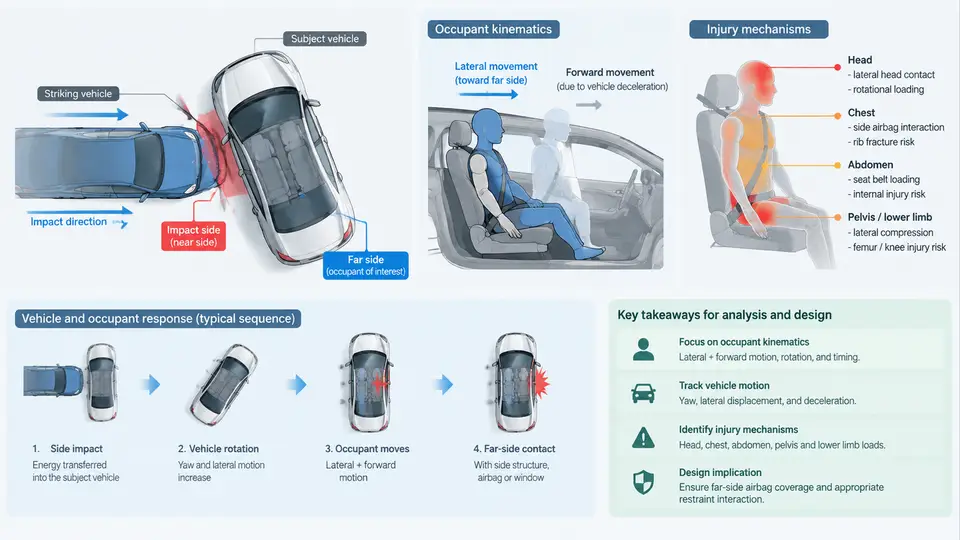
In a far-side collision, the occupant sits on the side of the vehicle opposite the impact. This seemingly simple geometric fact fundamentally changes the entire restraint problem. Whereas a near-side occupant is pushed into a door, B-pillar, and side airbag, a far-side occupant is thrown across the cabin toward the struck side, with no structural barrier between the body and the interior. Understanding this motion — and the injuries it produces — is the prerequisite for designing any far-side airbag system.
Defining the Far-Side Configuration
Consider a left-hand-drive vehicle struck on its right side. The driver (left seat) is the far-side occupant; the right-front passenger is the near-side occupant. The same logic applies to rear seats. Two parameters dominate the severity of the event:
- Impact location relative to the occupant: front, middle, or rear of the struck side.
- Impact angle: a pure lateral (90°) strike produces maximum lateral acceleration; oblique angles (e.g., 60° or 120°) introduce longitudinal components that change the occupant's trajectory.
Regulatory and consumer-test interest in far-side has grown because field data show that belted far-side occupants still sustain serious head, neck, and thoracic injuries — the belt alone does not control lateral excursion.
Vehicle Motion in a Far-Side Impact
When the struck vehicle is hit laterally, it experiences a rapid lateral acceleration pulse. The struck side is pushed inward, and the vehicle acquires both lateral velocity and, critically, yaw. The yaw arises because the impact force acts at a point offset from the vehicle's center of gravity (CG). A front-of-door strike rotates the vehicle one way; a rear-of-door strike rotates it the other. This yaw is not a minor detail — it rotates the occupant compartment while the occupant is still moving in roughly the original direction, effectively amplifying the relative lateral displacement between occupant and interior.
The occupant, restrained primarily by a three-point belt, does not instantly follow the vehicle. The torso is coupled to the vehicle through the belt, but the head and upper torso have inertia and are only loosely coupled. The result is a phase lag: the vehicle decelerates/rotates first, the pelvis follows the belt, and the head follows last, producing a characteristic head lag and lateral head excursion.
Occupant Kinematics: A Phased Description
The far-side kinematic sequence can be divided into overlapping phases. The timing below is illustrative for a 50 km/h lateral sled or crash pulse and should be treated as a teaching example, not a measured result.
- Belt engagement (0–30 ms): The lap and shoulder belt begin to load. The pelvis is captured first; the shoulder belt loads the upper torso. The occupant begins to rotate about the belt.
- Lateral excursion (30–80 ms): The torso translates and rotates toward the struck side. The head, lagging, develops lateral velocity relative to the torso. The neck begins to bend laterally and may rotate axially.
- Head excursion and interaction (80–150 ms): The head reaches its maximum lateral displacement. Depending on geometry, it may contact the opposite occupant's head, the opposite B-pillar or door, or the center console. This is the phase where far-side airbags are intended to intervene.
- Rebound / secondary motion (150 ms+): The belt and any deployed airbag decelerate the occupant; the head may rebound and the neck experiences a reversal of loading.
Two kinematic variables are especially important for design: maximum lateral head excursion (how far the head travels) and head-to-torso relative rotation (how much the neck is bent and twisted). Both are sensitive to belt geometry, seat position, and the presence of a far-side airbag.
Injury Mechanisms
Far-side injuries cluster into three groups, each tied to a specific kinematic phase.
| Injury group | Primary mechanism | Typical loading |
|---|---|---|
| Head injury (diffuse, contusion, skull fracture) | Head strikes opposite occupant, opposite interior, or center console after large lateral excursion | Linear + rotational acceleration; contact force |
| Neck injury (muscle strain, facet, ligament, in severe cases vertebral) | Belt restrains torso while head continues laterally → lateral bending + axial rotation of the neck | Combined lateral bending moment and axial torque |
| Thoracic / abdominal injury | Shoulder belt loads the torso; in oblique impacts the belt may slip and load the abdomen | Belt pressure, rib deflection, submarining |
The neck is the most characteristic far-side injury site. Because the shoulder belt anchors the torso on the struck side, the torso is held while the head swings across, producing a lateral bending plus axial rotation of the cervical spine. This combined loading is more injurious than pure lateral bending and is difficult to reproduce in a pure frontal or pure lateral test.
Why the Belt Alone Is Insufficient
A three-point belt is optimized for frontal and near-side restraint. In a far-side event it has three limitations:
- No lateral anchor: the belt cannot prevent the torso from rotating and translating toward the struck side.
- Head is uncoupled: the belt does not restrain the head, so head excursion is largely uncontrolled.
- Belt slip in oblique impacts: the shoulder belt can migrate off the shoulder, reducing torso coupling and increasing head excursion.
This is precisely the gap a far-side airbag is designed to fill: it deploys into the space between the far-side occupant and the center of the cabin, providing a lateral reaction surface that limits head and torso excursion and reduces neck loading.
Engineering Implications for Far-Side Airbag Design
From the kinematics above, several design requirements follow directly:
- Deployment timing: the airbag must be inflated before the head reaches the contact zone, i.e., within roughly the 30–80 ms window in the illustrative timeline. This drives sensor and inflator requirements.
- Coverage area: the bag must cover the lateral path of the head and upper torso, not just a fixed point.
- Reaction surface: the bag must be supported (by the seat, console, or roof) so it can absorb energy rather than being pushed aside.
- Out-of-position robustness: because the occupant may be leaning or turned, the bag must not create new injury risks during deployment.
Summary
Far-side impact dynamics are governed by the interaction of vehicle yaw, belt-restrained torso motion, and uncontrolled head excursion. The occupant's head lags the torso, travels across the cabin, and may contact the opposite occupant or interior, while the neck experiences combined lateral bending and axial rotation. These mechanisms — not the initial impact force alone — define the injury risk and set the design targets for far-side airbags. The next chapters build on this kinematic foundation to develop restraint concepts, sensing strategies, and validation methods.