3. Airbag deployment kinematics
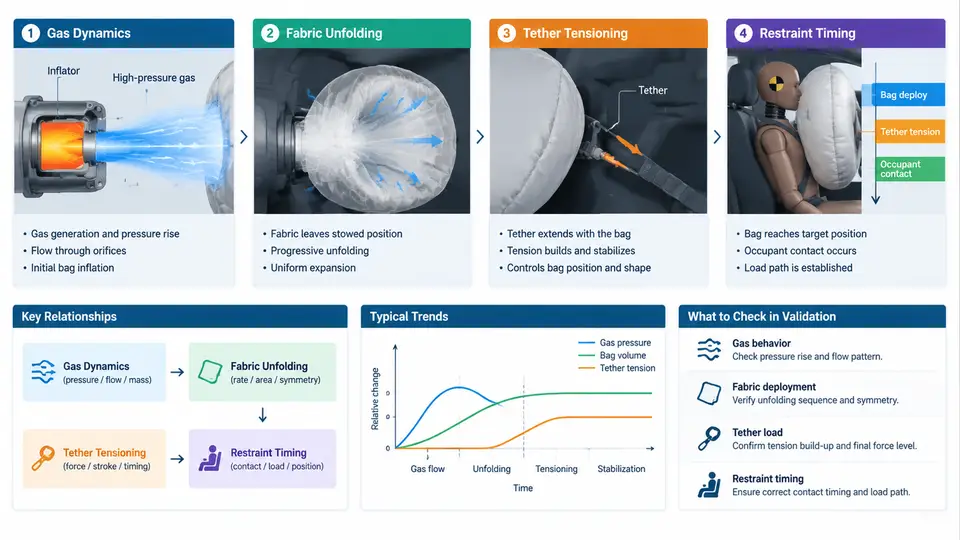
An airbag is not a static cushion that simply appears in front of an occupant. It is a transient, gas-driven mechanism whose usefulness depends on a precisely choreographed sequence of events lasting only tens of milliseconds. Tether design sits at the center of this choreography: tethers do not generate the deployment energy, but they shape how that energy is converted into cushion geometry, how the fabric unfolds, and when the cushion finally becomes a load-bearing restraint surface. This section examines the four coupled phenomena that define deployment kinematics — gas dynamics, fabric unfolding, tether tensioning, and restraint timing — and shows how they interact in a validated CAE workflow.
Gas Dynamics: The Energy Source and Its Time Scale
Deployment begins with the inflator. In a typical driver-side pyrotechnic inflator, the gas generator burns over roughly 20–40 ms, releasing a mass flow rate that peaks early and then decays. The cushion internal pressure P(t) is governed by the balance between mass inflow from the inflator, mass outflow through vents and fabric porosity, and the changing internal volume as the cushion unfolds:
dP/dt = (γ·R·T / V) · (ṁ_in − ṁ_out) − γ·P·(dV/dt) / V

where:
  γ   = ratio of specific heats (≈1.4 for air)
  R   = specific gas constant
  T   = gas temperature (K)
  V   = instantaneous cushion volume
  ṁ_in  = inflator mass flow rate
  ṁ_out = vent + porosity mass flow rate
The critical insight for tether design is that dV/dt is not a free variable — it is constrained by the tethers. A tether that limits cushion depth reduces the rate of volume growth, which in turn raises internal pressure and accelerates gas outflow through vents. This coupling means tether length and vent area must be tuned together; changing one without the other shifts the entire pressure history and therefore the occupant loading.
In CAE, the inflator is represented by a tank-pressure curve or a mass-flow-rate table derived from inflator characterization tests (typically a closed-tank or open-air test). The gas dynamics are solved either through a uniform-pressure (lumped) model or a CFD-based approach. For tether-focused studies, a lumped model with a calibrated discharge coefficient is usually sufficient, provided the vent flow is modeled with a pressure-dependent orifice equation.
Fabric Unfolding: From Packed Bundle to Cushion Geometry
Before deployment, the cushion is folded into a compact package. The unfolding process is driven by internal pressure acting on the fabric, but it is resisted by fabric bending stiffness, friction between folded layers, and the inertia of the fabric mass. The sequence typically proceeds as follows:
- Initial pressurization (0–5 ms): Gas fills the folded volume. The cushion begins to unfold along the path of least resistance, usually the pre-formed fold pattern.
- Primary unfolding (5–15 ms): The cushion expands outward from the module. Tethers, if present, begin to pay out and limit the expansion in specific directions.
- Full inflation (15–30 ms): The cushion reaches its designed geometry. Tethers become taut and define the final shape.
- Venting and restraint (30–50 ms): Gas escapes through vents and fabric porosity. The cushion pressure drops as the occupant loads the surface.
In CAE, fabric unfolding is modeled using membrane elements with orthotropic material properties. The folding pattern is imported from the CAD flattening process, and the initial folded state is defined through a pre-simulation (folding simulation) or by mapping the folded geometry directly. The key challenge is capturing the contact between fabric layers during unfolding; penalty-based contact with a friction coefficient of 0.1–0.3 is commonly used, though the exact value should be calibrated against deployment tests.
Tether Tensioning: The Geometry Constraint
Tethers are the primary tool for controlling cushion shape. A tether is a strip of fabric (often the same material as the cushion, e.g., nylon 6.6 with a silicone coating) sewn between two points on the cushion. When the cushion inflates, the tether becomes taut and prevents further expansion in that direction. The tension in the tether T is related to the internal pressure P and the geometry by:
T = P · A_projected / (2 · cos θ)

where:
  A_projected = projected area of the cushion panel restrained by the tether
  θ           = angle between the tether and the panel surface
This simple relation reveals two design levers: tether length (which sets θ and the final geometry) and tether attachment points (which set A_projected). A shorter tether increases θ, reduces the effective restraint, and can cause the cushion to bulge in unintended directions. A longer tether allows more expansion but may not provide sufficient shape control.
In CAE, tethers are modeled as tension-only elements (e.g., seatbelt elements or membrane strips) with a defined slack length. The slack length must match the physical tether length minus the stitch allowance. If the tether is modeled as a rigid link, the model will over-constrain the cushion and produce unrealistically high pressures. If it is modeled with too much slack, the cushion will over-expand and the tether will never engage.
Restraint Timing: When the Cushion Becomes Useful
The occupant restraint function of an airbag depends on the cushion being fully inflated and pressurized at the moment the occupant contacts it. This is a timing problem: the occupant's forward motion (driven by vehicle deceleration) and the cushion's inflation must converge. The key timing parameters are:
| Parameter | Typical Value | Effect of Variation |
|---|---|---|
| Time to fire (TTF) | 10–30 ms after crash pulse | Earlier firing increases risk of out-of-position loading; later firing reduces restraint effectiveness |
| Time to full inflation | 25–40 ms | Longer inflation delays restraint; shorter inflation increases pressure and occupant loading |
| Occupant contact time | 40–60 ms | Determined by occupant position and vehicle deceleration |
| Tether engagement time | 15–25 ms | Earlier engagement limits cushion depth; later engagement allows more expansion |
The goal is to have the tether fully tensioned and the cushion at its design pressure just before occupant contact. In CAE, this is validated by extracting the tether tension history and the cushion pressure history, then comparing the time of peak tension to the time of occupant contact. If the tether peaks too early, the cushion may be too stiff; if it peaks too late, the cushion may not have reached its intended shape.
Bringing It Together in CAE
A validated deployment kinematics model must reproduce all four phenomena simultaneously. The workflow typically proceeds as follows:
- Inflator characterization: Obtain the tank pressure curve or mass flow rate from a closed-tank test. This is the input to the gas dynamics model.
- Folding simulation: Generate the initial folded state from the flat pattern. This is often done in a separate explicit simulation and then imported.
- Deployment simulation: Run the explicit dynamics simulation with the inflator input, fabric material model, tether elements, and contact definitions.
- Validation: Compare the simulated cushion pressure, tether tension, and deployment timing against instrumented deployment tests (e.g., high-speed video, pressure transducers, load cells on tethers).
Common failure modes and their CAE symptoms include:
- Tether too short: Cushion pressure spikes early, tether tension peaks before occupant contact, cushion depth is insufficient. In CAE, the pressure curve shows a sharp early peak and the tether tension curve saturates early.
- Tether too long: Cushion over-expands, tether tension remains low until late, occupant may contact a partially inflated cushion. In CAE, the tether tension curve rises slowly and peaks after contact.
- Vent area mismatch: If vents are too large, pressure drops too quickly and the cushion is soft at contact. If too small, pressure remains high and occupant loading increases. In CAE, the pressure decay rate after peak is the key indicator.
- Fabric unfolding error: Cushion unfolds asymmetrically or gets caught. In CAE, the contact forces between fabric layers show unrealistic spikes, and the cushion geometry at full inflation deviates from the design intent.
The key takeaway is that tether design cannot be separated from gas dynamics, fabric unfolding, or restraint timing. A tether that works in isolation may fail when the inflator output changes, when the fold pattern is modified, or when the occupant contact time shifts. CAE validation must therefore treat deployment kinematics as a coupled system, with the tether tension history serving as the primary indicator of whether the cushion is behaving as intended at the moment it matters most.