3. Seam failure criteria and damage initiat
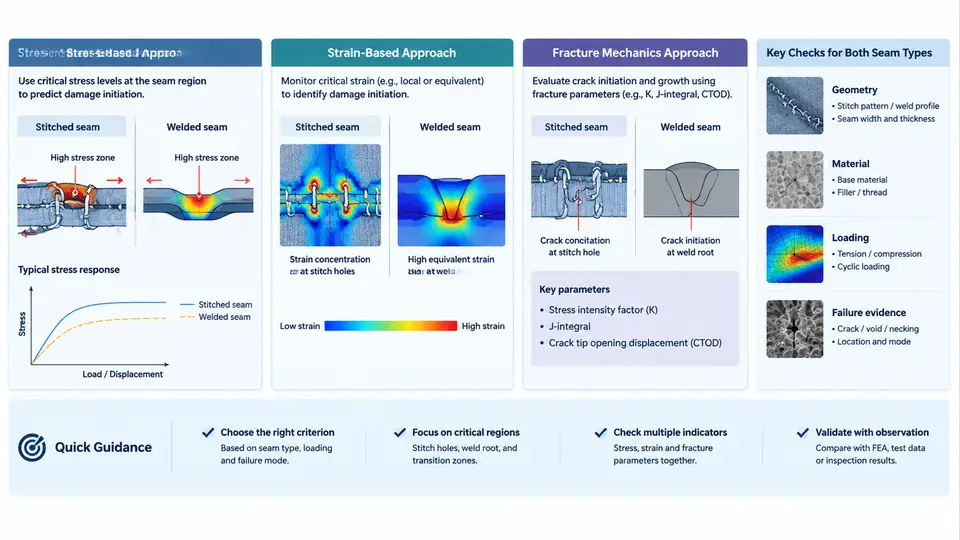
An airbag seam is not a homogeneous material region. It is a geometric and material discontinuity where two coated fabric panels are joined by stitching, welding, or a combination of both. Failure criteria for seams therefore cannot be borrowed directly from bulk fabric allowables. They must account for the local stress concentration at the seam edge, the load-transfer mechanism of the joint, and the damage mode that actually governs rupture. This section compares three families of criteria — stress-based, strain-based, and fracture mechanics — and shows how each is applied to stitched and welded seams in practice.
Why Seam Failure Differs from Fabric Failure
In a stitched seam, the load path runs from the fabric into the stitch threads through friction and interlocking, then back into the opposing panel. The stitch holes themselves are stress raisers: each needle penetration cuts yarns and creates a local notch. In a welded seam, the coating is fused or bonded, and load transfer occurs through the weld interface in shear and peel. The weld bead introduces a stiffness mismatch between the fused zone and the parent fabric.
Three consequences follow. First, the seam strength is almost always lower than the parent fabric strength, so the seam becomes the design-limiting feature. Second, the failure mode depends on loading direction relative to the seam line — transverse tension, longitudinal shear, and peel produce completely different damage patterns. Third, the criterion must be tied to the observed failure mode, not to a single scalar strength value.
Stress-Based Criteria
Stress-based criteria compare a computed or measured stress against an allowable. For seams, the most useful forms are:
- Average seam stress: σavg = F / (w · t), where F is the applied load, w is the seam width, and t is the fabric thickness. This is simple but ignores the stress concentration at the stitch line.
- Peak local stress: σpeak = Kt · σavg, where Kt is a stress concentration factor derived from the stitch-hole geometry or weld-bead profile. For a typical stitched seam with 4–6 stitches per centimeter, Kt commonly falls in the range 1.5–2.5.
- Shear stress in the stitch thread: τthread = F / (n · Athread), where n is the number of load-bearing stitches and Athread is the thread cross-section.
A stress-based criterion is appropriate when the seam behaves in a brittle, strength-limited manner and when the stress state can be reliably computed. Its main weakness is that coated fabrics are viscoelastic and rate-dependent; a stress allowable measured at 100 mm/min may not apply at the 10–30 m/s strain rates seen during airbag deployment.
Strain-Based Criteria
Strain-based criteria are often more suitable for airbag fabrics because the material is compliant and the failure is frequently strain-driven rather than stress-driven. The seam strain is measured or computed at the stitch line or weld edge:
- Seam strain: εseam = ΔL / L0, measured across the seam region using extensometry or digital image correlation (DIC).
- Strain concentration factor: Kε = εlocal / εnominal, which can be significantly higher than Kt in coated fabrics due to yarn decrimping and coating shear.
- Critical strain criterion: failure initiates when εlocal ≥ εcrit, where εcrit is the seam-level failure strain obtained from a controlled seam test.
Strain-based criteria are particularly effective for welded seams, where the weld bead may carry load in shear while the adjacent fabric undergoes large extension. A typical welded seam in a silicone-coated nylon may show εcrit of 0.18–0.25 at the weld toe, compared with 0.30–0.40 for the parent fabric. The gap between these values is the design margin.
Fracture Mechanics Approaches
When a seam contains a pre-existing defect — a missed stitch, a weld void, a cut yarn — stress- and strain-based criteria lose accuracy because they do not account for the defect size. Fracture mechanics provides a defect-tolerant framework:
- Linear elastic fracture mechanics (LEFM): KI = Y · σ · √(πa), where a is the defect half-length and Y is a geometry factor. Failure is predicted when KI ≥ KIC of the seam region.
- J-integral: J = −dU/da, suitable for the large-scale yielding observed in fabric seams. The critical value Jc is obtained from a seam fracture test.
- Cohesive zone modeling (CZM): The seam interface is represented by a traction–separation law with parameters (σmax, δc, Gc). Damage initiates when the traction reaches σmax and propagates as the separation energy reaches Gc.
Fracture mechanics is most valuable for welded seams and for stitched seams with known manufacturing defects. It requires more testing effort but gives a quantitative basis for accepting or rejecting a seam with a given flaw size.
Damage Initiation and Evolution
Damage initiation is not a single event. In a stitched seam, it typically follows this sequence: (1) yarn decrimping and coating shear at the stitch holes; (2) local strain concentration at the first and last stitches; (3) thread–fabric friction slip; (4) yarn rupture or thread breakage; (5) seam opening and catastrophic separation. In a welded seam, the sequence is: (1) stress concentration at the weld toe; (2) coating debonding or cohesive failure; (3) peel crack growth; (4) weld rupture.
A robust criterion must therefore specify both the initiation threshold and the evolution law. For CZM, this means defining the damage variable D that evolves from 0 to 1 as separation increases. For strain-based criteria, it means defining a damage accumulation rule under cyclic or variable loading.
Applying the Criteria: A Worked Example
Consider a stitched seam in a silicone-coated nylon airbag panel. The seam is 50 mm wide, the fabric thickness is 0.35 mm, and the seam must carry a transverse tensile load of 2.5 kN. The seam strip test gives σseam,allow = 120 MPa and εcrit = 0.22. The stitch pattern is 5 stitches/cm with Kt = 1.8 and Kε = 2.1.
Step 1 — Average stress:
σ_avg = F / (w · t) = 2500 N / (50 mm · 0.35 mm) = 142.9 MPa

Step 2 — Peak stress:
σ_peak = K_t · σ_avg = 1.8 · 142.9 = 257.2 MPa

Step 3 — Compare with allowable:
σ_peak (257.2 MPa) > σ_seam,allow (120 MPa) → stress criterion FAILS

Step 4 — Strain check:
ε_nominal = σ_avg / E_seam = 142.9 MPa / 800 MPa = 0.179
ε_local = K_ε · ε_nominal = 2.1 · 0.179 = 0.375
ε_local (0.375) > ε_crit (0.22) → strain criterion FAILS

Step 5 — Design action:
Increase seam width to 80 mm or reduce stitch spacing to 3 stitches/cm
to lower K_t and K_ε, then re-evaluate.
This example shows that both stress- and strain-based criteria can be evaluated from the same test data. The fracture mechanics approach would additionally require the defect size; if a 1 mm missed-stitch gap is present, KI can be computed and compared with KIC of the seam region.
Practical Selection Guidance
| Criterion | Best Suited For | Key Input | Main Limitation |
|---|---|---|---|
| Stress-based | Brittle seams, quick screening | σseam,allow, Kt | Ignores rate effects and large deformation |
| Strain-based | Compliant coated fabrics, welded seams | εcrit, Kε | Requires accurate local strain measurement |
| Fracture mechanics | Defect-tolerant design, welded seams | KIC or Jc, defect size a | Higher testing cost; CZM calibration effort |
In practice, the most reliable approach is a tiered one: use stress-based screening to eliminate clearly inadequate designs, apply strain-based criteria for the final geometry, and reserve fracture mechanics for seams with known defects or for welded joints where the weld quality is variable. The criterion must always be tied to the observed failure mode, and the allowable must come from a test that reproduces the seam's actual load path.