3. Airbag fabric and seam mechanics
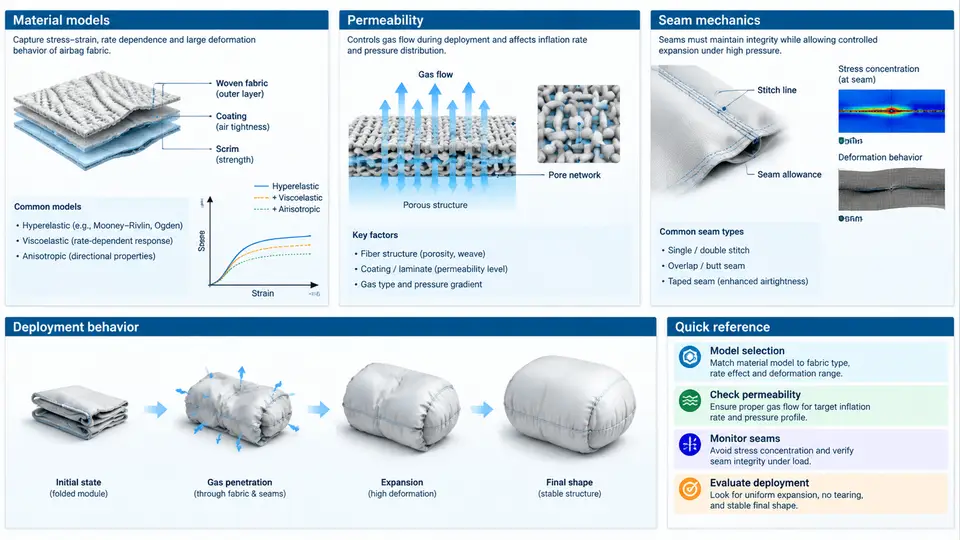
An airbag cushion is not a rigid pressure vessel. It is a woven, coated, stitched membrane that inflates in tens of milliseconds, stretches biaxially, leaks gas through its pores and seams, and then vents through dedicated openings. To simulate deployment credibly, the fabric and seam definitions must reproduce three coupled behaviors: the anisotropic stiffness of the weave, the pressure-dependent gas permeability of the coated textile, and the strength and failure of the stitched joints. This section develops those three pillars and shows how to calibrate and apply them in an explicit dynamics solver.
Fabric Architecture and the Origin of Anisotropy
Cushion fabric is typically a plain-weave nylon 6.6 (often 470 dtex or 840 dtex yarn) coated with silicone or neoprene. The warp and weft yarns interlace, so the sheet behaves differently along the two yarn directions and shears easily on the bias. This is why a single isotropic modulus is inadequate. The standard modeling approach is an orthotropic membrane with a fabric material model that tracks the yarn directions as they rotate during inflation.
Two families of constitutive models are common:
- Orthotropic elastic / hypoelastic membrane: defines separate Young's moduli and Poisson ratios for warp and weft, plus a shear modulus. Cheap and stable, but it does not capture the nonlinear stiffening as yarns straighten.
- Fabric / woven material model (e.g., LS-DYNA *MAT_FABRIC, *MAT_034): treats the fabric as a network of yarns with independent stress-strain curves in warp, weft, and shear. It naturally reproduces the low-stiffness crimp region followed by rapid stiffening once yarns are taut.
For a 470 dtex silicone-coated nylon, a representative calibration set (example values, to be replaced by coupon test data) is:
| Parameter | Warp | Weft | Notes |
|---|---|---|---|
| Young's modulus (GPa) | 3.5 | 3.2 | Secant at 5% strain |
| Poisson ratio | 0.20 | 0.18 | From biaxial test |
| Shear modulus (MPa) | 12 | Bias extension test | |
| Areal density (g/m²) | 260 | Mass scaling input | |
| Thickness (mm) | 0.35 | Coated, uncompressed | |
These values come from strip tensile tests in warp and weft and a bias-extension test for shear. The key point is that the shear response is highly nonlinear: the fabric offers little resistance until the yarns lock, then stiffens sharply. A fabric material model captures this with a shear stress-strain curve rather than a constant modulus.
Permeability: The Pressure-Dependent Leak
Coated fabric is not airtight. Gas escapes through the coating micro-structure and, more significantly, through the stitch holes along seams. Permeability is the volumetric flow rate per unit area per unit pressure difference, and it rises with the pressure difference across the fabric. In simulation this is handled by a porous or leakage model that couples the internal control volume pressure to the external ambient pressure.
A practical form is a power-law leakage:
Q = C * (dP)^n
where:
  Q  = volumetric leak rate per unit area  [m^3/(s·m^2)]
  dP = internal pressure - ambient pressure [Pa]
  C  = permeability coefficient            [m^3/(s·m^2·Pa^n)]
  n  = exponent (typically 1.0 to 1.5)
For uncoated or lightly coated fabric, C is on the order of 1e-6 to 1e-5 in SI units with n ≈ 1.2. Coated fabric reduces C by one to two orders of magnitude. The exponent n > 1 means leakage grows faster than linearly with pressure, which is why a fully inflated cushion loses pressure quickly at peak dP but retains it at low dP.
Seam Mechanics and Failure
Seams are the weakest link. A typical cushion uses a double-lapped or folded seam with nylon thread. Under deployment the seam carries the same membrane tension as the surrounding fabric but concentrates it at stitch holes, which act as stress risers and leak paths. Two failure modes matter:
- Thread rupture: the stitch line fails when thread tensile strength is exceeded. Modeled as a tie-break or spot-weld contact with a force criterion.
- Fabric tear-out: the yarns pull out of the seam before the thread breaks. Modeled by reducing the effective fabric strength along the seam line or by a damage initiation criterion.
In an explicit solver, seams are usually represented by one of three methods: shared nodes (rigid seam, no failure), tied contacts with a normal/tangential failure force, or discrete beam/spring elements along the stitch line. The tied-contact approach is the most practical because it allows the seam to open progressively and to leak once open.
A representative seam definition for a 470 dtex fabric with size-69 nylon thread (example values):
| Quantity | Value | Source |
|---|---|---|
| Stitch density | 8 stitches / 25 mm | Specification |
| Thread breaking force | 45 N | Thread datasheet |
| Seam efficiency | 70% | Seam tensile test |
| Failure force per stitch | 31.5 N | 45 N × 0.70 |
The seam efficiency of 70% means the stitched joint reaches only 70% of the parent fabric strength. This is the number that governs whether the cushion survives the peak pressure pulse.
Structural Behavior During Deployment
When the inflator fires, the cushion unfolds and the fabric experiences a rapid biaxial load. The sequence is: (1) the folded fabric is pulled taut, (2) internal pressure rises and the membrane stretches, (3) seams load up and may leak or open, (4) the cushion reaches full volume and vents. The simulation must capture the interaction between membrane stretch, seam opening, and gas leakage because they feed back on each other: a leaking seam lowers pressure, which reduces stretch, which changes the deployment trajectory.
The figure below summarizes how the three mechanisms interact across the deployment timeline.
Calibration Workflow and Verification
A defensible fabric-and-seam model is built in four steps. First, run strip tensile tests in warp and weft and a bias-extension test for shear; fit the fabric material curves. Second, run a pressure-decay test on a sealed coupon and fit C and n for permeability. Third, run a seam tensile test to establish seam efficiency and failure force per stitch. Fourth, run a single-cushion deployment and compare the internal pressure history and the cushion outer profile at 20 ms and 40 ms against a physical or validated reference.
Typical failure symptoms and their causes:
- Cushion inflates too fast and pressure overshoots: permeability coefficient C too low or n too low; leakage is under-predicted.
- Seam opens at low pressure: failure force per stitch set below the calibrated 31.5 N, or seam efficiency not applied.
- Fabric stretches unrealistically without stiffening: shear curve omitted or linearized; the yarn-lock region is missing.
- Pressure decays too slowly after peak: vent area not modeled, or seam leak not activated after seam opening.
The practical takeaway is that fabric, seam, and permeability parameters must be calibrated from separate coupon tests and then verified together in a full deployment. A model that matches pressure history but ignores seam opening will pass a single test and fail the next configuration. Treat the three mechanisms as one coupled system, and the simulation will predict both the deployment kinematics and the structural margin of the cushion.