1. Airbag fabric material modeling and test
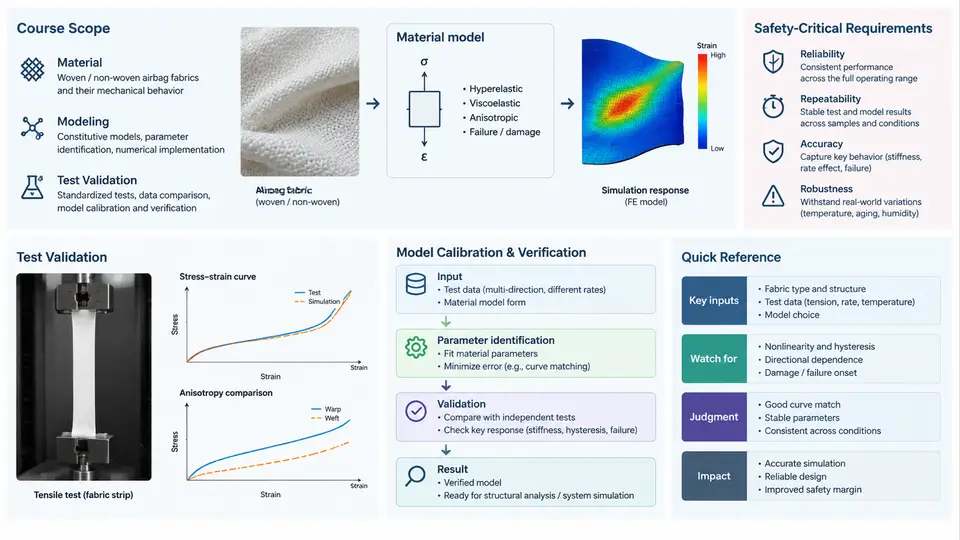
An airbag is a textile pressure vessel that must inflate in tens of milliseconds, survive a violent gas-fill transient, and then hold pressure long enough to cushion an occupant. Unlike a metal pressure vessel, its wall is a woven, coated, anisotropic membrane that folds, wrinkles, and slides against itself before it ever sees load. Modeling such a structure is not a purely academic exercise: the simulation result directly determines whether a restraint system deploys at the right time, at the right pressure, and with the right shape to keep an occupant's head and chest within injury thresholds. This course addresses the full chain from fabric material characterization, through constitutive model calibration, to validation against physical tests — and this first chapter establishes what that chain contains, why it exists, and what "correct" means in a safety-critical context.
What the Course Covers
The subject sits at the intersection of three disciplines: textile mechanics, explicit finite element analysis (FEA), and occupant safety engineering. The course scope can be organized into four connected layers.
- Material characterization. Measuring the mechanical response of coated and uncoated fabrics — warp and weft tensile behavior, shear rigidity, bending stiffness, friction between fabric plies, and permeability to inflation gas. Standard references include ASTM D5035 and ISO 13934-1 for strip tensile testing, and ASTM D1388 for bending stiffness.
- Constitutive modeling. Turning those measurements into a material card usable by an explicit solver. For airbag fabrics this typically means an orthotropic membrane formulation with separate warp/weft moduli, nonlinear stress–strain curves, shear coupling, and a permeability model that links pressure difference to volumetric flow through the weave.
- Structural simulation. Building the folded airbag model, defining the inflator gas source, and running the deployment transient in a solver such as LS-DYNA (keyword
*MAT_FABRIC,*AIRBAG_family) or equivalent explicit codes. - Test validation. Comparing simulation output against instrumented physical tests — static deployment, tank pressure tests, and full sled or vehicle crash tests — and quantifying the agreement.
Each layer feeds the next. A permeability value measured at the wrong pressure differential, or a shear modulus taken from a single bias-extension test, propagates silently into the deployment pressure curve and then into occupant injury criteria. That propagation is the central engineering risk this course teaches you to control.
Engineering Context: Why Fabric Modeling Is Hard
Metals are forgiving to model: isotropic, nearly incompressible, and well characterized. Airbag fabric is the opposite on every count.
Anisotropy. Warp and weft yarns have different counts, deniers, and crimp levels, so the fabric is orthotropic. A 470 dtex nylon 6.6 plain weave, for example, may show a warp modulus near 2.5 GPa and a weft modulus near 2.1 GPa in the initial linear region — but those "moduli" change with strain because the yarns decrimp and straighten before they carry load in tension.
Nonlinearity and low initial stiffness. The first few percent of strain is dominated by crimp interchange and weave geometry, not yarn extension. A model that assumes constant stiffness will over-predict load at low strain and under-predict it at high strain.
Membrane behavior with near-zero bending stiffness. The fabric carries in-plane tension but buckles instantly in compression. This is why airbag models use membrane or shell elements with no compressive stiffness, and why wrinkling — not stress — often governs the deployed shape.
Permeability and coating. Silicone-coated fabrics leak far less than uncoated ones, but leakage still controls the pressure decay after peak inflation. Permeability is a function of pressure differential, temperature, and fabric strain, and it is frequently the single largest source of validation error.
Contact and self-contact. During deployment the fabric unfolds, slides against itself, and contacts the occupant. Friction coefficients between coated fabric plies are low and variable, and contact instability can dominate the simulation.
The Validation Hierarchy
Safety-critical modeling follows a bottom-up validation logic. Each level has its own specimen, its own measured quantity, and its own acceptance criterion.
| Level | Specimen / Test | Primary Measured Quantity | What It Validates |
|---|---|---|---|
| Coupon | Strip tensile, warp and weft (ASTM D5035) | Force–displacement, failure strain | Orthotropic elastic and failure parameters |
| Coupon | Bias-extension / picture-frame shear | Shear angle vs. shear force | In-plane shear stiffness and locking angle |
| Coupon | Permeability cell (pressure decay) | Volumetric flow vs. ΔP | Leakage / porosity model |
| Component | Static deployment into free air | Bag shape, seam loads, internal pressure | Folding scheme, seam definition, inflation logic |
| System | Sled or full-vehicle crash test | Occupant kinematics, injury criteria (HIC, chest deflection) | End-to-end restraint performance |
The logic is deliberate: if a coupon-level model cannot reproduce a strip tensile curve within a stated tolerance, no amount of tuning at the system level produces a trustworthy result. Conversely, a model that passes coupon tests but fails static deployment usually has a folding, seam, or permeability problem — not a material problem.
Safety-Critical Requirements
Because airbag performance is regulated and life-protecting, the modeling process carries requirements that ordinary simulation work does not.
- Traceability. Every material parameter must trace to a specific test, specimen, and date. A modulus value with no source is not usable in a safety case.
- Conservatism where uncertainty is high. When a parameter is poorly characterized, the model should be run with bounding values to show the result is acceptable across the range, not just at the nominal point.
- Documented acceptance criteria. Agreement between simulation and test must be judged against pre-defined tolerances — for example, peak pressure within ±10%, time-to-peak within ±2 ms, and bag shape within a stated envelope — not by visual inspection alone.
- Version control of models and data. Material cards, fold files, and inflator definitions must be revision-controlled so that a validated configuration can be reproduced exactly.
- Independence of validation data. The tests used to calibrate a model should not be the same tests used to declare it validated, wherever the budget allows.
How the Pieces Connect
The diagram below shows the dependency structure of the whole workflow. Note that permeability and shear feed the deployment simulation in parallel with tensile properties — they are not optional refinements.
What You Will Be Able to Do
By the end of this course you should be able to take a fabric specification and a set of test data and produce a defensible material card, build and run a folded-airbag deployment model, and judge the result against physical tests using explicit criteria. You will also be able to diagnose the common failure modes: a bag that inflates too slowly (often permeability or inflator mass-flow), a bag that over-pressures (often seam leakage or an over-stiff tensile curve), and a bag whose shape diverges from test (often folding or friction).
The next chapters move into the coupon tests themselves, beginning with the tensile characterization that anchors every downstream parameter. The essential mindset to carry forward is this: in safety-critical fabric modeling, the material card is a claim about physical behavior, and validation is the evidence that supports it.