3. Regulatory and consumer rating requireme
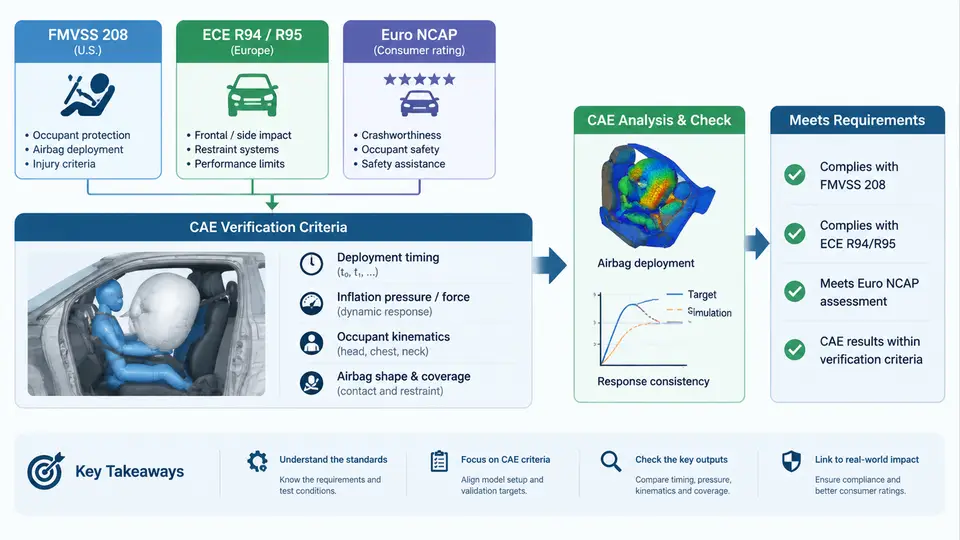
Airbag CAE verification does not exist in a vacuum. Every occupant-safety model that supports a production release must ultimately demonstrate compliance with a defined set of regulatory and consumer-rating requirements. These requirements determine the load cases you must simulate, the dummy types and positions you must use, the injury metrics you must extract, and the pass/fail thresholds against which your correlation and margin assessments are judged. Understanding the regulatory landscape is therefore not a legal afterthought — it is the foundation of the verification criteria themselves.
FMVSS 208: The U.S. Self-Certification Baseline
FMVSS 208 (Federal Motor Vehicle Safety Standard No. 208, Occupant Crash Protection) is the primary U.S. regulation governing frontal occupant protection. Its most consequential feature for CAE is the unbelted test requirement: vehicles must protect an unbelted 50th-percentile male Hybrid III dummy in a 25 mph (40 km/h) rigid barrier impact, in addition to belted configurations. This unbelted case drives airbag size, venting, and deployment timing far more aggressively than belted-only regulations, because the airbag alone must manage the occupant's kinetic energy.
For CAE verification, FMVSS 208 imposes specific criteria that your model must reproduce within defined tolerances:
- Head Injury Criterion (HIC15) ≤ 700 for the 50th-percentile male in the unbelted rigid barrier test.
- Chest deflection ≤ 63 mm (Hybrid III 50th male), with a corresponding viscous criterion limit.
- Femur axial force ≤ 10 kN per leg.
- Neck injury criteria (Nij) ≤ 1.0, evaluated in tension-extension and compression-flexion quadrants.
Additionally, FMVSS 208 includes out-of-position (OOP) requirements for occupants — particularly small-stature females and children — who may be close to or in contact with the airbag module at deployment. These static deployment tests (e.g., 5th-percentile female at various positions relative to the steering wheel) impose severe demands on airbag inflator output and module design. In CAE, OOP simulations require a coupled fluid-structure interaction (FSI) approach or a validated uniform-pressure surrogate, and the verification criterion is typically a correlation of chest acceleration and neck force against physical test data, not just a pass/fail threshold.
ECE R94 and R95: European Frontal and Side Impact
ECE R94 (frontal impact) and ECE R95 (lateral impact) are United Nations regulations adopted by the European Union and many other markets. Unlike FMVSS 208, ECE R94 is a belted-only regulation — the 50th-percentile Hybrid III dummy is tested with the seat belt fastened in a 56 km/h offset deformable barrier (ODB) impact with 40% overlap. This offset configuration produces asymmetric loading and significant vehicle yaw, making it a more demanding structural test than the full-frontal rigid barrier, even though the dummy injury thresholds are similar.
Key ECE R94 criteria for CAE verification include:
- HIC15 ≤ 1000 (with a secondary requirement that HIC36 ≤ 1000).
- Chest deflection ≤ 50 mm for the 50th-percentile male.
- Femur force ≤ 10 kN, and tibia force ≤ 8 kN.
- Knee displacement limits and pelvis acceleration limits for side impact (R95).
ECE R95 introduces the EuroSID-2 dummy for side impact, with criteria including rib deflection, abdominal force, and pubic symphysis force. For CAE, the side impact model must capture door intrusion, seat structure deformation, and side airbag interaction — a significantly different modeling challenge from frontal airbag deployment.
Euro NCAP: Consumer Ratings and the Margin Problem
Euro NCAP (European New Car Assessment Programme) is not a regulation — it is a consumer information program. However, its influence on CAE verification criteria is arguably greater than that of the regulations, because a poor Euro NCAP rating directly affects marketability. Euro NCAP's frontal offset test (50 km/h, 50% overlap with a deformable barrier) and its mobile progressive deformable barrier (MPDB) test introduce more severe and more varied loading than ECE R94.
The MPDB test is particularly challenging for CAE because it evaluates both occupant protection and compatibility — the tendency of a vehicle to cause damage to the opposing vehicle. This requires the CAE model to predict not only the subject vehicle's occupant response but also the deformation of the MPDB barrier, which is then used to compute a compatibility score. The verification criterion here is not a simple injury threshold but a correlation of barrier deformation patterns and a margin assessment against the scoring bands.
Euro NCAP also mandates the use of the THOR (Test Device for Human Occupant Restraint) dummy in frontal tests and the WorldSID dummy in side tests. These dummies have different biofidelity and instrumentation than the Hybrid III and EuroSID-2, which means your CAE model must be validated against a different set of dummy calibration and response data. The verification criteria shift accordingly: THOR-based chest deflection and abdominal pressure criteria replace the simpler Hybrid III metrics.
How Requirements Shape CAE Verification Criteria
The practical consequence of this regulatory and rating landscape is that a single airbag CAE model is never verified against a single criterion. Instead, you build a verification matrix that maps each load case to its governing requirement, dummy type, and injury metric. The table below summarizes the primary mappings for a typical frontal airbag program.
| Load Case | Governing Requirement | Dummy | Primary CAE Verification Metric |
|---|---|---|---|
| 25 mph rigid barrier, unbelted | FMVSS 208 | Hybrid III 50th | HIC15 ≤ 700, chest defl. ≤ 63 mm |
| 56 km/h ODB, belted | ECE R94 | Hybrid III 50th | HIC15 ≤ 1000, chest defl. ≤ 50 mm |
| 50 km/h MPDB, belted | Euro NCAP | THOR 50th | HIC15, chest defl., compatibility score |
| 32 km/h side pole | FMVSS 214 / Euro NCAP | ES-2re / WorldSID | Rib deflection, abdominal force |
| OOP static deployment | FMVSS 208 | Hybrid III 5th / child | Neck force, chest accel. correlation |
Each row in this matrix implies a different model configuration: different barrier geometry, different impact velocity, different dummy positioning, and different airbag deployment timing. The CAE verification criteria are therefore not a single number but a set of case-specific acceptance bands, each with its own correlation tolerance and margin requirement.
From Requirement to Verification Criterion: A Worked Example
Consider a frontal airbag program targeting both FMVSS 208 and Euro NCAP. The CAE engineer must first extract the regulatory thresholds and rating targets, then define the verification criteria for each simulation. For the FMVSS 208 unbelted case, the criterion might be: "Predicted HIC15 ≤ 630 (10% margin below the 700 limit) with a correlation error ≤ 8% against physical sled test data." For the Euro NCAP MPDB case, the criterion might be: "Predicted THOR chest deflection ≤ 42 mm (against a 50 mm threshold) with a correlation error ≤ 10% and a compatibility score within 0.5 points of the physical test."
The margin percentage is not arbitrary — it is derived from the historical correlation error of the model class, the test-to-test variability of the physical setup, and the program's risk tolerance. A model with a demonstrated correlation error of ±5% on HIC requires a larger margin than one with ±2% error. This is why regulatory and rating requirements cannot be separated from the correlation and margin methodology covered in later chapters: the requirement defines the target, but the correlation defines how much confidence you can place in the prediction.
Visualizing the Requirement-to-Criterion Flow
The diagram below illustrates how regulatory and consumer-rating requirements cascade into specific CAE verification criteria, showing the parallel paths for FMVSS 208, ECE R94/R95, and Euro NCAP, and the point at which they converge into a unified verification matrix.
The cascade shown above makes one point clear: regulatory and consumer-rating requirements are not a checklist to be satisfied after the CAE work is done. They are the specification that defines what the CAE work must prove. FMVSS 208 sets the unbelted frontal baseline; ECE R94/R95 sets the belted European regulatory floor; Euro NCAP raises the bar with more severe loading, more biofidelic dummies, and compatibility scoring. Each of these sources contributes distinct load cases, dummy types, and injury metrics to the verification matrix, and each demands its own correlation and margin evidence before the airbag model can be considered production-ready.