1. Side impact crashworthiness fundamentals
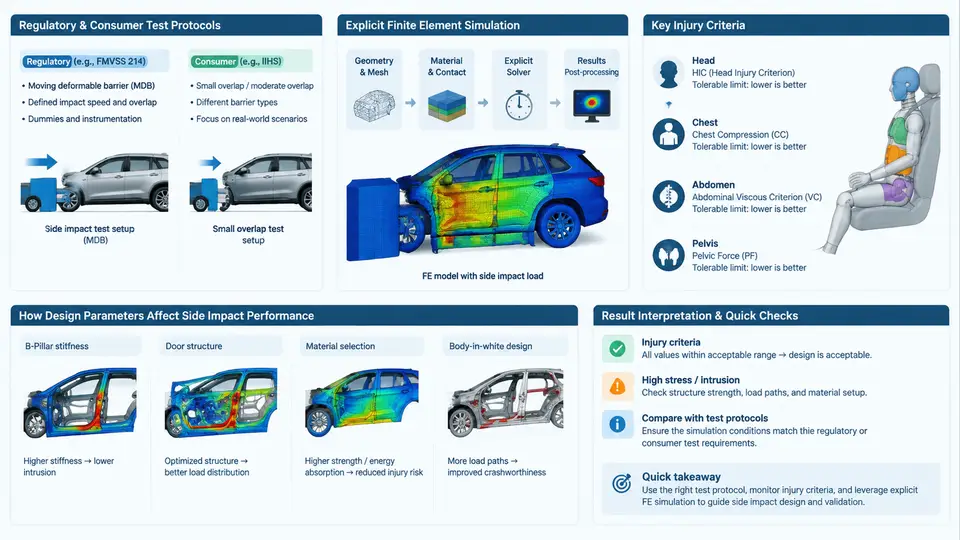
Side impact is one of the most demanding load cases in vehicle body design. Unlike frontal crashes, where a long crumple zone can absorb energy progressively, the lateral load path between the striking barrier and the occupant is extremely short — typically only 250–400 mm of door, B-pillar, and seat structure. The occupant sits close to the struck side, and there is no equivalent of the engine bay or front rails to manage the pulse. This geometric reality drives nearly every requirement in side impact regulation, consumer testing, and simulation practice.
Regulatory and Consumer Test Protocols
Two families of protocols dominate global side impact development. Regulatory tests define minimum legal performance; consumer tests discriminate between vehicles and feed star ratings. Both must be satisfied, and they often load the structure differently.
| Protocol | Type | Barrier / Striker | Impact Speed | Primary Focus |
|---|---|---|---|---|
| FMVSS 214 (US) | Regulatory | MDB, 1,368 kg, 27° crabbed | 54 km/h | Structural intrusion, occupant injury |
| UN R95 / ECE R95 | Regulatory | MDB, 950 kg, deformable face | 50 km/h | Occupant protection in side impact |
| Euro NCAP Side MDB | Consumer | AE-MDB, 1,300 kg | 60 km/h | Injury values, star rating |
| Euro NCAP Side Pole | Consumer | Rigid pole, 254 mm diameter | 32 km/h | Head containment, curtain airbag |
| IIHS Side | Consumer | MDB, 1,500 kg, higher ride height | 50 km/h | Severe intrusion, SUV compatibility |
The moving deformable barrier (MDB) is the central fixture in most protocols. Its deformable face — typically a honeycomb aluminium block — is calibrated so that the barrier itself absorbs a defined portion of the impact energy. This matters for simulation: the barrier must be modelled with a validated material model, not as a rigid wall, otherwise the energy split between barrier and vehicle will be wrong and intrusion predictions will be non-conservative.
The pole test is structurally different. A rigid 254 mm pole concentrates load on a narrow strip of the door and B-pillar, producing high local deformation and a strong risk of head contact with the pole if the curtain airbag does not deploy correctly. In simulation, pole tests demand fine mesh in the door outer panel and accurate airbag deployment timing.
Injury Criteria
Crashworthiness is ultimately judged by injury criteria measured on instrumented dummies. The most relevant for side impact are:
- HIC (Head Injury Criterion) — integrates resultant head acceleration over the critical time window. In side impact, HIC is dominated by head-to-pole or head-to-B-pillar contact, so curtain airbag coverage and deployment timing are decisive.
- Thoracic Trauma Index (TTI) — used in FMVSS 214 and US NCAP. It combines spine and rib acceleration with a mass-scaling factor. TTI is sensitive to the lateral stiffness of the door and the presence of a thorax side airbag.
- Rib Deflection Criteria (RDC) — used in Euro NCAP and UN R95. Measured directly by rib deflection potentiometers on the WorldSID or ES-2re dummy. RDC is the most direct indicator of chest compression and is strongly influenced by door intrusion and armrest geometry.
- Abdominal and pelvic criteria — APF (Abdominal Pressure Force) and pubic symphysis force, relevant when the barrier loads the lower torso.
The Role of Explicit Finite Element Simulation
Physical side impact tests are destructive, expensive, and slow — a single MDB test can cost tens of thousands of dollars and weeks of turnaround. Explicit finite element simulation, typically with LS-DYNA or PAM-CRASH, allows engineers to evaluate dozens of design variants before committing to a physical test. The explicit solver is used because side impact involves large deformation, contact, material failure, and short duration (typically 100–150 ms), all of which are well suited to explicit time integration.
A typical side impact simulation model includes:
- Vehicle body-in-white — shell elements for doors, B-pillar, rocker, roof rail, floor, and seat structure. Mesh size in the impact zone is typically 5–8 mm.
- Closures and trim — door inner panel, armrest, door trim, and glass, often modelled with solid or shell elements depending on the level of detail required.
- Occupant restraint systems — side airbag, curtain airbag, seat belt, and pretensioner, modelled with airbag fabric, gas flow, and contact.
- Dummy model — ES-2re, WorldSID 50th, or SID-IIs, positioned according to the protocol.
- Barrier model — MDB with calibrated honeycomb material, or rigid pole.
The simulation output is not just a deformation plot. Engineers extract intrusion profiles at defined heights, door velocity at the occupant contact point, dummy injury criteria time histories, and energy balance. The energy balance is a critical sanity check: the sum of kinetic, internal, contact, and hourglass energy should remain close to the initial kinetic energy, with hourglass energy typically below 5% of total internal energy.
Design Workflow and Simulation Feedback
Side impact design follows an iterative loop. The body structure is first sized to meet intrusion targets, then restraint systems are tuned to meet injury criteria, and finally the two are balanced. Simulation is the primary tool at every stage.
The loop shown above is not a one-pass sequence. In practice, engineers run parametric studies on B-pillar thickness, side beam geometry, rocker section, and airbag pressure simultaneously. A typical side impact development program may involve 200–500 explicit simulations before a physical test is scheduled. The simulation results guide which physical test configurations are most likely to reveal a problem, and the physical test then validates the model for the next program.
Practical Considerations for the Analyst
Three points are worth emphasizing for anyone starting side impact simulation:
- Barrier calibration is not optional. The MDB honeycomb material model must be validated against the barrier certification test. Using a generic aluminium foam model will produce incorrect force-deflection behaviour and mislead the entire design.
- Contact definition drives accuracy. Side impact involves door-to-door, door-to-dummy, airbag-to-dummy, and dummy-to-seat contacts. Penetration or missing contacts are the most common source of non-physical results. A contact thickness check and a visual review of the contact interfaces at the first few milliseconds are standard practice.
- Energy balance is the first sanity check. Before looking at injury criteria, verify that total energy is conserved, hourglass energy is low, and the barrier has not passed through the door. If the energy balance is wrong, the injury numbers are meaningless.
With these fundamentals established — the protocols, the injury criteria, and the simulation workflow — the next step is to build a working side impact model. That begins with understanding the explicit solver, its time step control, and how to set up a stable, efficient model that captures the physics without excessive runtime.