1. Course overview
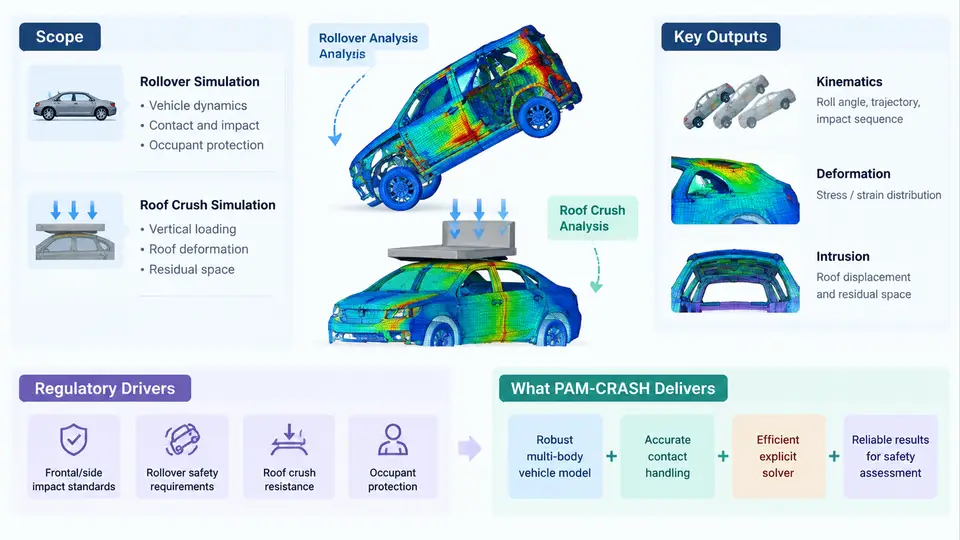
Rollover crashes are among the most severe occupant-protection scenarios in vehicle safety engineering. Although they represent a relatively small fraction of all road accidents, they account for a disproportionately high share of fatalities and serious injuries, largely because the occupant compartment can be crushed or the occupant can be partially or fully ejected. Roof crush simulation exists to predict how the passenger compartment structure deforms when the roof contacts the ground, and to verify that survival space is preserved under standardized loading. This course teaches you how to perform that simulation with PAM-CRASH, from model setup through regulatory evaluation and design iteration.
The scope of the course is deliberately narrow and deep. It covers the explicit finite element workflow for two related but distinct load cases: dynamic rollover, in which a vehicle is launched, rotated, and impacted against a ground plane, and quasi-static roof crush, in which a rigid platen is pushed into the roof at a controlled rate. Both cases share the same structural model, material definitions, and contact logic, but they differ in loading, boundary conditions, and the metrics used to judge pass or fail. By the end of the course you will be able to build, run, debug, and interpret both.
Why roof strength is regulated
Regulatory interest in roof strength grew from field data showing that occupant survival space collapses in rollover. Two rule sets dominate global practice. In the United States, FMVSS 216a (Federal Motor Vehicle Safety Standard 216a) specifies a quasi-static test in which a flat, rigid platen is applied to one side of the roof at a fixed pitch and roll angle. The roof must withstand a force equal to a multiple of the vehicle's unloaded weight — the multiplier depends on vehicle weight — while the platen displacement is limited to a specified travel. In Europe and many other markets, UN ECE R94 and related regulations address occupant protection in frontal impact, while rollover-specific structural requirements appear in FMVSS 216a and in manufacturer-internal standards that often exceed the legal minimum.
The key engineering quantities are therefore force, displacement, and residual survival space. A roof structure passes when it sustains the required force without the platen penetrating beyond a defined limit above the seat reference point. In simulation, these quantities are extracted directly from the platen contact force and the nodal displacement history of the roof structure.
Where PAM-CRASH fits
PAM-CRASH is an explicit finite element solver optimized for crash and impact events. Its explicit time integration scheme advances the solution in small time steps, which makes it well suited to the large deformations, contact, and material failure that characterize roof crush. The solver provides:
- Robust contact algorithms for platen-to-roof and ground-to-body interaction, including penalty-based and kinematic options.
- Material models for sheet steel, aluminum, and composite roof structures, with strain-rate sensitivity and failure criteria.
- Rigid body and constraint tools to represent the platen, the ground plane, and the vehicle's suspension and tires.
- Output requests for force, displacement, energy, and section forces that map directly to regulatory metrics.
The typical workflow is: import or build the vehicle model, define materials and properties, set up contact and boundary conditions, apply the loading, run the explicit solver, and post-process the results. Each of these steps is covered in later chapters. This chapter establishes the mental model and the regulatory context so that every subsequent modeling decision has a clear purpose.
The simulation workflow at a glance
The diagram below shows the relationship between the regulatory requirement, the physical test, and the simulation model. It is not a step-by-step procedure; it is a map of how the pieces connect. The regulatory rule defines the test conditions. The physical test defines the loading and boundary conditions. The simulation model reproduces those conditions in PAM-CRASH, and the output metrics are compared back to the rule.
What you will be able to do
After completing this course, you will be able to set up a PAM-CRASH model for both quasi-static roof crush and dynamic rollover, select appropriate material and contact parameters, run the explicit solver, and extract the regulatory metrics. You will also learn to diagnose common failure modes: contact penetration, hourglassing, non-physical energy growth, and unstable time steps. These are the practical skills that separate a model that runs from a model that predicts.
The course is organized around the actual engineering workflow, not around software menus. Each chapter introduces a concept, shows how it maps to a PAM-CRASH input or setting, and demonstrates the effect on the simulation result. By the end, you will have a complete, reproducible roof crush analysis that you can adapt to your own vehicle program.
Course structure and how to use it
The course is divided into six parts. Part 1 (Chapters 1–4) covers fundamentals: regulatory context, PAM-CRASH solver architecture, explicit time integration, and model preparation. Part 2 (Chapters 5–10) covers material modeling, contact definition, and boundary conditions. Part 3 (Chapters 11–16) covers quasi-static roof crush setup and execution. Part 4 (Chapters 17–22) covers dynamic rollover simulation. Part 5 (Chapters 23–27) covers post-processing, regulatory metrics, and validation. Part 6 (Chapters 28–30) covers advanced topics and a complete worked example.
You should follow the chapters in order if you are new to explicit crash simulation. If you already have PAM-CRASH experience, you can use the chapter summaries and the SVG diagrams as a reference map and jump to the topics you need. Each chapter is self-contained enough to be read on its own, but the modeling decisions build on each other, so the full sequence gives the most coherent picture.
The single most important idea to carry forward is this: a roof crush simulation is not a generic structural analysis. It is a regulatory test reproduced numerically. Every modeling choice — element size, material curve, contact stiffness, loading rate — should be traceable to the physical test condition it represents. Keep that traceability in mind, and the rest of the course will fall into place.