3. Positioning and settling of dummy models
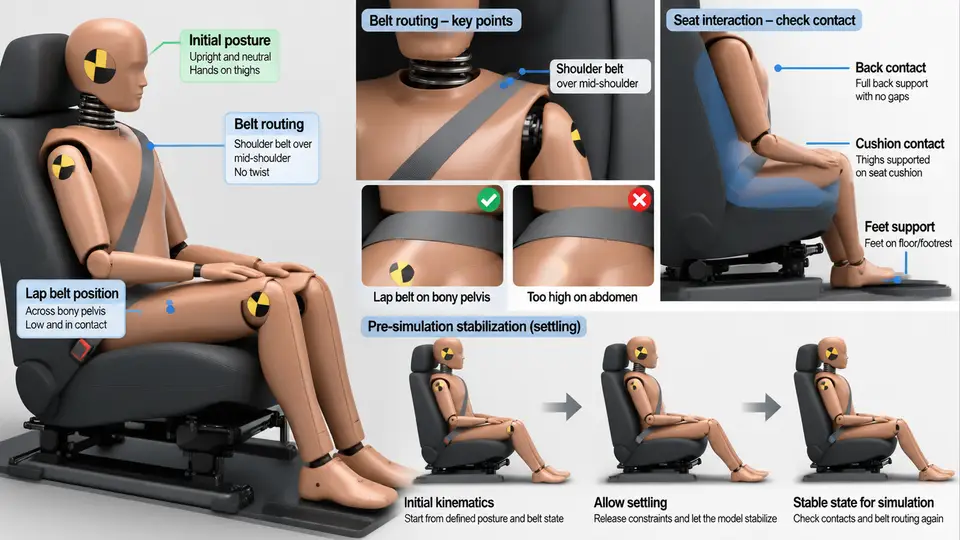
Before any restraint system can be judged, the occupant model must be placed in a state that is physically defensible. In PAM-CRASH, a dummy that is merely dropped into the seat at the nominal H-point will almost always produce a first-contact transient that contaminates the early crash response. Positioning and settling is therefore a distinct pre-simulation phase: it establishes the initial kinematics, resolves belt routing, and lets the dummy reach a stable equilibrium with the seat and restraints before the crash pulse is applied.
Initial Kinematics and Reference Frames
All positioning work depends on a consistent reference frame. The vehicle coordinate system is defined as X forward, Y to the left, Z upward, with the origin at the vehicle datum. The dummy is assembled in its own local frame and then transformed into the vehicle frame through a rigid-body placement. The three placement parameters that matter most are the H-point location, the torso recline angle, and the pelvis rotation about Y.
For a 50th percentile Hybrid III in a driver position, a typical starting set is:
- H-point: X = 1180 mm, Y = 365 mm, Z = 285 mm (example values, vehicle-specific)
- Torso recline: 23° from vertical, measured at the pelvis-to-head axis
- Pelvis angle: 0° nominal, adjusted to match the seat pan inclination
- Head angle: 0° relative to the torso, with the neck at its neutral length
These are starting values only. The seat pan inclination and cushion compression will shift the effective H-point, so the placement must be verified after settling rather than trusted from the CAD nominal.
Seat Interaction and Cushion Penetration
The dummy must contact the seat without initial penetration. In PAM-CRASH this is checked by extracting the minimum distance between the dummy's pelvis/upper-leg surfaces and the seat cushion elements. A negative gap indicates penetration and will generate an artificial contact force at t = 0. The standard remedy is to raise the dummy by the penetration depth and re-run the settling phase, iterating until the maximum penetration is below roughly 1 mm.
Cushion stiffness also matters. A seat foam modeled with a linear elastic law will not compress realistically, so the dummy may appear to float. Using a foam material with a proper unloading curve (for example, a low-density foam with a plateau stress around 0.05–0.15 MPa) produces a more realistic sink-in of 10–25 mm, which then changes the belt geometry.
Belt Routing
Belt routing is the most common source of early-time error. The lap belt must pass over the anterior superior iliac spine (ASIS), not over the soft abdomen. The shoulder belt must cross the chest between the sternum and the clavicle, passing over the shoulder without cutting into the neck.
In PAM-CRASH, belt segments are typically modeled with seatbelt elements or shell strips. The routing procedure is:
- Define the anchor points from the vehicle CAD (retractor, buckle, outboard anchor).
- Create an initial belt path through the slip ring and across the dummy surface.
- Apply a pre-tension of 5–20 N to remove slack without pulling the dummy out of position.
- Check that the belt lies on the intended body landmarks using the contact gap output.
A belt that sits too high on the abdomen will produce excessive submarining in the crash phase; a belt that sits too low on the shoulder will slide off during forward excursion. Both are visible in the settling phase as abnormal belt slip or contact force spikes.
Pre-Simulation Stabilization
Settling is a short dynamic relaxation run. The crash pulse is not applied. Gravity is applied, the belt pre-tension is held, and the dummy is allowed to reach equilibrium. Typical settings:
*CONTROL
  TSTART = 0.0
  TEND   = 0.10 s
  DT     = 1.0e-6 s (initial)
*GRAVITY
  GX = 0.0, GY = 0.0, GZ = -9.81 m/s^2
*DAMPING
  Mass-proportional = 0.05
  Stiffness-proportional = 0.02
The run is judged converged when the kinetic energy falls below 1% of the initial potential energy and the dummy's H-point displacement between consecutive 10 ms windows is less than 0.5 mm. If the dummy continues to slide or oscillate, increase mass-proportional damping or reduce the belt pre-tension.
A common failure symptom is a slow drift of the pelvis forward over the settling window. This usually indicates that the lap belt is too loose or that the seat cushion is too soft. Increasing pre-tension to 15–20 N or stiffening the foam plateau will typically resolve it. A second symptom is head oscillation, which points to an over-stiff neck or a head mass that is not balanced; check the neck element properties and the head center-of-gravity offset.
Verification and Handoff
Once settled, the model is written out as a restart state. The crash phase then starts from this state with the pulse applied. The verification checklist before handoff is:
| Check | Criterion | Output |
|---|---|---|
| Seat penetration | < 1 mm | Contact gap |
| Belt landmark | Lap on ASIS, shoulder on chest | Belt contact force |
| Kinetic energy | < 1% of potential | Energy summary |
| H-point drift | < 0.5 mm / 10 ms | Node displacement |
| Belt tension | 5–20 N stable | Element force |
The settled state should be saved with a clear naming convention, for example dummy_settled_50th_driver_v03.restart, so that the crash run can be traced back to the exact positioning and belt routing used.
The settled restart state is the handoff point between positioning and the crash simulation. If the verification table passes, the crash pulse can be applied with confidence that the early-time response reflects the restraint system rather than a positioning artifact. If any row fails, the iteration loop shown in the diagram should be followed before proceeding.