1. Course overview
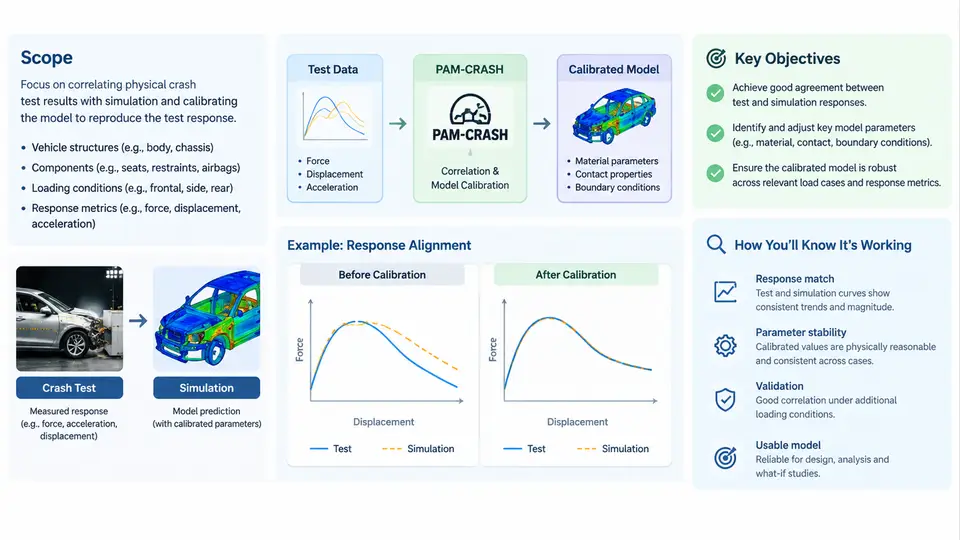
Crashworthiness engineering lives or dies by one question: does the simulation reproduce what the physical test actually did? A finite element model that looks plausible in an animation but misses occupant injury criteria, intrusion targets, or structural failure modes by 20–30% is not a predictive tool — it is an expensive illustration. This course is about closing that gap systematically using PAM-CRASH (ESI Group's explicit dynamic solver, now distributed within the ESI Virtual Performance Solution family) as the simulation engine, and physical crash test data as the ground truth against which the model is judged.
What "Correlation" and "Calibration" Actually Mean
These two terms are often used interchangeably in project meetings, but they describe different activities with different deliverables, and confusing them is one of the most common sources of wasted effort.
Correlation is a comparison and diagnosis activity. You take an existing model, run it under the same boundary and initial conditions as the test, and quantitatively compare simulation output against measured test signals — accelerations, forces, displacements, intrusions, and timing of events. The output of correlation is a verdict plus a diagnosis: how far off is the model, in which channels, at which times, and what physical mechanism is most likely responsible.
Calibration is a modification activity. Based on the correlation diagnosis, you adjust model parameters — material card constants, failure strains, contact definitions, spot-weld or adhesive properties, mesh refinement in critical zones, mass scaling, damping — and re-run until the correlation metrics fall inside an agreed acceptance band. Calibration without correlation is guesswork; correlation without calibration is a report nobody acts on.
The Correlation Workflow at a Glance
The diagram below shows the closed loop that this course builds up chapter by chapter. Note that the loop is not a one-way pipeline: a failed correlation check sends you back to parameter identification, and a physically indefensible parameter set sends you back to the material characterization stage — not to blind numerical tuning.
Why PAM-CRASH Specifically
PAM-CRASH is an explicit finite element solver built for short-duration, high-nonlinearity, contact-dominated events. Its relevance to correlation work comes from several concrete capabilities that this course will use repeatedly:
- Explicit time integration with automatic time-step control. The stable time step is governed by the smallest element and the local wave speed, Δt ≈ Le / c, where c = √(E/ρ) for the elastic case. This matters for correlation because mass scaling — a common trick to raise the time step — directly perturbs the inertia of the model and can shift peak accelerations. Knowing when mass scaling is acceptable and when it invalidates a correlation is a core skill.
- Mature material and failure models. Elasto-plastic metals with strain-rate sensitivity (e.g., Johnson–Cook type formulations), GISSMO and related damage/failure models for ductile fracture, and composite ply-based failure criteria. Calibration of these cards against coupon data is where most of the physical credibility is won or lost.
- Robust contact and connection modeling. Penalty-based and kinematic contact, self-contact, and dedicated spot-weld, seam-weld, and adhesive (cohesive zone) representations. Weld rupture timing is frequently the single largest contributor to correlation error in body-in-white models.
- Native interfaces to test data and post-processing. Direct import of measured channels, filtering to ISO 6487 channel frequency classes (CFC 60 for structural acceleration, CFC 180 or higher for occupant-relevant signals), and side-by-side overlay of simulation and test curves.
Course Objectives
By the end of this course you should be able to do the following, not merely describe them:
- Prepare measured crash test data correctly — apply the appropriate CFC filter, remove sensor zero offset, and align the simulation and test time origins so that phase error is not mistaken for a modeling error.
- Set up a PAM-CRASH deck that reproduces the test's boundary and initial conditions: impact velocity, barrier or pole geometry, sled pulse, gravity, and instrumentation locations mapped to model nodes or rigid bodies.
- Compute and interpret correlation metrics — peak value deviation, time-of-peak shift, area/magnitude error, and a normalized correlation factor — and decide which metric governs acceptance for a given channel.
- Diagnose the physical cause of a mismatch: is the peak too high because of missing strain-rate hardening, too early because of an over-stiff contact, or too low because of premature weld failure?
- Calibrate material, failure, contact, and connection parameters within physically defensible bounds derived from coupon and component tests.
- Document a calibration so that another engineer can reproduce it and judge whether the parameter set is transferable to a different load case.
Scope and Boundaries
This course covers structural crash correlation: full-vehicle frontal and side impacts, sled tests, and component-level tests such as bumper, B-pillar, and door intrusion. It treats occupant restraint system modeling only where it interacts with structural correlation — for example, when a seat or steering column model must be validated before an occupant response can be trusted.
It does not attempt to be a complete PAM-CRASH user manual. Solver keyword syntax is introduced only where it is needed to make a calibration decision concrete. Nor does it cover pedestrian protection, NVH, or durability, which use different correlation criteria and different acceptance bands.
A Concrete Example of the Problem This Course Solves
Consider a 40% offset frontal impact at 64 km/h. The test measures a peak left B-pillar acceleration of 42 g at t = 78 ms, and a maximum dash intrusion of 185 mm. A first PAM-CRASH run predicts 51 g at t = 71 ms and 152 mm intrusion. The peak is 21% high and 7 ms early; the intrusion is 18% low. These are not random errors — the early, high peak combined with low intrusion typically points to a structure that is too stiff early in the event and then loses load path too quickly, often because a weld or a material failure strain is mis-calibrated. The rest of this course gives you the tools to confirm that hypothesis, quantify it, and fix it with parameters you can defend.
The chapters that follow move from test data preparation, through model setup and metric definition, into material and connection calibration, and finally into documentation and transferability. Each chapter is built around a reproducible task so that the techniques can be applied directly to your own correlation projects.