1. Introduction to PAM-CRASH crash model qu
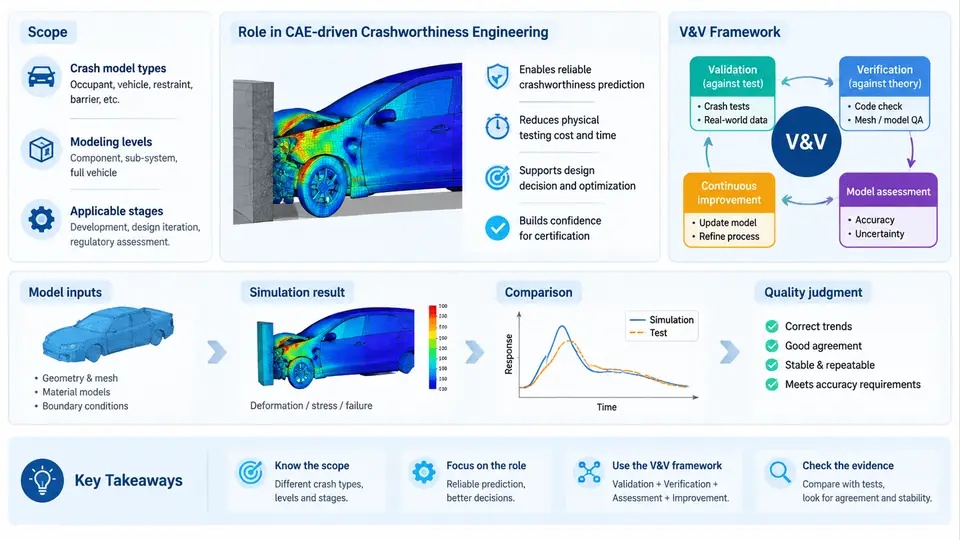
PAM-CRASH is an explicit finite element solver widely used in the automotive industry for simulating vehicle crash events, occupant restraint interactions, and structural energy absorption. Its explicit time-integration scheme advances the solution through very small stable time steps, which makes it well suited to highly nonlinear, contact-dominated, large-deformation problems. However, the credibility of any result produced by such a solver depends almost entirely on the quality of the model that feeds it. A crash model is not merely a mesh and a set of material cards; it is an engineering representation whose assumptions, discretization, connections, and boundary conditions must all be defensible. This chapter establishes the scope of crash model quality and verification, explains why it matters in CAE-driven crashworthiness engineering, and introduces the verification and validation (V&V) framework that structures the rest of this course.
Why Model Quality Determines Result Credibility
In crashworthiness engineering, simulation is used to make decisions that carry real consequences: whether a rail absorbs energy progressively, whether a door remains closed, whether a battery enclosure is breached, or whether a restraint fires at the correct time. These decisions are only as reliable as the model. A common misconception is that a converged explicit run with no error messages is a "good" model. In reality, explicit solvers will happily produce plausible-looking animations from a model with inverted elements, unphysical hourglassing, missing spot welds, or a mass scaling factor that silently changes the physics. Quality assurance is therefore not a post-processing formality; it is the discipline that keeps simulation output connected to physical reality.
Model quality in PAM-CRASH spans several layers. At the geometry layer, it concerns mesh density, element quality, and the fidelity of the CAD-to-mesh conversion. At the connection layer, it concerns spot welds, adhesives, bolts, seams, and their failure criteria. At the material layer, it concerns the constitutive models, strain-rate dependence, failure strains, and the calibration data behind them. At the setup layer, it concerns contact definitions, initial velocities, boundary conditions, and control parameters such as time step and mass scaling. At the correlation layer, it concerns how the model is compared against physical tests. Verification and validation touch all of these layers.
The Role of V&V in CAE-Driven Crashworthiness
Verification and validation are related but distinct activities. Verification asks, "Are we solving the equations correctly?" It is a mathematics-and-software question: does the code implement the intended formulation, does the mesh converge, are the time step and energy balance consistent, and are there numerical artifacts such as hourglass energy or negative volumes? Validation asks, "Are we solving the right equations?" It is a physics question: does the model reproduce the physical test within an accepted tolerance, and is the comparison meaningful given the test's own uncertainty?
In a CAE-driven development program, V&V provides the evidence trail that allows a simulation result to be trusted for a specific decision. Without it, CAE becomes an expensive animation generator. With it, CAE can reduce prototype builds, guide design direction, and support regulatory submissions. The framework used throughout this course follows the standard decomposition: define the intended use, characterize the physical system, build and verify the model, validate against test data, quantify uncertainty, and document the credibility evidence. Each of these steps produces artifacts that a reviewer or regulator can inspect.
The V&V Framework at a Glance
The framework can be understood as a sequence of credibility-building activities, each with its own inputs, outputs, and acceptance criteria. The figure below shows the relationship between the physical test, the simulation model, and the verification and validation loops that connect them.
What "Quality" Means in Practice
In day-to-day PAM-CRASH work, model quality is judged through a set of observable indicators. These are not abstract ideals; they are quantities you can extract from the solver output and the input deck. The table below summarizes the most important ones and the typical symptoms that indicate a problem.
| Quality Indicator | What to Check | Typical Warning Sign |
|---|---|---|
| Element quality | Jacobian, warpage, aspect ratio, minimum angle | Solver terminates with negative volume or excessive distortion |
| Time step stability | Smallest element size, mass scaling factor, added mass percentage | Added mass > 1–2% of total model mass; results shift noticeably |
| Energy balance | Hourglass energy, internal energy, kinetic energy, sliding interface energy | Hourglass energy exceeds ~5% of internal energy |
| Contact behavior | Penetration depth, contact thickness, friction coefficients | Visible interpenetration or unphysical sliding |
| Connection integrity | Spot weld failure forces, adhesive traction-separation | Connections fail immediately or never fail |
| Correlation metrics | Peak force, intrusion, acceleration pulse, timing | Good visual match but large peak or timing error |
A Reproducible First Check: Energy Balance in a PAM-CRASH Run
Before any correlation work, a verified model must satisfy basic numerical health checks. A practical first step is to inspect the energy summary that PAM-CRASH writes to the output file. The following example shows the kind of values you would look for in a simple frontal impact model. These numbers are illustrative and represent a reasonable target range, not a measured result from a specific test.
ENERGY SUMMARY (illustrative example, not measured data)
  Internal energy (IE)        : 42.5 kJ
  Kinetic energy (KE)         :  3.1 kJ
  Hourglass energy (HE)       :  0.9 kJ
  Sliding interface energy    :  1.4 kJ
  Added mass                  :  0.8 % of total mass

  HE / IE ratio               :  2.1 %   -> acceptable (< 5 %)
  Added mass                  :  0.8 %   -> acceptable (< 2 %)
  Total energy drift          :  1.3 %   -> acceptable (< 5 %)
If the hourglass energy ratio exceeds roughly 5%, the first response is not to accept the result but to investigate: refine the mesh in the affected region, switch to a fully integrated element formulation where appropriate, or adjust the hourglass control. If added mass exceeds 2%, the mass scaling is altering the inertia of the structure and the result may no longer represent the intended physical event. These checks are fast, objective, and independent of any test data, which is exactly what makes them verification activities.
Scope of This Course
This course covers the full V&V workflow for PAM-CRASH crash models: mesh and element quality, material and connection modeling, contact and boundary condition setup, numerical stability checks, test correlation methods, uncertainty quantification, and documentation for review. The goal is not to memorize a checklist but to develop the judgment to decide when a model is fit for its intended use and when it is not. Each subsequent chapter builds on the framework introduced here, moving from verification fundamentals to validation practice and finally to credibility documentation.
By the end of this course, you should be able to inspect a PAM-CRASH input deck and identify the quality-critical parameters, run and interpret verification checks, design a validation comparison against physical test data, and produce a credibility argument that a reviewer can follow. The first step is understanding that model quality is not a single property but a layered, evidence-based claim—and that claim begins with the V&V framework.