3. Side impact loading mechanisms
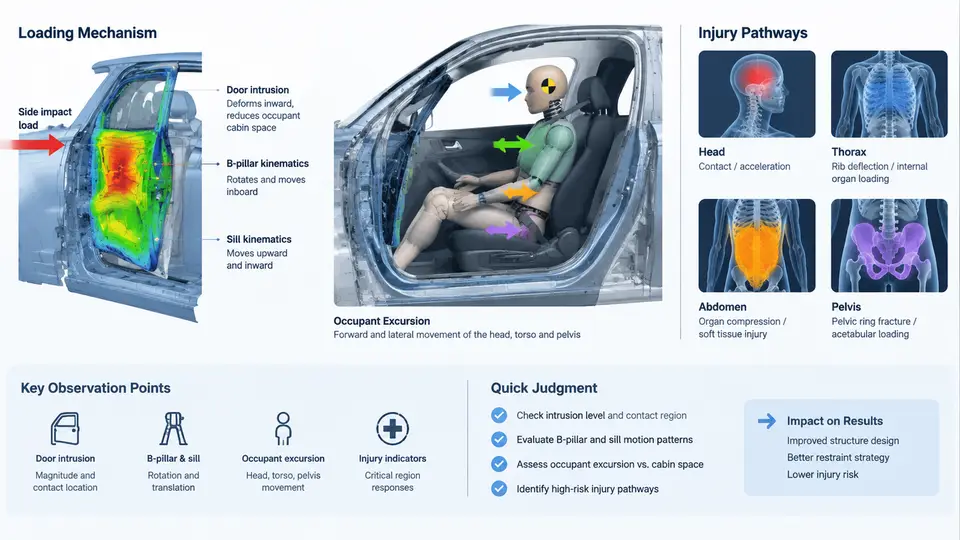
In a side impact, the striking vehicle or barrier transfers energy into the struck vehicle over a very short distance and time. Unlike frontal crashes, where a long crumple zone and restraint systems can manage deceleration, the lateral load path is short: the door outer panel, door beam, B-pillar, sill, roof rail, and floor structure must absorb and redirect energy before it reaches the occupant. Understanding this load path is essential for building a credible MADYMO side impact model, because the model must reproduce not only the vehicle's global motion but also the local deformation that drives occupant loading.
Door Intrusion and the Lateral Load Path
Door intrusion is the inward displacement of the door assembly into the occupant compartment. It is driven by the barrier or bullet vehicle contacting the outer door panel, which then loads the door beam (side impact protection beam), the door inner panel, and the beltline. The door beam transfers load to the B-pillar and the front and rear door hinges/latches, while the door inner panel and trim contact the occupant's pelvis, abdomen, and thorax. In MADYMO, this is typically represented by a combination of rigid or deformable door geometry, a beam element or prescribed intrusion curve, and contact definitions between the door trim and the occupant's finite element or facet body regions.
A practical modeling approach is to prescribe the door intrusion as a time-dependent displacement boundary condition derived from a physical sled or full-vehicle test, rather than simulating the full barrier contact. For example, a door inner panel intrusion pulse might be defined as a piecewise linear curve reaching 120 mm at 40 ms and 180 mm at 70 ms, with the peak velocity occurring between 20 ms and 45 ms. This pulse is applied to the door trim surface, and the occupant model interacts with it through contact. The key check is that the simulated door-to-occupant contact force and the resulting occupant kinematics match the test corridor.
B-Pillar and Sill Kinematics
The B-pillar is the primary vertical load-carrying member on the struck side. Its kinematics are characterized by translation (inward displacement), rotation (bending about the longitudinal axis), and local buckling. The sill (rocker panel) provides the lower lateral load path and often undergoes bending and torsion. Together, the B-pillar and sill define the boundary conditions for the door and the seat, and therefore strongly influence occupant excursion.
In a MADYMO model, the B-pillar and sill are often represented as rigid bodies with prescribed motion or as flexible bodies with modal or finite element representation. If the focus is occupant response rather than structural failure, prescribing the B-pillar and sill motion from test data is efficient and robust. The prescribed motion should include both the inward translation and the rotation, because rotation changes the effective intrusion direction at different heights. For instance, at the beltline the B-pillar may move inward 150 mm with 8° rotation, while at the sill the inward displacement may be 60 mm with negligible rotation. This height-dependent motion is what produces the characteristic "door wedge" intrusion profile.
Occupant Excursion and Interaction with the Restraint System
Occupant excursion in side impact is the lateral displacement of the occupant relative to the vehicle interior. It is driven by the intruding door and by the occupant's own inertia. Because the struck-side occupant is initially in contact with or very close to the door trim, the available ride-down distance is small. The occupant's pelvis, abdomen, and thorax are loaded sequentially as the door intrudes, and the head may strike the door glass, B-pillar, or the intruding roof rail.
In MADYMO, occupant excursion is controlled by the initial seating position, the contact stiffness between the occupant and the door trim, the seat belt and side airbag (if present), and the friction between the occupant and the seat. A typical side impact model uses a facet occupant model with contact characteristics calibrated to cadaver or dummy test data. The side airbag, if modeled, is represented as a gas-filled volume with a defined deployment timing and venting behavior. The timing of airbag deployment relative to door intrusion is critical: if the airbag deploys too late, the occupant has already moved into the intrusion zone; if it deploys too early, it may be pushed aside by the intruding door.
Injury Pathways to Head, Thorax, Abdomen, and Pelvis
Injury pathways in side impact are region-specific and are strongly influenced by the local intrusion velocity and the contact area. The table below summarizes the primary loading mechanisms and the corresponding MADYMO output variables used for assessment.
| Body Region | Primary Loading Mechanism | Key MADYMO Output | Typical Injury Threshold (Example) |
|---|---|---|---|
| Head | Contact with intruding B-pillar, roof rail, or glass; rotational acceleration from door trim contact | HIC36, resultant head acceleration, angular velocity | HIC36 = 700 (moderate); 1000 (serious) |
| Thorax | Compression by door trim and armrest; rib deflection and viscous loading | Rib deflection, VC (viscous criterion), chest compression | Deflection = 42 mm; VC = 1.0 m/s |
| Abdomen | Compression between door trim and spine; loading of liver, spleen, and kidneys | Abdominal compression, force-deflection | Compression = 65 mm (example) |
| Pelvis | Direct loading by door trim and armrest; pubic symphysis and acetabulum loading | Pelvic force, pubic force, acetabular force | Pelvic force = 4 kN (example) |
The head injury pathway is often dominated by the B-pillar and roof rail intrusion, especially in high-severity impacts. The thorax is loaded by the door trim and armrest, and the rib cage deflection is a strong predictor of injury. The abdomen is vulnerable because the door trim can compress the abdominal cavity against the spine, and the pelvis is loaded directly by the door trim and armrest. In MADYMO, these pathways are captured by defining contact between the occupant's body regions and the intruding structures, and by using appropriate contact stiffness and damping. The modeler should check that the contact forces and deflections are physically plausible and consistent with the prescribed intrusion.
Practical Modeling Considerations and Verification
When building a MADYMO side impact model, the following checks help ensure that the loading mechanisms are correctly represented. First, verify the initial gap between the door trim and the occupant's body regions. A gap that is too large will delay contact and underpredict injury; a gap that is too small will overpredict early loading. Second, check the intrusion pulse against the test data: the peak intrusion, time to peak, and residual intrusion should match the physical test within a reasonable tolerance (typically ±10% for peak intrusion and ±5 ms for timing). Third, verify that the contact stiffness between the occupant and the door trim is calibrated to the correct body region; using a single stiffness for all regions is a common error. Fourth, check the side airbag deployment timing and venting: the airbag should be fully deployed before the occupant's thorax reaches the intrusion zone, and the venting should allow the airbag to absorb energy without becoming a rigid barrier.
A useful verification exercise is to run a baseline simulation with a prescribed intrusion pulse and compare the occupant response to a known test corridor. If the head acceleration is too low, check whether the head is contacting the B-pillar or roof rail; if the thorax deflection is too high, check the door trim contact stiffness and the airbag pressure. If the pelvis force is too low, check the initial gap and the armrest geometry. These checks are iterative and should be performed systematically.
In summary, side impact loading in MADYMO is a chain of events: barrier contact produces door intrusion, which loads the B-pillar and sill, which in turn drives occupant excursion and region-specific injury. By prescribing realistic intrusion and B-pillar/sill kinematics, defining accurate contact between the occupant and the intruding structures, and verifying the model against test data, the simulation can provide reliable predictions of head, thorax, abdomen, and pelvis injury risk. The next step is to apply these mechanisms in a full side impact model with a validated occupant and restraint system.