1. Introduction to MADYMO for seatbelt and
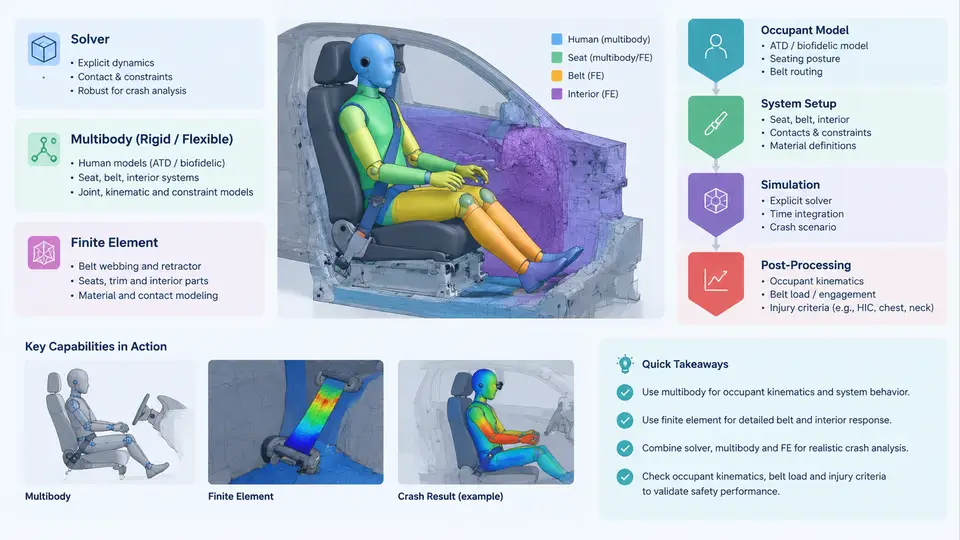
MADYMO (Mathematical Dynamic Model) is a dedicated multi-body and finite element solver developed by TASS International (now part of Siemens) for occupant safety simulation. In seatbelt and crash analysis, it serves as the numerical engine that predicts how a restraint system interacts with an occupant during a collision event. Unlike general-purpose FEA packages, MADYMO was designed from the ground up around the specific physics of restraint-occupant interaction: belt routing over deformable bodies, retractor locking, pretensioner firing, load limiter slip, airbag deployment, and contact between the occupant and interior structures. Understanding what the solver offers — and where its two modeling paradigms diverge — is the foundation for every subsequent modeling decision in this course.
Two Modeling Paradigms: Multibody and Finite Element
MADYMO provides two complementary formulations that can be coupled within a single model:
- Multibody (MB) — Rigid bodies connected by kinematic joints (revolute, translational, spherical, universal, free). Each body carries mass and inertia; joints constrain relative motion. Contact is handled through ellipsoid-based force-penetration models. MB models are computationally cheap, numerically robust, and ideal for representing the occupant's gross kinematics, belt routing, and restraint system components.
- Finite Element (FE) — Deformable meshes using shell, solid, membrane, and beam elements with material models ranging from linear elastic to hyperelastic and viscoelastic. FE captures local deformation: belt stretching, airbag fabric folding, knee bolster crushing, and structural intrusion. FE models are more expensive but necessary when local deformation drives injury metrics.
The coupling is a defining strength of MADYMO. A typical seatbelt model uses MB ellipsoids for the occupant skeleton, FE shell elements for the belt webbing, and MB joints for the retractor and buckle. The belt slides over MB ellipsoids via a penalty-based contact algorithm, while the webbing itself stretches according to its FE material definition. This hybrid approach gives the accuracy of FE where it matters and the speed of MB everywhere else.
Solver Architecture and Key Components
MADYMO's solver is an explicit time-integration scheme. The central components relevant to seatbelt and crash analysis are:
| Component | Role in Seatbelt/Crash Analysis | Typical Input |
|---|---|---|
| MB bodies & joints | Occupant skeleton, seat structure, belt anchor points | Mass, inertia, joint type, initial position |
| FE elements | Belt webbing, airbag fabric, deformable interior | Mesh, material card, thickness |
| Contact models | Belt-to-occupant, occupant-to-interior, belt-to-belt | Ellipsoid pairs, FE surface definitions, friction |
| Restraint components | Retractor, pretensioner, load limiter, buckle | Locking curve, firing time, force-displacement |
| Acceleration field | Crash pulse applied to vehicle environment | Time-history table (g vs. ms) |
The solver advances in discrete time steps. At each step it computes contact forces, updates joint positions, integrates velocities and accelerations, and writes state data to the result file. The time step is governed by the smallest element or stiffest contact in the model; for a typical belt model with 5–10 mm shell elements, stable time steps fall in the 1–5 µs range. A 120 ms crash pulse therefore requires roughly 24,000–120,000 steps — a runtime of minutes to hours depending on model complexity.
Typical Occupant Safety Workflow
A complete MADYMO seatbelt study follows a repeatable sequence. The diagram below shows the data flow and the key decision points where the analyst chooses between MB and FE representations.
The workflow begins with model inputs: occupant geometry (typically a Hybrid III 50th percentile male MB ellipsoid set), belt routing defined by anchor points and slip rings, and the crash pulse. The restraint system is then parameterized — retractor locking threshold, pretensioner firing time (commonly 10–20 ms after t=0), and load limiter force level (typically 3–6 kN for a front occupant). The solver executes the explicit integration, and results are post-processed for belt force, chest deflection, and injury criteria such as HIC15 and chest compression.
The decision diamond in the diagram captures a critical engineering judgment: if local deformation drives the injury metric, the MB representation must be refined with FE elements. For example, if chest deflection predicted by MB ellipsoid contact exceeds 50 mm, the analyst should replace the chest ellipsoid with a deformable FE rib cage to capture the actual force-deflection response. If the MB result is within acceptable margins, the faster MB model can proceed to validation.
Practical Example: A 50 km/h Frontal Belt Model
Consider a baseline MADYMO model for a 50 km/h frontal impact with a three-point belt. The key inputs are:
Occupant: Hybrid III 50th MB ellipsoid set (mass 78 kg)
Belt: FE shell, 2-node membrane, thickness 1.2 mm
  Material: linear elastic, E = 3.5 GPa, density = 1.15e-6 kg/mm³
Retractor: locking at 0.5 g vehicle deceleration
Pretensioner: pyrotechnic, firing at t = 12 ms, stroke 60 mm
Load limiter: force limit 4.0 kN, slip after 2 kN
Crash pulse: 50 km/h, 0–120 ms, peak 35 g at 45 ms
Contact: belt-to-occupant friction μ = 0.3
Time step: 2 µs (governed by belt shell element size 8 mm)
Running this model produces a belt force time history that peaks around 4.5 kN at 55 ms, chest deflection of 38 mm, and HIC15 of approximately 620. These values are illustrative and depend on exact geometry and material calibration. The analyst checks three things: (1) does the belt force plateau at the load limiter setting? (2) does chest deflection stay below 50 mm? (3) does the occupant kinematics show the head missing the airbag or contacting it at the correct time? If the belt force spikes above the limiter setting, the load limiter model is likely too stiff or the belt is locking prematurely. If chest deflection is excessive, the pretensioner timing or belt routing may need adjustment.
Why MADYMO for Seatbelt Work?
Three characteristics make MADYMO particularly suited to seatbelt and crash analysis. First, its MB–FE coupling allows the belt to be modeled as a deformable FE structure while the occupant remains a fast MB assembly — a balance that pure FE codes struggle to match in runtime. Second, its contact algorithms are tuned for the specific geometry of belt-over-body interaction, including slip and friction along the belt path. Third, its restraint component library (retractor, pretensioner, load limiter, buckle) is built in, so the analyst does not need to script these behaviors from scratch. The result is a workflow that can go from model setup to injury metric in hours rather than days, which is essential for the iterative design studies typical of restraint system development.
With this foundation — the solver's dual formulation, its component architecture, and the standard workflow — the next step is to build the occupant model itself. That begins with the multibody ellipsoid representation and the kinematic joints that define how the occupant can move.