1. MADYMO in restraint system development
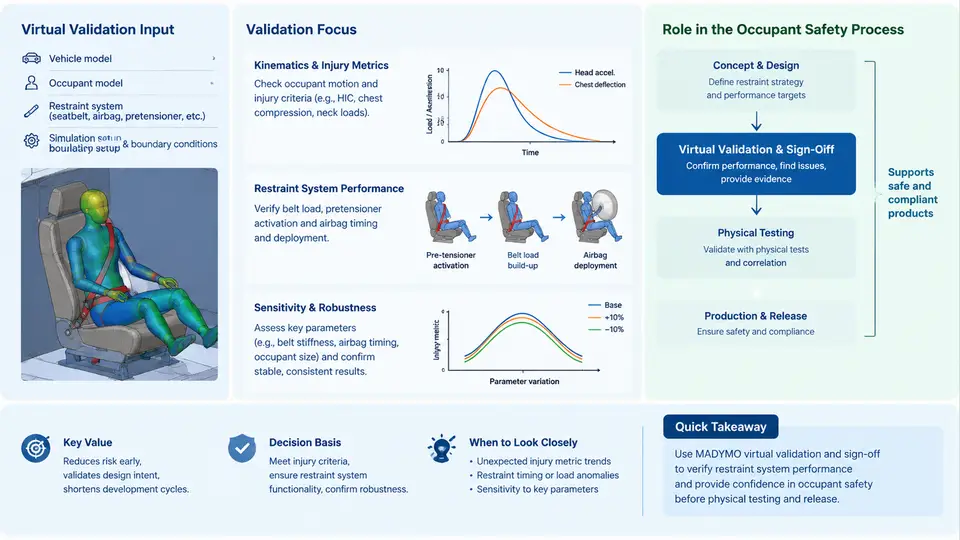
In modern occupant safety engineering, the restraint system — airbags, seat belts, pretensioners, load limiters, and the seat structure that anchors them — must be proven to protect occupants across a wide range of crash scenarios before a single physical prototype is built. MADYMO (Mathematical Dynamic Model), now part of the TASS International / Siemens Simcenter portfolio, has served for decades as the industry-standard tool for this task. It is a multibody-plus-FE solver specialized in occupant kinematics, and it occupies a specific and well-defined place in the safety development process: it is the tool that converts a crash pulse and a restraint design into a predicted injury outcome, and it is the evidence base on which a restraint system is signed off.
Why Virtual Validation Exists
A full-vehicle frontal crash test costs tens of thousands of dollars and consumes a vehicle. A sled test is cheaper but still requires a buck, a seat, and a full restraint build. Multiply that by the dozens of load cases a modern program must cover — frontal ODB, full frontal rigid barrier, MPDB, side pole, side MDB, rear impact, rollover, out-of-position (OOP) airbag deployment, and low-risk deployment (LRD) — and physical testing alone becomes economically and temporally impossible. Virtual validation with MADYMO allows the restraint engineer to evaluate hundreds of design variants in the time it takes to run a handful of sled tests, and to do so at a level of detail (belt force time histories, head-to-airbag contact pressure, chest deflection) that physical instrumentation can only partially capture.
The role of MADYMO is therefore not to replace physical testing but to front-load the decision-making. The physical test then becomes a confirmation of a design that has already been optimized virtually, rather than a discovery exercise.
Where MADYMO Sits in the Occupant Safety Process
The restraint development workflow typically proceeds through a sequence of model fidelity levels, each with a distinct purpose:
- Concept phase: A simplified multibody occupant model (rigid bodies for head, thorax, pelvis, and limbs, connected by joints) is coupled to a lumped restraint model. Belt is represented as a spring-damper or a 1D belt element; airbag as a uniform-pressure or simple gas-flow model. The goal is to establish the restraint architecture — belt routing, airbag volume, vent size, tether configuration — and to screen concepts.
- Design phase: The occupant model is refined with deformable FE components (a detailed thorax, a facet head, a deformable pelvis). The airbag becomes an FE mesh with a validated gas flow model (uniform pressure, hybrid, or CFD-coupled). The belt becomes a full FE belt with slip rings and retractor. This is where restraint parameters are tuned against sled test data.
- Sign-off phase: The validated model is run across the full load-case matrix, with statistical or worst-case occupant positioning, to demonstrate compliance with regulatory and consumer-test criteria (FMVSS 208, ECE R94/R95, Euro NCAP, C-NCAP). The model must be correlated to physical tests within an agreed tolerance before it can be used as sign-off evidence.
The critical concept here is model correlation and validation. A MADYMO model is not trusted because it is detailed; it is trusted because its predictions have been compared against physical test results and shown to fall within an accepted corridor. Typical correlation targets for a frontal occupant model are: head resultant acceleration peak within ±10%, chest deflection peak within ±15%, belt force peak within ±10%, and head excursion within ±20 mm. Until these are met, the model is a design tool, not a sign-off tool.
The Sign-Off Decision and Its Evidence
Sign-off is a formal engineering judgment: the restraint system is declared compliant for a given load case and occupant population. In a MADYMO-based sign-off, the evidence package typically contains:
| Evidence item | Purpose | Typical acceptance basis |
|---|---|---|
| Correlated baseline model | Demonstrates predictive capability | Within correlation corridors vs. sled test |
| Load-case matrix results | Covers regulatory and consumer scenarios | All criteria met with margin |
| Robustness study | Accounts for occupant and build variation | Worst-case still passes |
| Sensitivity analysis | Identifies critical parameters | No cliff-edge behavior |
| Physical test confirmation | Final validation of the design | Test result within model prediction band |
The robustness study deserves emphasis. A restraint system that passes with a 50th-percentile Hybrid III in the nominal seating position but fails with a 5th-percentile female or an out-of-position occupant is not signable. MADYMO's speed makes it practical to run a Design of Experiments (DoE) or Monte Carlo study over occupant size, seat position, belt anchorage location, and airbag inflator output, and to identify the parameter combinations that produce the worst injury metrics.
How the Workflow Actually Runs
A concrete frontal driver-side example illustrates the loop. The input is a vehicle-specific crash pulse (deceleration vs. time, typically 0–150 ms) applied to the MADYMO model's vehicle reference frame, plus the restraint definition. The model is run, and the engineer inspects:
- Head acceleration (3 ms clip): compared against the FMVSS 208 limit of 80 g.
- Chest deflection: compared against the 63 mm limit (or the Euro NCAP 42 mm "low risk" threshold).
- Femur force: compared against the 10 kN limit.
- Head excursion: compared against the 813 mm (or 711 mm with belt) requirement.
- Nij / HIC: computed from the head and neck time histories.
If a metric exceeds its limit, the engineer adjusts restraint parameters — vent hole diameter, tether length, belt force limiter level, pretensioner firing time — and re-runs. The iteration is fast: a typical frontal occupant model runs in minutes to a few hours depending on FE content. Once all metrics pass with margin, the model is frozen and the physical confirmation test is scheduled.
The Validation Loop Visualized
The diagram below shows how MADYMO sits between the design inputs and the sign-off decision, and how physical testing closes the loop.
What Makes a MADYMO Sign-Off Defensible
Three properties separate a defensible virtual sign-off from an optimistic simulation exercise. First, traceability: every input parameter — pulse, belt stiffness, airbag vent area, friction coefficient — must be traceable to a measured or supplier-specified value, not a tuning knob chosen to make the result pass. Second, conservatism: where a parameter is uncertain, the sign-off case should use the value that produces the worse injury outcome, or the uncertainty must be covered by a robustness study. Third, correlation: the model must have been validated against at least one physical test of the same restraint architecture, and the correlation must be documented with time-history overlays, not just peak-value comparisons.
When these three properties hold, the MADYMO model becomes more than a design aid — it becomes the primary evidence for restraint system sign-off, with physical testing serving as confirmation. This is the operating model that the remainder of this course builds on: the following chapters will develop the model-building, correlation, load-case definition, and robustness techniques that make such a sign-off possible.