3. Pedestrian human body models in MADYMO
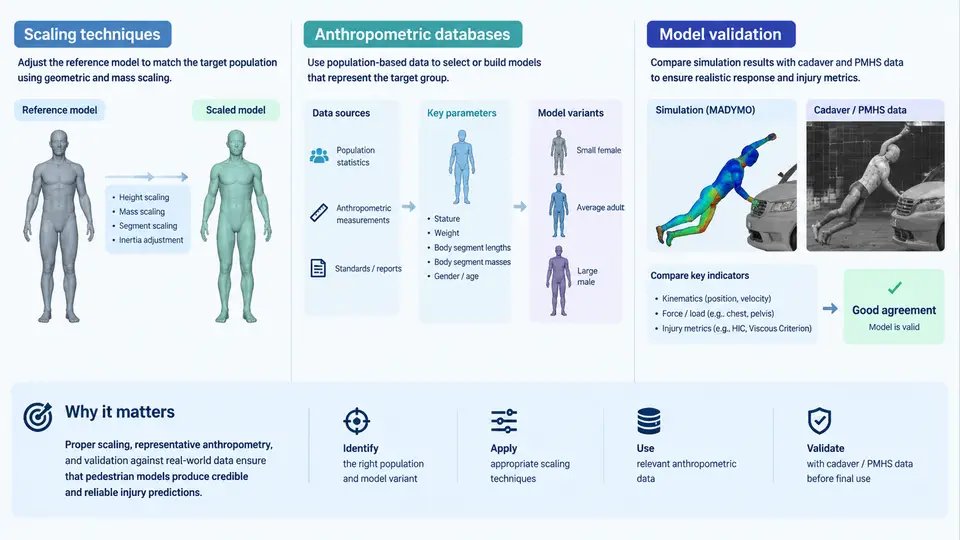
MADYMO does not ship a single "pedestrian dummy." Instead, it provides a family of facet and multibody human body models that can be scaled, positioned, and validated for specific impact scenarios. This section explains how those models are constructed, how scaling techniques adapt them to different anthropometries, which anthropometric databases supply the target dimensions, and how the resulting models are validated against cadaver and PMHS (Post-Mortem Human Subject) test data.
Model Families and Their Structure
MADYMO pedestrian models fall into two broad categories. Multibody (MB) models represent the body as rigid segments connected by kinematic joints with defined stiffness and damping characteristics. They are computationally cheap and well suited to parameter sweeps, but they cannot predict local bone fracture or soft-tissue injury. Facet models discretize the body surface and internal structures into triangular facet elements with contact stiffness, enabling prediction of contact forces, head acceleration, and bone loading. The PedFacet and PedMB model families are the standard starting points.
A typical facet pedestrian model contains separate parts for the head, neck, thorax, abdomen, pelvis, upper and lower extremities, each with assigned material properties and contact definitions. The head, for example, is modeled as a rigid shell with a deformable scalp layer; the thorax includes rib cage facets with stiffness derived from cadaver rib testing. These part-level properties are not arbitrary — they trace back to specific PMHS experiments, which is why validation is inseparable from model construction.
Scaling Techniques
Because the baseline model represents one specific anthropometry (often a 50th percentile male), scaling is required to study children, small females, or large males. MADYMO supports several scaling approaches:
- Geometric scaling — uniform or non-uniform scaling of segment dimensions based on ratios of target-to-baseline body dimensions. A scaling factor for a given segment is computed as the ratio of the target segment length to the baseline segment length.
- Mass scaling — segment masses are scaled by the ratio of target total body mass to baseline total body mass, distributed across segments according to anthropometric mass distribution data.
- Stiffness scaling — contact and joint stiffness values are adjusted using scaling laws. For bone, stiffness typically scales with cross-sectional area (length squared), while mass scales with volume (length cubed).
- Non-linear scaling — for pediatric models, simple linear scaling is insufficient because children's proportions change non-uniformly with age. MADYMO allows segment-specific scaling factors derived from growth data.
The scaling relationship for a segment can be expressed as:
lambda_L = L_target / L_baseline          (length scaling factor)
lambda_M = M_target / M_baseline          (mass scaling factor)
lambda_K = lambda_L^2                     (stiffness scaling, area-based)
lambda_D = lambda_L^3                     (density/volume scaling)
In practice, you apply these factors through the SCALE keyword or via the model's built-in scaling utility. A common pitfall is applying uniform scaling to the head when the target subject has a different head-to-body ratio — this produces unrealistic head mass and inertia, which directly affects head injury criteria (HIC) predictions.
Anthropometric Databases
Scaling targets come from established anthropometric databases. The most frequently used in pedestrian safety are:
| Database | Population | Key Dimensions |
|---|---|---|
| ANSUR II | US military | Stature, segment lengths, circumferences |
| NHANES | US civilian | Stature, weight, BMI distribution |
| CAESAR | US/European civilian | 3D body scans, surface geometry |
| GEBOD | Generic | Segment mass, inertia, center of mass |
GEBOD (Generator of Body Data) is particularly relevant because it provides regression equations that generate segment masses, moments of inertia, and center-of-mass locations as functions of stature, weight, and gender. MADYMO's scaling utility can ingest GEBOD-derived targets directly. For a 50th percentile adult male, GEBOD predicts a total body mass of approximately 78 kg and stature of 175 cm; for a 5th percentile female, approximately 50 kg and 152 cm. These targets then drive the scaling factors applied to the baseline model.
Validation Against Cadaver and PMHS Data
Validation is the process of demonstrating that the scaled model reproduces the biomechanical response observed in physical tests. The gold standard is comparison against PMHS experiments, which provide force-deflection curves, acceleration time histories, and fracture thresholds.
Key validation datasets for pedestrian models include:
- Head impact: Nahum et al. (1977) and Yoganandan et al. — intracranial pressure and skull fracture force data from cadaver head impacts.
- Thorax impact: Kroell et al. (1971) — chest deflection and force time histories from cadaver thorax impacts at various velocities.
- Pelvis and lower extremity: Cavanaugh et al. and Kerrigan et al. — pelvis force-deflection and knee ligament failure thresholds.
- Full-body pedestrian: EEVC WG17 and subsequent PMHS pedestrian impact tests, providing head, thorax, and lower limb responses in realistic vehicle impact configurations.
Validation metrics typically include peak force, peak deflection, time-to-peak, and the shape of the force-deflection curve. A common quantitative measure is the CORA (CORrelation and Analysis) score, which combines corridor, cross-correlation, and phase-shift components into a single rating. A CORA score above 0.7 is generally considered acceptable for pedestrian model validation.
Practical Workflow: Scaling and Validating a Model
Consider a study requiring a 5th percentile female pedestrian model. The workflow proceeds as follows:
- Select the baseline model (e.g.,
PedFacet_50M) and extract its segment dimensions, masses, and inertias. - Query GEBOD or the chosen anthropometric database for the target 5th percentile female dimensions: stature 152 cm, mass 50 kg, and segment-level targets.
- Compute scaling factors per segment. For the head, if the baseline head mass is 4.5 kg and the target is 3.6 kg, the mass scaling factor is 0.80; the corresponding length factor is 0.80^(1/3) ≈ 0.928.
- Apply scaling via the model's scaling utility, adjusting geometry, mass, inertia, and contact stiffness.
- Run a validation simulation replicating a known PMHS test — for example, a lateral thorax impact at 4.3 m/s — and compare the predicted chest deflection against the experimental corridor.
- Compute CORA scores for each body region. If any region falls below 0.7, adjust the scaling assumptions (e.g., use non-linear scaling for the thorax) and re-run.
The observable verification criteria are the CORA scores and the visual overlay of predicted versus experimental curves. Typical failure symptoms include: head acceleration peaks that are too high (indicating over-stiff head contact), chest deflection that is too low (indicating over-stiff thorax), or phase shifts in the force time history (indicating incorrect mass distribution). Each symptom points to a specific scaling parameter that needs adjustment.
Key Considerations for Model Selection
When choosing between multibody and facet models, consider the injury metric you need. For HIC and head acceleration, a facet head model is essential. For lower extremity injury risk (tibia/fibula fracture, knee ligament rupture), facet models with bone stiffness are required. For gross body kinematics and throw distance, a multibody model may suffice and runs orders of magnitude faster.
Validation against PMHS data is not merely a formality — it is the only way to establish confidence in the model's predictive capability. A model that has not been validated for the specific impact configuration and anthropometry you are studying should be treated as a hypothesis generator, not a predictive tool. Always document the validation status, the CORA scores achieved, and the specific PMHS datasets used, so that downstream users understand the model's limitations.
Summary of key parameters for a 5th percentile female pedestrian model:
- Stature: 152 cm, Total mass: 50 kg
- Head mass scaling factor: 0.80, Length factor: 0.928
- Thorax stiffness scaling: λ_K = λ_L² ≈ 0.861
- Validation target: CORA ≥ 0.7 against Kroell thorax and Nahum head PMHS data
- Typical failure symptom: over-stiff thorax → chest deflection below experimental corridor → reduce λ_K