1. Introduction to pedestrian impact simula
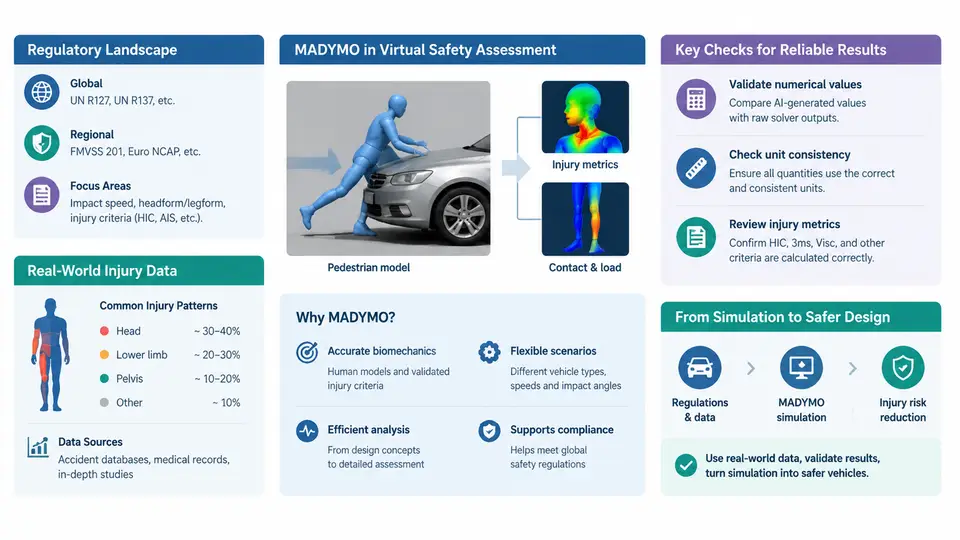
Pedestrian protection is one of the most demanding problems in vehicle safety engineering. Unlike an occupant, a pedestrian is unconstrained, unalerted, and interacts with the vehicle across a wide range of impact geometries. The vehicle front-end must therefore be designed to manage energy transfer to a standing human body whose posture, stature, and walking gait vary from case to case. Virtual simulation is the only practical way to evaluate this variability early in a vehicle program, and MADYMO — the Mathematical Dynamic Model software — has become one of the most widely used tools for that purpose. This chapter establishes the regulatory and epidemiological context, then explains where MADYMO fits in the virtual safety assessment workflow.
1.1 The Regulatory Landscape
Two regulatory families dominate pedestrian protection worldwide. The United Nations Regulation No. 127 (UN R127, formerly UN R127/00 and the older ECE R127 lineage) and the Global Technical Regulation No. 9 (GTR No. 9) define a set of subsystem impact tests using impactors that represent the adult and child head, the upper leg, and the lower leg. The European New Car Assessment Programme (Euro NCAP) applies a stricter, scoring-based version of the same test matrix, and since 2023 it has added active-bonnet and vulnerable-road-user (VRU) scenarios to its protocol.
The core subsystem tests are:
- Head impact — a 4.5 kg adult headform or 3.5 kg child headform is fired at the bonnet top and windscreen area at 35 km/h (GTR No. 9) or 40 km/h (Euro NCAP). The Head Injury Criterion (HIC) is computed from the resultant linear acceleration over the impact window.
- Upper leg impact — a 9.5 kg upper-leg impactor strikes the bumper at 40 km/h; the bending moment at the knee and the shear displacement are the primary injury metrics.
- Lower leg impact — a 13.4 kg lower-leg impactor strikes the bumper at 40 km/h; the tibia bending moment and knee ligament elongation are evaluated.
Each test defines a wrap-around distance (WAD) grid that maps the vehicle front-end into zones. The WAD is the arc length measured from a reference ground line along the vehicle surface. For a typical C-segment passenger car, the bonnet leading edge sits near WAD 900–1000 mm, the bonnet top spans roughly WAD 1000–1700 mm, and the windscreen base begins around WAD 1700–1800 mm. These numbers are vehicle-specific and must be measured on the actual geometry, but they illustrate the scale of the problem: the headform can land anywhere in that band, and the local stiffness of the bonnet, hinges, and cowl determines the HIC.
1.2 Real-World Injury Data
Regulation tells you what to test; field data tells you what actually happens. The International Harmonized Research Activities (IHRA) pedestrian injury database and the German In-Depth Accident Study (GIDAS) show a consistent pattern:
- Head injuries account for the largest share of fatal pedestrian injuries, followed by chest and abdomen injuries from the bonnet leading edge and lower-leg injuries from the bumper.
- The most frequent impact speed in pedestrian–car collisions is in the 20–40 km/h range, but fatality risk rises steeply above 40 km/h.
- For an adult pedestrian struck by a passenger car, the primary head contact is the bonnet top or windscreen; for a child, the head more often contacts the bonnet top or the front of the vehicle because of the lower stature.
These findings drive the test matrix: the headform mass and speed, the WAD grid, and the choice of upper- and lower-leg impactors all reflect the statistical distribution of real collisions. When you set up a MADYMO model, you are effectively reproducing a statistical average of these real-world events, not a single deterministic crash.
1.3 The Role of MADYMO in Virtual Safety Assessment
MADYMO is a multibody and finite-element solver specialized in occupant and pedestrian kinematics. In pedestrian simulation it is used in three distinct ways:
- Subsystem impactor simulation — the headform, upper-leg, or lower-leg impactor is modeled as a rigid body with a defined mass and initial velocity, and fired at a vehicle FE model. This mirrors the regulatory test and is used for design iteration before physical testing.
- Full pedestrian-to-vehicle simulation — a full-body pedestrian multibody model (e.g., the MADYMO pedestrian model) is positioned in front of the vehicle and given an initial velocity. The simulation predicts the complete kinematic sequence: bumper contact, leg rotation, pelvis and torso loading, and head strike on the bonnet or windscreen.
- Active and deployable systems — pop-up bonnets, external airbags, and pedestrian detection sensors can be represented in the model to evaluate their effect on HIC and leg moments.
The workflow is iterative. A typical loop starts with CAD geometry, meshes the front-end structure, assigns material and contact properties, runs a baseline simulation, compares the predicted HIC and leg moments against the target, modifies the structure (e.g., adds a deformable bonnet inner panel or softens the bumper energy absorber), and re-runs. The goal is to converge on a design that meets the regulatory limits with margin before any physical prototype is built.
1.4 From Regulation to Simulation: A Concrete Example
Consider a C-segment hatchback with a bonnet leading edge at WAD 950 mm and a bonnet top spanning WAD 1000–1650 mm. The engineering team wants to check whether the baseline bonnet meets the GTR No. 9 head impact requirement before building a prototype.
The simulation setup proceeds as follows. The bonnet outer panel is meshed with shell elements at a nominal size of 8 mm; the inner reinforcement and hinges are modeled with coarser shells and rigid bodies where appropriate. The headform is represented as a 4.5 kg rigid sphere with a defined contact stiffness derived from the impactor certification test. The initial velocity is set to 35 km/h along the impactor axis, and the impact point is placed at WAD 1200 mm, the middle of the bonnet top.
After the run, the solver outputs the headform acceleration time history. The HIC is computed over the 36 ms window that maximizes the criterion. Suppose the baseline result is HIC = 1180, which exceeds the GTR No. 9 limit of 1000. The engineer then softens the bonnet inner panel by reducing its thickness from 1.2 mm to 0.9 mm and adding a local cutout near the hinge. The re-run gives HIC = 920, which passes with margin. The same model is then used to check the Euro NCAP scoring band, where the target is typically HIC ≤ 1000 for full points and HIC ≤ 1700 for zero points.
1.5 What This Course Covers
The remaining chapters build on this foundation. You will learn how to construct a MADYMO pedestrian model from CAD data, how to define contacts and material properties, how to set up and run subsystem and full-body simulations, how to interpret HIC and leg moment outputs, and how to use the results to drive design decisions. The emphasis throughout is on reproducible engineering practice: clear inputs, documented assumptions, and verifiable outputs.
By the end of the course, you should be able to take a vehicle front-end geometry, build a MADYMO model, run a regulatory-style pedestrian impact simulation, and judge whether the design meets its safety targets — and if not, know which parameters to change and why.