1. MADYMO occupant model calibration and va
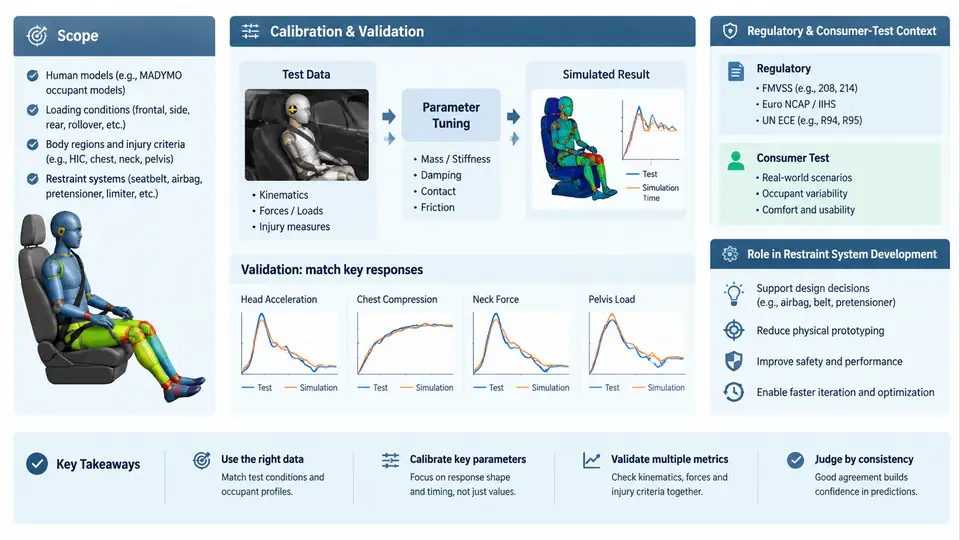
MADYMO (Mathematical Dynamic Model) is a multibody-plus-finite-element solver dedicated to occupant safety simulation. Its core strength lies in combining rigid-body dynamics for skeletal articulation with FE discretization for deformable structures such as airbags, seat belts, and instrument panels. In restraint system development, MADYMO models serve as virtual surrogates for physical crash tests: they predict occupant kinematics, injury criteria, and restraint interaction before hardware exists. However, a model is only as trustworthy as its calibration and validation pedigree. This course addresses that trust chain end-to-end.
What Calibration and Validation Mean in This Context
Calibration is the process of tuning model parameters — joint stiffness, contact characteristics, belt properties, airbag inflation curves — so that simulation output matches a known reference dataset. Validation is the independent confirmation that the calibrated model predicts a different set of physical tests within acceptable tolerances. The distinction matters: a model calibrated and validated against the same data is merely curve-fitted, not predictive.
The reference data typically come from sled tests, component tests (e.g., belt pull tests, airbag static deployment), or full-scale crash tests. Each data source carries its own measurement uncertainty, filtering requirements, and boundary conditions. A rigorous workflow documents these sources and propagates their uncertainty into the acceptance criteria.
Key principle: Calibration adjusts free parameters within physically justifiable bounds. Validation uses locked parameters and fresh data. Any post-validation adjustment invalidates the validation and requires re-validation.
Regulatory and Consumer-Test Landscape
MADYMO models are developed in response to specific assessment protocols. The regulatory framework includes FMVSS 208 (occupant crash protection, US), ECE R94/R95 (frontal and side impact, Europe), and GB 11551 (China). Consumer programs — Euro NCAP, US NCAP, C-NCAP, and IIHS — impose additional, often more severe, loading conditions and injury thresholds. Each protocol defines crash pulse, impact angle, occupant size (e.g., Hybrid III 50th percentile male, THOR, WorldSID), and injury criteria such as HIC15, Nij, chest deflection, and femur force.
These protocols dictate the model's required fidelity. A model intended for FMVSS 208 compliance must accurately capture airbag deployment timing and belt load limiting. A model for Euro NCAP far-side occupant protection must resolve lateral head excursion and far-side airbag interaction. The calibration targets — which signals to match, at what tolerance — derive directly from the protocol's pass/fail thresholds and the program's internal safety margins.
| Protocol | Primary Load Case | Key Injury Metric | Typical Model Requirement |
|---|---|---|---|
| FMVSS 208 | Frontal rigid barrier, 56 km/h | HIC15, chest deflection, femur force | Airbag + belt interaction, occupant kinematics |
| ECE R94 | Frontal offset deformable barrier, 56 km/h | HIC, chest compression | Asymmetric loading, structural intrusion |
| Euro NCAP | Frontal MPDB, 50 km/h; side MDB | HIC, chest deflection, far-side excursion | Multi-occupant, far-side airbag |
| C-NCAP | Frontal 50 km/h, side 50 km/h | HIC, chest, pelvis | Local restraint tuning |
Role of Simulation in Restraint System Development
In a typical vehicle program, restraint system development follows a V-model: concept simulation → component tests → sled tests → full-scale crash tests. MADYMO occupies the left side of the V, where design space exploration is cheap and fast. A single sled test can cost thousands of dollars and weeks of lead time; a MADYMO run costs minutes to hours and can be parameterized for DOE studies.
The simulation's role is not to replace physical testing but to reduce the number of test iterations and to explain test outcomes. When a sled test shows excessive chest deflection, a validated MADYMO model can isolate the cause — belt geometry, retractor load limit, airbag vent size — and propose a fix before the next hardware build. This diagnostic capability depends entirely on model fidelity.
Why This Course Focuses on Both Calibration and Validation
Many practitioners treat calibration as the primary task and validation as a formality. In practice, validation failures are the most common source of program delays. A model that matches one sled test but fails a different pulse or occupant size indicates overfitting. The course therefore treats calibration and validation as inseparable: every calibration decision must be justified by its impact on validation robustness.
The chapters ahead cover the full workflow: model architecture selection, material and contact parameterization, signal processing and correlation metrics, DOE-based calibration strategies, validation matrix design, and documentation for regulatory submission. Each chapter includes hands-on examples using representative MADYMO input decks and post-processing scripts.
Practical note: Before calibrating any parameter, verify that the model's boundary conditions — crash pulse, seat geometry, belt routing — match the reference test. A significant portion of correlation errors originate from incorrect boundary conditions rather than from occupant model parameters.
Course Structure and Expected Outcomes
By the end of this course, you will be able to:
- Select appropriate MADYMO model fidelity (multibody vs. FE vs. hybrid) for a given protocol and development stage.
- Calibrate occupant and restraint parameters against sled and component test data using objective correlation metrics.
- Design a validation matrix that covers occupant sizes, impact modes, and severity levels required by regulatory and consumer programs.
- Document calibration and validation evidence in a format suitable for internal design reviews and regulatory submissions.
- Diagnose common correlation failures — phase shift, magnitude mismatch, timing errors — and trace them to root causes.
The next chapter begins with model architecture: how to choose between multibody, FE, and hybrid representations based on the restraint system under development and the injury metrics that must be predicted.