1. MADYMO hybrid multibody-FE occupant simu
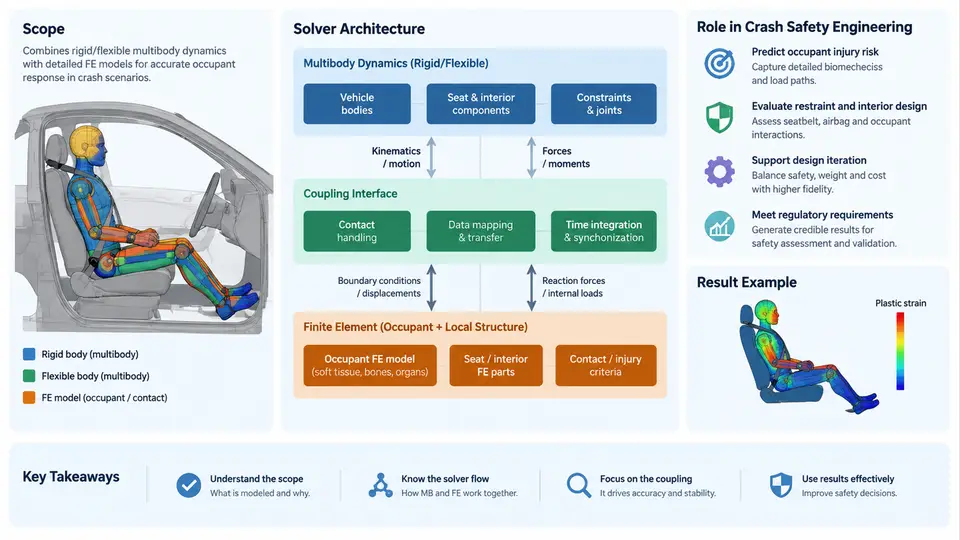
MADYMO (Mathematical Dynamic Model) is a dedicated CAE platform for occupant safety simulation, developed by TASS International and now maintained within the Siemens Simcenter portfolio. Its defining characteristic is a hybrid solver architecture that couples rigid-body multibody dynamics with explicit finite element analysis inside a single time-integration loop. This hybrid design lets engineers model the occupant as a chain of articulated rigid bodies while representing airbags, seat belts, and structural panels as deformable FE meshes — combining the computational efficiency of multibody simulation with the predictive fidelity of explicit FE where it matters most.
Why Hybrid Simulation Exists
A full FE occupant model — a finely meshed human body, an airbag with fabric porosity, a seat with foam crush, and a steering column with collapse — can require hours per run and is difficult to parameterize across dozens of design variants. Conversely, a pure multibody dummy (rigid segments connected by kinematic joints) runs in seconds but cannot capture airbag deployment pressure curves, belt webbing elongation, or structural intrusion. MADYMO's hybrid approach resolves this trade-off: the occupant remains multibody, while the interaction environment — airbag, belt, contact surfaces — is FE. The solver exchanges contact forces and kinematic states between the two domains at every time step.
Solver Architecture
The MADYMO solver integrates both domains with a shared explicit time-stepping scheme. The multibody subsystem uses a recursive formulation for tree-structured body chains, computing joint accelerations from applied forces and constraint reactions. The FE subsystem uses an explicit central-difference integrator with a critical time step governed by element size and material wave speed. Coupling is handled through:
- Contact interfaces: Multibody ellipsoids or planes penetrate FE surfaces; penalty forces are computed from penetration depth and surface stiffness.
- Belt elements: Seat belts are modeled as FE membrane/spring elements that slide through multibody slip rings, transferring restraint forces to the occupant.
- Airbag FE meshes: Gas flow is computed via uniform-pressure or finite-volume gas models; the deploying bag contacts the multibody dummy.
- Prescribed motion: Vehicle structure can be imposed as rigid-body acceleration or as an FE deformable barrier.
The critical time step is typically on the order of 1–5 µs for FE-dominated models, but can be relaxed when the FE mesh is coarse and the multibody bodies dominate the dynamics. A typical frontal impact simulation covers 120–150 ms of physical time.
Role in Crash Safety Engineering
MADYMO occupies a specific niche in the vehicle development workflow. It is not a replacement for full-vehicle FE crash simulation (LS-DYNA, PAM-CRASH, Abaqus Explicit), nor is it a substitute for physical sled or barrier testing. Instead, it serves three primary roles:
- Restraint system design and optimization: Because a hybrid model runs in minutes rather than hours, engineers can sweep airbag vent sizes, belt force limiters, pretensioner timing, and seat positions across hundreds of load cases. This is the core MADYMO use case.
- Occupant response prediction: Given a vehicle deceleration pulse (from full-vehicle FE or sled test), MADYMO predicts occupant kinematics and injury metrics. The pulse is applied as prescribed motion to the multibody environment.
- Regulatory and rating compliance: MADYMO models are accepted for FMVSS 208, ECE R94/R95, Euro NCAP, and C-NCAP occupant safety assessments, provided they are validated against physical tests.
Practical Workflow: Frontal Impact Example
Consider a driver-side frontal impact simulation at 56 km/h (Euro NCAP ODB configuration). The workflow proceeds as follows:
Input preparation. The vehicle deceleration pulse is extracted from a full-vehicle FE run or a sled test, typically as a time-history table of X_acceleration versus time over 0–150 ms. The occupant is a Hybrid III 50th percentile multibody dummy. The airbag is an FE mesh with a uniform-pressure gas model; the belt is a FE membrane with a force-limiting retractor.
Model assembly. The dummy is positioned in the driver seat using H-point coordinates. Joint stiffness values are set from the dummy certification database. The airbag is folded and positioned relative to the steering wheel. Belt routing is defined through slip rings at the D-ring and buckle.
Simulation execution. The solver advances with a time step of approximately 2 µs. Contact between the deploying airbag and the dummy chest is activated at the moment of bag–chest proximity. Belt forces build as the retractor locks and the force limiter pays out webbing.
Result interpretation. Key outputs include head acceleration (for HIC15), chest deflection (for chest injury criterion), and femur loads. A typical validated model might predict HIC15 ≈ 450, chest deflection ≈ 32 mm, and peak belt force ≈ 4.5 kN — values that must fall within corridor tolerances defined by the rating protocol.
Scope Boundaries and Limitations
MADYMO is not intended for structural crashworthiness analysis — it does not predict vehicle crush, intrusion, or component failure. Those must come from full-vehicle FE. MADYMO also assumes the occupant remains within the vehicle interior; ejection and far-side occupant interactions require careful modeling of interior surfaces. Finally, the hybrid approach means that any FE mesh in MADYMO is typically coarser than in a dedicated FE solver, so stress concentrations in airbag fabric or belt webbing should be interpreted qualitatively rather than as precise material stress values.
Understanding these boundaries is essential before proceeding to model construction. The next sections will address the specific input decks, material models, and contact definitions that make the hybrid solver operational.