3. Anthropometry and scaling
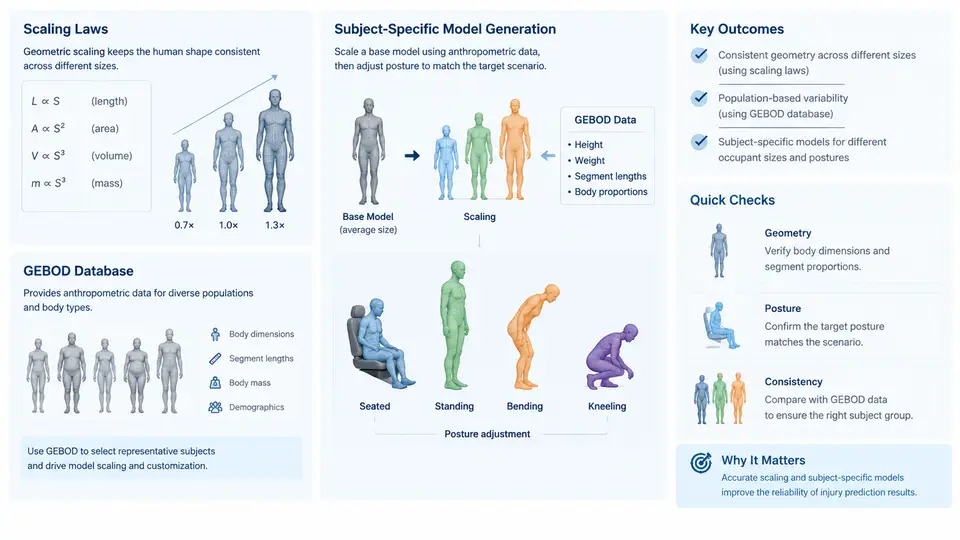
Crash safety cannot be validated against a single "average" occupant. Real vehicle occupants span a wide range of statures, masses, and postures, and injury tolerance changes dramatically across that range. This chapter explains how MADYMO converts a baseline human model into a family of scaled, subject-specific models using anthropometric scaling laws and the GEBOD database, and how posture is applied on top of that geometric transformation.
Why Scaling Is Necessary
A validated finite element (FE) or multibody human model is normally developed from a single cadaver or volunteer dataset — for example, the THUMS or GHBMC 50th percentile male. That model is only directly valid for an occupant matching its source anthropometry. To evaluate a 5th percentile female driver or a 95th percentile male passenger, you must either build a new model from medical imaging (expensive, slow) or transform the existing one. Scaling laws provide the second path: they map segment dimensions, masses, and inertial properties from the baseline to a target anthropometry while preserving the model's topology and joint definitions.
Geometric Scaling Laws
The core assumption is geometric similarity: if a body segment is scaled by a factor λ in length, its other dimensions scale by λ, areas by λ², and volumes and masses by λ³ (assuming constant density). MADYMO implements this through per-segment scale factors rather than a single global factor, because human bodies are not isometric — a taller person does not simply have proportionally longer legs and arms.
Two scaling approaches are common:
- Uniform (isometric) scaling — one λ applied to the whole body. Fast, but inaccurate for segment proportions.
- Non-uniform / segment-wise scaling — separate λx, λy, λz per body region (head, thorax, pelvis, upper/lower extremities), derived from measured segment lengths. This is the default for injury prediction work.
For a target occupant, the scale factor for a segment is computed as the ratio of target segment length to baseline segment length:
lambda_segment = L_target / L_baseline
mass_segment  = mass_baseline * (lambda_x * lambda_y * lambda_z)
I_segment     = I_baseline * (lambda^5)   # for a given axis, isometric case
The λ⁵ dependence of mass moment of inertia follows from mass scaling as λ³ and length-squared scaling as λ². This is why a 95th percentile male model is not merely "bigger" — its rotational inertia is disproportionately larger, which changes head and torso kinematics in a crash pulse.
The GEBOD Database
GEBOD (Generator of Body Data) is a widely used anthropometric database and generator originally developed for the U.S. Air Force and later adapted for automotive and military occupant modeling. It provides regression-based predictions of body segment dimensions, masses, and centers of mass as functions of user-specified parameters such as stature, weight, age, and gender.
In practice, GEBOD is used to supply the target anthropometry that drives the scaling. A typical workflow:
- Specify target occupant descriptors — e.g., stature 1750 mm, mass 78 kg, male, age 45.
- Query GEBOD for segment lengths (head, neck, thorax, abdomen, pelvis, upper arm, forearm, hand, thigh, shank, foot) and segment masses.
- Compare against the baseline model's segment data to compute per-segment scale factors.
- Apply the factors to the MADYMO model's ellipsoids, FE nodes, or facet geometry.
GEBOD is valuable because it is internally consistent: the segment masses and dimensions it returns are derived from the same statistical population, avoiding the mismatch that occurs when you mix data from different sources.
Generating a Subject-Specific Model in MADYMO
MADYMO's scaling utility (often invoked through the SCALING input block or the madyscale / madymo_scaling tooling) accepts a baseline model and a target anthropometry definition. The essential inputs are:
- Baseline model file and its known anthropometry (stature, mass, segment lengths).
- Target anthropometry — either explicit segment values or a GEBOD query result.
- Scaling method — isometric, non-uniform, or user-defined per-segment factors.
- Posture specification — joint angles for the target occupant position.
Posture is applied after geometric scaling. MADYMO models expose joint degrees of freedom (hip flexion, knee flexion, neck flexion, etc.), and a posture is defined by setting these joint angles. Because scaling changes segment lengths, the same joint angles produce different absolute positions — so posture must be re-specified or re-solved for each scaled model. A common error is to scale a model and reuse the baseline's joint angles, which can cause interpenetration between the thigh and abdomen in a large occupant or gaps in a small one.
Worked Example: 5th Percentile Female vs. 95th Percentile Male
Consider a baseline 50th percentile male model with a 450 mm thigh length. A GEBOD query for a 5th percentile female returns a thigh length of approximately 380 mm, giving λ = 380/450 ≈ 0.844. For a 95th percentile male, GEBOD returns roughly 500 mm, giving λ ≈ 1.111. Applying these factors to the thigh segment scales its geometry, mass, and inertia accordingly. The table below summarizes representative segment scale factors for the three occupants (values are illustrative, derived from typical GEBOD outputs):
| Segment | Baseline (50th M) | 5th F λ | 95th M λ |
|---|---|---|---|
| Head | 1.00 | 0.93 | 1.06 |
| Thorax | 1.00 | 0.88 | 1.10 |
| Pelvis | 1.00 | 0.90 | 1.08 |
| Thigh | 1.00 | 0.84 | 1.11 |
| Shank | 1.00 | 0.85 | 1.10 |
Note that the head scales less than the thigh — this reflects the real anthropometric trend that head size varies less across the population than leg length. Using a single global λ would over-scale the head of a small female and under-scale it for a large male, degrading head injury criterion (HIC) predictions.
Posture Variation
Subject-specific modeling is not only about size. Occupant posture — seatback angle, hip position, knee flexion, and upper extremity placement — strongly affects injury outcome. MADYMO allows posture to be defined through joint angle inputs, and modern workflows use optimization or inverse kinematics to place the model into a target posture while respecting joint limits. For out-of-position (OOP) studies, the model may be placed with the head near the airbag module or the torso rotated, and the scaling must be re-validated because contact geometry changes.
Verification and Validation
After generating a scaled model, verify it against the target anthropometry: check total body mass, segment lengths, and center-of-mass locations. A quick sanity check is to sum the scaled segment masses and compare to the GEBOD target total mass — a mismatch greater than a few percent indicates an error in the scale factor application or a missing segment. For validation, run a standard crash pulse (e.g., a sled test) and compare kinematic corridors (head, chest, pelvis acceleration) against published scaled corridors for that occupant size.
Key Takeaways
- Scaling laws transform a validated baseline model into a target anthropometry using per-segment scale factors; mass scales as λ³ and inertia as λ⁵.
- GEBOD supplies internally consistent target segment dimensions and masses from stature, weight, age, and sex.
- Non-uniform scaling is essential because human proportions are not isometric — the head scales less than the limbs.
- Posture is applied after scaling and must be re-specified, since joint angles produce different absolute positions in a scaled model.
- Always verify scaled models against target mass and geometry, and validate kinematics against published corridors before using them for injury prediction.