1. MADYMO FE restraint system modeling and
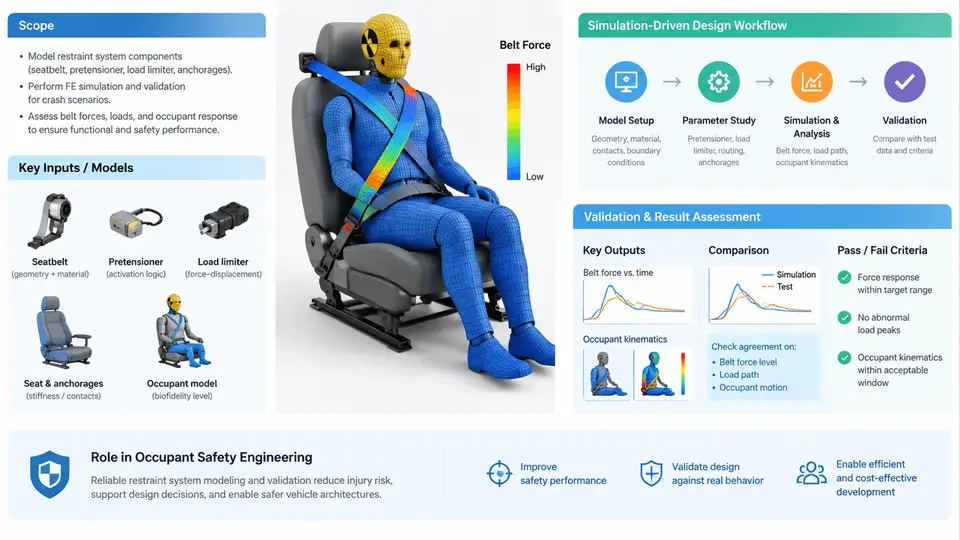
MADYMO (Mathematical Dynamic Model) is a multi-body and finite element solver developed by TASS International (now part of Siemens) that has been a workhorse of occupant safety engineering for more than three decades. Within the broader CAE landscape, MADYMO occupies a specific niche: it is optimized for crash and occupant simulation, coupling rigid multi-body dynamics with explicit finite element structural models in a single solver. This course focuses on one high-value application of that capability — building, running, and validating finite element models of restraint systems, principally airbags, seat belts, and the interactions between them and the occupant.
The scope of the course is deliberately narrow. We do not attempt to cover full vehicle crashworthiness, body-in-white durability, or pedestrian protection. Instead, every chapter addresses the restraint system as a modeling object: how an airbag is folded and inflated, how a seat belt retractor and pretensioner are represented, how the occupant interacts with these devices, and how the resulting model is judged against physical test data. The goal is that by the end of the course you can take a restraint system from CAD and test data to a validated MADYMO FE model that predicts occupant response with quantified confidence.
Why Restraint Systems Deserve Their Own Modeling Discipline
Restraint systems are unusual among automotive structures because they are deployed structures. A seat belt is slack until a crash pulse triggers the retractor; an airbag is a folded, compressed package until a pyrotechnic inflator fills it in tens of milliseconds. Their behavior is therefore strongly time-dependent, strongly nonlinear, and strongly coupled to the occupant. A model that captures the geometry correctly but misrepresents the inflation timing or the belt load-limiting force will produce occupant responses that look plausible but are quantitatively wrong.
This is why MADYMO's hybrid multi-body/FE architecture is well suited to the problem. The occupant can be represented as a multi-body dummy (fast, robust, well-validated) while the airbag and belt are represented as FE meshes (accurate for fabric, folding, and contact). The coupling between the two domains is handled internally by the solver, so the analyst does not need to build a separate co-simulation harness.
The Simulation-Driven Design Workflow
In a typical OEM or Tier-1 restraint development program, the MADYMO FE model is not an isolated artifact. It sits inside a workflow that runs from requirements to hardware. The diagram below shows the principal stages and the data that flows between them.
The loop is the important part. A MADYMO FE model is not built once and trusted forever; it is tuned against physical test data, and the tuning parameters are the ones that dominate the physics — airbag fabric porosity, fold pattern, vent orifice area, belt webbing stiffness, retractor force-limiting level, and contact friction. Each of these has a defensible physical range, and the analyst's job is to find a combination that reproduces the measured occupant response without leaving that range.
What "Validation" Actually Means Here
Validation in restraint modeling is not a binary pass/fail. It is a graded judgment based on how well the model reproduces a set of measured signals. In practice, the most useful validation targets are:
- Occupant kinematics — head and chest acceleration time histories, head excursion, and the timing of peak values relative to the crash pulse.
- Belt force — shoulder and lap belt load at the retractor and anchor points, which reveals whether the load limiter and pretensioner are behaving correctly.
- Airbag pressure — internal pressure trace, which is sensitive to vent area, porosity, and inflator mass flow.
- Injury metrics — HIC15, chest deflection, and femur load, compared against the physical test values with an acceptance band agreed with the program.
A model that matches peak HIC but is 15 ms late on the chest acceleration peak is not validated, even if the final number looks good. Timing errors usually indicate a wrong inflator mass flow curve or an incorrect belt pretensioner trigger time, and they will mislead any design decision that follows.
A Concrete Starting Point
To make the workflow tangible, consider a driver-side frontal airbag model for a 50th percentile male occupant in a sled environment. The minimum input set is:
| Input | Typical source | Example value / form |
|---|---|---|
| Airbag FE mesh | CAD unfold + meshing | ~8,000–15,000 shell elements, fabric thickness 0.3 mm |
| Fold pattern | Physical bag teardown | accordion + radial fold, captured as initial coordinates |
| Inflator mass flow | Tank test | time–mass curve, peak ~120 g/ms at 10 ms |
| Fabric porosity | Material test | permeability coefficient, e.g. 2.5e-9 m² |
| Vent orifice | CAD | two 25 mm diameter holes |
| Belt webbing | Material test | stiffness ~1,800 N per 10% strain |
| Retractor load limit | Component test | 4.0 kN ± 0.3 kN |
| Sled pulse | Accelerometer | Δv = 56 km/h, peak ~35 g at 45 ms |
With these inputs, a first run typically produces an occupant response that is qualitatively correct but quantitatively off — often the head acceleration peak is too high because the bag is too stiff, or the chest deflection is too low because the belt is too stiff. The tuning loop then adjusts porosity, vent area, and belt stiffness within their measured uncertainty bands until the response falls inside the validation corridor.
Where This Course Goes
The remaining chapters build the capability in layers. We start with the MADYMO FE environment and the data structures that define an airbag and belt model. We then cover folding strategies, inflator representation, material models for fabric and webbing, contact definitions, and the coupling to multi-body occupants. Later chapters address validation methodology, corridor construction, sensitivity analysis, and the documentation required to defend a model in a design review or certification context. Each chapter is written so that the modeling decisions are explicit and the validation criteria are testable.
The measure of success for this course is simple: given a restraint system, a set of physical test data, and a crash pulse, you should be able to build a MADYMO FE model, run it, compare it against the test, and state with evidence whether the model is fit for the design decision it is meant to support.