1. MADYMO in driver restraint engineering
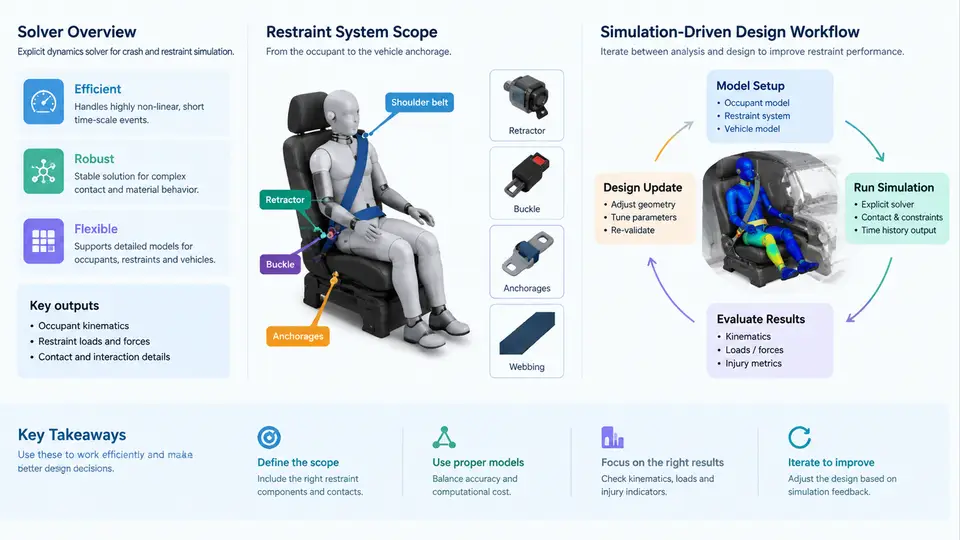
MADYMO (Mathematical Dynamic Model) is a multibody–finite element (MB–FE) solver specialized in occupant safety simulation. In driver restraint engineering it serves as the virtual proving ground where airbag, seat belt, steering column, seat, and occupant interact under crash pulses long before a physical sled or vehicle test is available. This chapter establishes what the solver actually computes, which restraint components fall inside its scope, and how a simulation-driven design loop is organized around it.
1.1 What the Solver Computes
MADYMO solves the coupled equations of motion for rigid bodies, deformable finite element meshes, and their interactions. The core numerical engine advances the system in time using an explicit integration scheme, which is well suited to the short, highly nonlinear events typical of crash loading (typically 0–150 ms). Three model families coexist in one input deck:
- Multibody (MB) systems — rigid bodies connected by kinematic joints (revolute, translational, spherical, bracket, etc.). The occupant is often represented as a chain of ellipsoids, which is computationally cheap and robust for parameter sweeps.
- Finite element (FE) models — shell and solid meshes for airbags (fabric), seat structures, instrument panels, and increasingly for detailed human body models (THUMS, GHBMC).
- FE–MB coupling — contact and constraint interfaces that let a multibody dummy interact with an FE airbag or an FE seat frame.
Contact is handled through penalty-based or kinematic contact algorithms, and the airbag itself is solved with a control-volume (CV) or arbitrary Lagrangian–Eulerian (ALE) gas model. The CV method computes internal pressure from the ideal-gas relation P = (γ−1)·E/V, where E is internal energy supplied by the inflator mass-flow curve and V is the current bag volume. This is why the inflator definition — mass flow rate versus time and gas temperature — is one of the most sensitive inputs in any driver airbag model.
1.2 Scope of a Driver Restraint System
A complete driver restraint model in MADYMO typically includes the following subsystems, each with its own modeling fidelity trade-off:
| Subsystem | Typical representation | Key outputs |
|---|---|---|
| Driver airbag (DAB) | FE shell + CV/ALE gas | Bag pressure, deployment kinematics, contact force on chest/head |
| Seat belt (3-point) | FE belt segments + slipring + retractor + pretensioner + load limiter | Belt force, payout, chest deflection |
| Steering column | MB joint with translational collapse + FE rim | Column stroke, rim force |
| Seat structure | FE shell or MB with stiffness | Seatback rotation, sink-in |
| Occupant | MB ellipsoid dummy or FE human body model | Head acceleration, HIC, chest deflection, femur force |
| Vehicle environment | Rigid or FE toeboard, floor, A-pillar | Boundary conditions for occupant motion |
The restraint engineer's job is to tune the interaction among these subsystems so that injury criteria stay below regulatory or consumer-test thresholds while packaging and cost constraints are respected.
1.3 The Simulation-Driven Design Workflow
A practical MADYMO workflow for driver restraint design follows an iterative loop rather than a single linear pass. The figure below shows the data flow and the decision points that govern whether a design iteration is accepted or returned for modification.
In practice, the loop begins with a validated baseline model — often a previous program's deck adapted to the new vehicle pulse and package. The engineer then perturbs restraint parameters one at a time or in small groups, because simultaneous changes make it impossible to attribute the injury-criteria shift to a specific design variable.
1.4 A Concrete First Iteration
Consider a mid-size sedan driver-side model with a 50th-percentile male Hybrid III dummy. The baseline deck uses a 120 L driver airbag with a single vent hole of 30 mm diameter, a belt load limiter set to 4.0 kN, and a retractor pretensioner firing at 12 ms. The crash pulse is a 56 km/h frontal rigid-barrier deceleration applied to the vehicle body.
After the first run, the engineer inspects the standard output channels:
- Head resultant acceleration — peak value and the 3 ms clip; HIC15 is computed from the resultant acceleration trace.
- Chest deflection — measured at the sternum relative to the spine box; the peak value is compared against the 63 mm limit.
- Belt force — at the shoulder and lap anchors; excessive force indicates the load limiter is too stiff or the pretensioner too aggressive.
- Bag pressure — the CV pressure trace reveals whether the bag is over- or under-pressurized during the occupant's forward excursion.
- Kinematics animation — the engineer checks for "bag bottoming" (head penetrating to the steering rim) or belt slip off the shoulder.
Suppose the first run shows HIC15 = 720 and chest deflection = 58 mm. Both are below the typical targets (HIC15 ≤ 700 for some consumer protocols, chest deflection ≤ 63 mm), but HIC is marginal. The engineer might increase the vent diameter from 30 mm to 35 mm to soften the bag, or add a tether to reshape the bag surface. Each change requires a new run, and the effect on chest deflection must be re-checked because a softer bag can allow deeper chest penetration.
1.5 Why MADYMO Rather Than a General-Purpose FE Solver
General-purpose explicit FE codes can simulate the same event, but MADYMO offers three advantages specific to restraint engineering. First, its multibody formulation makes dummy positioning and belt routing far faster to set up and far more robust than a fully meshed occupant. Second, the built-in airbag CV/ALE gas models and belt slipring/retractor elements are purpose-built for restraint components, reducing the need for user subroutines. Third, the solver's contact algorithms are tuned for the soft, large-deformation interactions (bag–head, belt–chest) that dominate occupant loading. The trade-off is that MADYMO is less suited to structural crush simulation of the vehicle body, so it is usually coupled with a full-vehicle FE solver or fed a prescribed pulse.
1.6 Key Takeaways
- MADYMO is an MB–FE solver whose explicit integration and purpose-built restraint elements make it the standard tool for occupant restraint simulation.
- A driver restraint model spans airbag, belt, column, seat, occupant, and vehicle environment — each with a fidelity choice that affects runtime and accuracy.
- The design workflow is an iterative loop: define inputs, assemble the model, run, review injury criteria, and update parameters until targets are met.
- Parameter sensitivity is best established one variable at a time before moving to DOE or optimization.
- Injury criteria such as HIC15, chest deflection, and belt force are the primary acceptance metrics; kinematics animation is the primary diagnostic tool.
The next chapter examines the dummy and human body models available in MADYMO and how their positioning and joint stiffness affect the fidelity of the restraint simulation.