1. Introduction to MADYMO for curtain airba
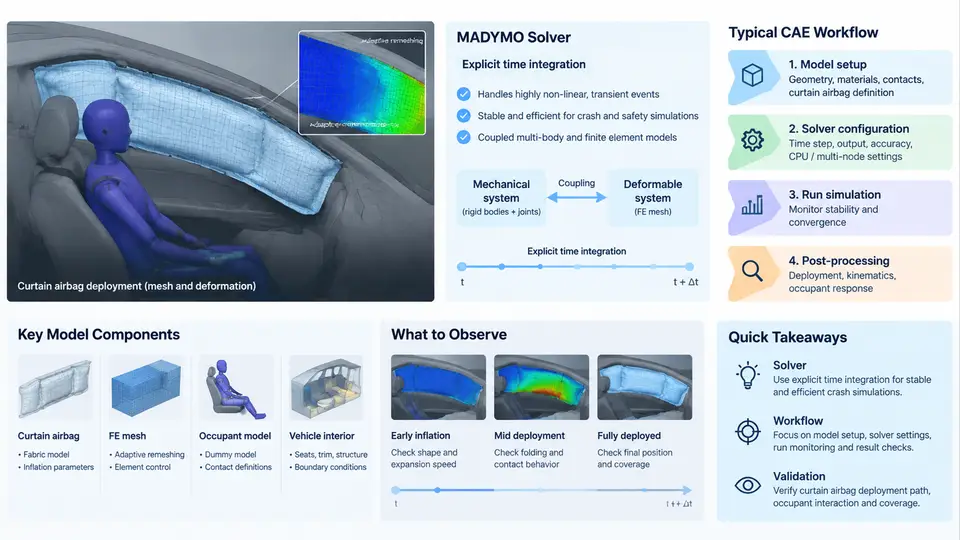
MADYMO (Mathematical Dynamic Model) is a multi-body and finite element solver developed by TASS International (now part of Siemens) that has been the de facto standard for occupant safety simulation in the automotive industry for over three decades. In the context of curtain airbag engineering, MADYMO provides a coupled simulation environment where the inflating airbag — modeled as a finite element membrane — interacts with a multi-body occupant model and the vehicle interior structure. This coupling is what makes MADYMO particularly well suited to restraint system development: it captures the strong two-way interaction between the deploying cushion, the occupant, and the surrounding trim without requiring a full vehicle FE model.
1.1 The Solver at a Glance
MADYMO's core is an explicit time-integration solver. The equations of motion are advanced in time using a central difference scheme, which is conditionally stable: the time step must satisfy the Courant–Friedrichs–Lewy (CFL) condition, Δt ≤ Lc/c, where Lc is the characteristic element length and c is the wave speed in the material. For a typical curtain airbag FE mesh with element sizes around 5–10 mm and a fabric wave speed on the order of 100–200 m/s, the stable time step falls in the range of 0.5–2 µs. This is why explicit solvers are preferred for airbag deployment: the physical event lasts only 30–80 ms, but the high-frequency membrane dynamics demand very small steps.
The solver supports two primary model types that can be coupled:
- Multi-body (MB) systems — rigid bodies connected by joints and restraint elements (belts, contacts). Occupant dummies such as Hybrid III and THOR are typically represented as MB chains.
- Finite element (FE) models — shell and membrane elements for the airbag fabric, plus solid elements for surrounding structures when needed.
Coupling between MB and FE domains is handled through contact interfaces and prescribed kinematic constraints. In a curtain airbag simulation, the FE cushion inflates and contacts the MB occupant; the contact forces are computed each time step and fed back into both domains.
1.2 The Inflator Model
Curtain airbag deployment is driven by a pyrotechnic or hybrid inflator. In MADYMO, the inflator is represented by a gas inflow model that specifies mass flow rate and temperature as functions of time, or by a tank-pressure-based model. A common approach is the uniform pressure (UP) model, where the cushion is treated as a single control volume and the internal pressure is computed from the ideal gas law with the inflator mass flow as input. For larger curtains with multiple chambers, a gas distribution model with connecting orifices is used instead.
The inflator input is typically provided as a tabulated mass flow curve derived from tank tests. For example, a driver-side curtain inflator might deliver a peak mass flow of 2.5–4.0 kg/s at 10–15 ms after trigger, with a total gas mass of 60–120 g. These values are illustrative and must be replaced with the actual inflator data for the specific program.
1.3 Typical CAE Workflow
The engineering workflow for a curtain airbag simulation in MADYMO follows a consistent sequence, though the details vary by OEM and tier-one supplier. The diagram below summarizes the data flow and the key decision points.
The workflow begins with the cushion geometry, which is typically provided as a 3D CAD surface representing the folded or unfolded bag. The mesh must capture the seam lines, tethers, and any internal partitions. A common pitfall is insufficient mesh density near the inflator inlet, where the gas jet creates a high-pressure gradient; element sizes there should be reduced to 3–5 mm to avoid numerical instability.
Material definition for the fabric is equally critical. Curtain airbags are usually made of nylon 6.6 woven fabric with a silicone or polyurethane coating. In MADYMO, the fabric is modeled with a membrane or shell material that includes orthotropic stiffness, strain-rate dependence, and a failure criterion. Typical elastic modulus values range from 2–5 GPa in the warp direction and 1–3 GPa in the weft direction, with Poisson's ratio around 0.2–0.3. These are starting points for calibration against material coupon tests.
Once the model is assembled, the simulation is run with a prescribed trigger time (typically 10–30 ms after the crash pulse onset, depending on the sensing algorithm). The solver outputs time-history data for cushion pressure, occupant accelerations, and contact forces. The engineer then checks the injury criteria — HIC for the head, Nij for the neck, chest deflection, and head excursion relative to the vehicle interior. If any criterion is violated, the model is revised: the inflator mass flow may be increased, the cushion volume adjusted, or the tether configuration modified.
1.4 Why MADYMO for Curtain Airbags?
Compared to a full vehicle FE model, MADYMO offers several advantages for curtain airbag work. First, the multi-body occupant models are computationally inexpensive and have been extensively validated against physical dummy tests. Second, the FE cushion can be coupled to the MB occupant without modeling the entire vehicle body in detail — only the relevant interior surfaces (A-pillar, B-pillar, roof rail, seat) need to be represented. Third, the solver's explicit integration scheme handles the large deformation and self-contact of the inflating cushion robustly, provided the time step and mesh quality are controlled.
The trade-off is that MADYMO's FE capabilities are less general than those of a full-featured explicit code like LS-DYNA. For curtain airbag engineering, however, the focused feature set — membrane elements, gas flow models, and occupant coupling — is precisely what is needed. The next sections will build on this foundation, moving from the solver overview into the specific modeling techniques for cushion geometry, inflator characterization, and validation against test data.