3. Vehicle crash pulse characterization
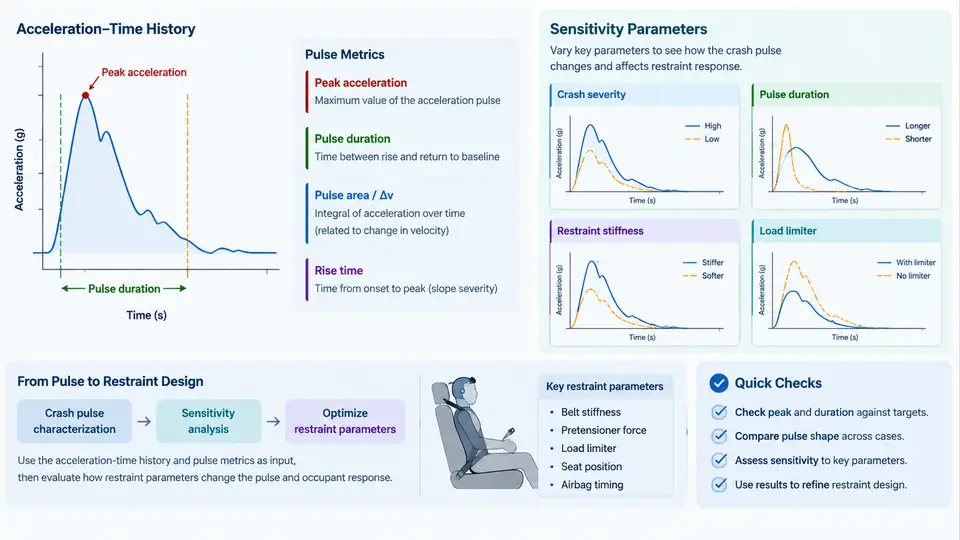
In MADYMO restraint design, the crash pulse is the boundary condition that drives everything downstream. It defines the deceleration environment imposed on the occupant compartment, and therefore determines how the occupant moves relative to the restraint system. Before any airbag vent size, seat belt load limiter, or pretensioner timing can be tuned meaningfully, the engineer must be able to read a pulse, extract its governing metrics, and understand which of those metrics the restraint system is actually sensitive to. This section covers the acceleration–time history as a physical signal, the standard metrics used to summarize it, and the parameters that most strongly influence occupant response.
3.1 The Acceleration–Time History as a Signal
A vehicle crash pulse is the acceleration measured at a structural location — typically the B-pillar base, rocker, or seat track — during a barrier or sled event. In MADYMO it is applied as a prescribed motion to the vehicle model, usually through a MOTION or ACCELEROMETER input on the vehicle body. The sign convention must be fixed before anything else: by SAE convention, deceleration during a frontal impact is negative in the vehicle-fixed frame, but many pulse files are stored as positive magnitudes. A sign error here propagates directly into occupant kinematics and is one of the most common causes of nonsensical belt force output.
The raw signal is rarely used directly. It is filtered per SAE J211, typically at CFC 60 for occupant-relevant pulses and CFC 180 or higher for structural response. Filtering removes high-frequency noise that would otherwise be amplified when the pulse is integrated twice to obtain displacement. The engineer should always verify that the filtered pulse integrates to a physically plausible velocity change and that the final displacement returns to a reasonable value.
3.2 Standard Pulse Metrics
Several metrics are used to summarize a pulse. The most important for restraint design are listed below.
| Metric | Definition | Typical Frontal Value | Design Relevance |
|---|---|---|---|
| Delta-v (Δv) | Integral of acceleration over the event | 48–64 km/h (barrier) | Sets total occupant energy to be managed |
| Peak acceleration | Maximum filtered deceleration | 30–50 g | Drives peak belt force and airbag loading |
| Time to peak (tpeak) | Time from t0 to peak | 40–70 ms | Determines airbag deployment timing window |
| Pulse duration | Time until acceleration returns to zero | 90–130 ms | Sets the restraint ride-down period |
| Positive phase area | Integral of deceleration over the primary pulse | — | Governs occupant forward excursion |
| Ride-down efficiency | Ratio of occupant deceleration to vehicle deceleration | 0.5–0.7 | Measures how well restraints spread the load |
These metrics are not independent. A pulse with a high peak and short duration produces a different occupant response than one with a lower peak and longer duration, even at identical delta-v. The area under the curve — the velocity change — is the same, but the rate at which energy is transferred differs, and that rate is what the restraint system must accommodate.
3.3 Pulse Shape and Its Sensitivity Parameters
Pulse shape is often described by idealized forms: square, triangular, half-sine, or a two-stage pulse with an initial high-g spike followed by a lower plateau. Real pulses are more complex, but the idealized forms help isolate which parameters matter.
The most sensitive parameters for restraint design are:
- Peak acceleration magnitude — directly scales belt force and airbag pressure. A 10% increase in peak g typically produces a 8–12% increase in peak belt force at the retractor.
- Time to peak — controls whether the airbag is fully deployed when the occupant loads it. If tpeak is shorter than the airbag deployment time, the occupant may contact a partially inflated bag.
- Pulse duration and positive phase area — determines total forward excursion. A longer pulse gives the restraint more time to decelerate the occupant, reducing peak forces.
- Initial slope (jerk) — the rate of onset affects pretensioner and load limiter activation timing. A steep onset may require earlier pretensioner firing.
- Secondary pulses — oscillations after the primary pulse can re-accelerate the occupant and cause rebound or belt slack.
In MADYMO, these parameters are varied systematically in a sensitivity study. The typical approach is to define a baseline pulse, then perturb each metric by ±10–20% while holding others constant, and observe the change in occupant injury criteria such as HIC, chest deflection, and femur force. The resulting sensitivity coefficients tell the engineer which pulse features the restraint design must be robust against.
3.4 Practical Workflow: From Pulse File to Sensitivity Insight
A reproducible workflow for pulse characterization in MADYMO proceeds as follows. First, import the acceleration–time history and verify the sign convention and filtering. Second, compute the metrics in the table above using a script or the built-in FUNCTION objects. Third, define the baseline MADYMO model with the pulse applied to the vehicle body. Fourth, run a parametric sweep: scale the pulse amplitude, shift the time-to-peak, and stretch the duration independently. Fifth, extract occupant response metrics and compute sensitivity coefficients.
For example, a baseline frontal pulse with Δv = 56 km/h, peak = 40 g, tpeak = 55 ms, and duration = 110 ms might be perturbed to peak = 44 g (+10%) while keeping Δv constant by reducing duration. The resulting chest deflection may increase by 6–9%, indicating that the restraint system is moderately sensitive to peak acceleration but can compensate through load limiting. If the same perturbation causes a 20% increase in chest deflection, the load limiter is likely too stiff or the airbag vent is too small.
The output of this workflow is a sensitivity ranking: which pulse parameters most strongly affect which injury criteria. That ranking directly informs restraint design priorities — for instance, if the design is highly sensitive to tpeak, the airbag deployment timing must be robust across the expected range of pulse onsets.
3.5 Interpreting Sensitivity Results
The sensitivity ranking produced by the sweep is not just an academic exercise. It tells the restraint engineer where to focus robustness efforts. If tpeak dominates, the airbag deployment timing must be validated across the full range of expected pulse onsets, and the occupant may need a seat position sensor or adaptive restraint strategy. If peak acceleration dominates, the load limiter force level and airbag vent area become the primary tuning parameters. If duration dominates, the restraint must manage a longer ride-down, which may require a larger airbag volume or a progressive load limiter.
It is also important to recognize that sensitivity is not constant across occupant sizes. A 5th percentile female occupant may be more sensitive to tpeak because she sits closer to the airbag module, while a 95th percentile male may be more sensitive to peak acceleration because his greater mass generates higher belt forces. A complete sensitivity study therefore includes multiple occupant models, not just the 50th percentile Hybrid III.
Finally, the pulse itself is not a fixed input in real-world crashes. It varies with impact speed, barrier type, vehicle structure, and occupant position. The sensitivity parameters identified here become the dimensions along which the restraint design must be robust, and they feed directly into the design-of-experiments and optimization work covered in later sections.