1. MADYMO crash pulse sensitivity and restr
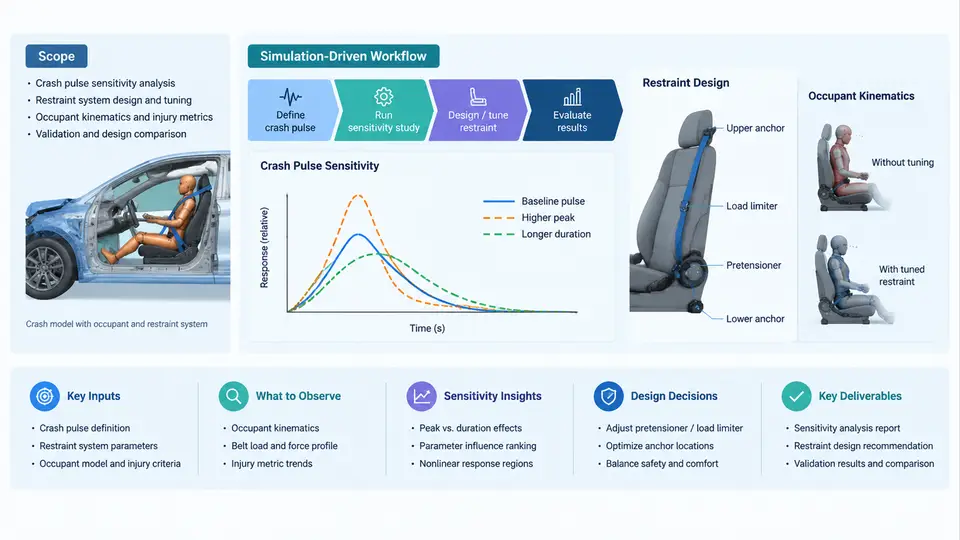
Crash pulse sensitivity is the study of how a restraint system's performance changes when the deceleration–time history applied to the vehicle body varies. In MADYMO, this is not a single simulation but a structured investigation: the pulse is treated as an uncertain input, the occupant and restraint model as the system under test, and injury criteria as the response variables. This chapter establishes the scope of the course, the simulation-driven workflow that connects pulse definition to restraint tuning, and the concrete deliverables you will produce.
Why Pulse Sensitivity Matters
A frontal occupant restraint system is certified against a limited number of barrier tests. In service, however, the same vehicle encounters different impact speeds, overlap conditions, and structural responses. The occupant restraint controller (ORC) receives a filtered acceleration signal and decides when to fire the pretensioner and airbag stages. If the pulse shape shifts — earlier or later rise, higher or lower peak, longer or shorter duration — the firing decision and the restraint interaction change. A design that passes one pulse may fail another.
MADYMO provides two complementary solvers: the multibody (MB) solver for fast restraint and occupant kinematics studies, and the finite element (FE) solver for detailed airbag deployment and structural contact. For pulse sensitivity, the MB solver is typically used to sweep hundreds of pulse variants quickly, while FE is reserved for validating the most critical cases. The course focuses on the MB-driven workflow, with FE checkpoints where necessary.
Course Scope and Boundaries
This course covers frontal impact pulse sensitivity for driver and passenger restraint systems. It includes:
- Pulse parameterization: how to describe a crash pulse with a small set of physically meaningful variables.
- Occupant model setup: Hybrid III 50th percentile male, seat belt with retractor and pretensioner, and airbag representation.
- Restraint parameters: belt load limiter force, pretensioner timing, airbag vent size, and firing thresholds.
- Sensitivity analysis: design of experiments (DOE), response surfaces, and robustness metrics.
- Deliverables: pulse library, parameter table, response curves, and a robustness report.
It does not cover side impact, rear impact, or pedestrian protection. It also does not cover the detailed FE modeling of airbag fabric or gas flow; those are treated as calibrated inputs.
Simulation-Driven Workflow
The workflow is iterative and consists of five stages. Each stage produces a specific artifact that feeds the next.
- Pulse library construction. Start from a baseline vehicle pulse, typically a filtered accelerometer signal from a full frontal rigid barrier test at 56 km/h. Parameterize it using four variables: time to peak
t_peak, peak decelerationa_peak, pulse durationt_dur, and a shape factorkthat controls rise steepness. Generate a Latin Hypercube sample of 50–100 variants within physically plausible ranges. For example,t_peakfrom 40 to 80 ms,a_peakfrom 35 to 55 g,t_durfrom 90 to 130 ms, andkfrom 1.5 to 3.0. - Occupant and restraint model setup. Build the MADYMO MB model with a seat, floor, toe pan, belt system, and airbag. The belt is modeled with a retractor, a pretensioner, and a load limiter. The airbag is represented as a uniform pressure volume with a vent. Calibrate the model against a baseline test using belt force and head acceleration.
- DOE execution. Run the MB solver for each pulse variant. Use a script to automate the runs and extract injury criteria: HIC15, chest deflection, chest acceleration (3 ms clip), and femur force. The output is a response matrix.
- Sensitivity analysis. Fit a response surface (e.g., quadratic polynomial) to each injury criterion as a function of pulse and restraint parameters. Compute sensitivity indices (e.g., Sobol or standardized regression coefficients) to rank which parameters dominate.
- Restraint tuning and robustness check. Adjust restraint parameters to minimize the worst-case injury across the pulse library. Validate the tuned design with FE simulations for the most severe pulse variants.
The following SVG illustrates the data flow and decision logic of this workflow, including the key inputs, the simulation loop, and the output deliverables.
Key Deliverables and How to Judge Them
Each deliverable has a clear acceptance criterion. The pulse library is acceptable when the sampled pulses cover the intended range without clustering and when each pulse is physically realizable (no negative deceleration, no discontinuity). The parameter table is acceptable when every restraint parameter has a defined baseline, lower bound, and upper bound, and when the bounds are justified by hardware limits or regulatory constraints.
The response curves are acceptable when the fit quality is sufficient: for a quadratic response surface, an adjusted R² above 0.85 for each injury criterion is a reasonable target. The robustness report is acceptable when it identifies the top three pulse parameters that drive injury variation and when the tuned restraint design keeps all injury criteria below the target thresholds across the entire pulse library.
ACCELEROMETER or SYSTEM input. For MB simulations, use a filtered pulse to avoid numerical noise. The filter cut-off frequency should match the vehicle structure's relevant mode, typically 60–100 Hz for frontal impact.
Example: Baseline Pulse and Parameter Ranges
Consider a baseline pulse with t_peak = 60 ms, a_peak = 45 g, t_dur = 110 ms, and k = 2.0. The LHS sample might produce a variant with t_peak = 48 ms, a_peak = 52 g, t_dur = 98 ms, and k = 2.6. This variant represents an earlier, harsher pulse. Running the MB model with this pulse and a baseline restraint setting might yield HIC15 = 720, chest deflection = 42 mm, and 3 ms clip = 58 g. If the target thresholds are HIC15 ≤ 700, chest deflection ≤ 40 mm, and 3 ms clip ≤ 60 g, then this variant fails on HIC15 and chest deflection. The sensitivity analysis would then show that t_peak and a_peak are the dominant factors, and the restraint tuning would reduce the load limiter force from 4.0 kN to 3.2 kN and advance the pretensioner timing by 5 ms to compensate.
Summary
This chapter defined the scope of crash pulse sensitivity in MADYMO, presented a five-stage simulation-driven workflow, and listed the key deliverables: pulse library, parameter table, response curves, and robustness report. The next step is to build the pulse library and set up the occupant model, which will be covered in the following chapters.