1. Side impact crash dynamics and injury me
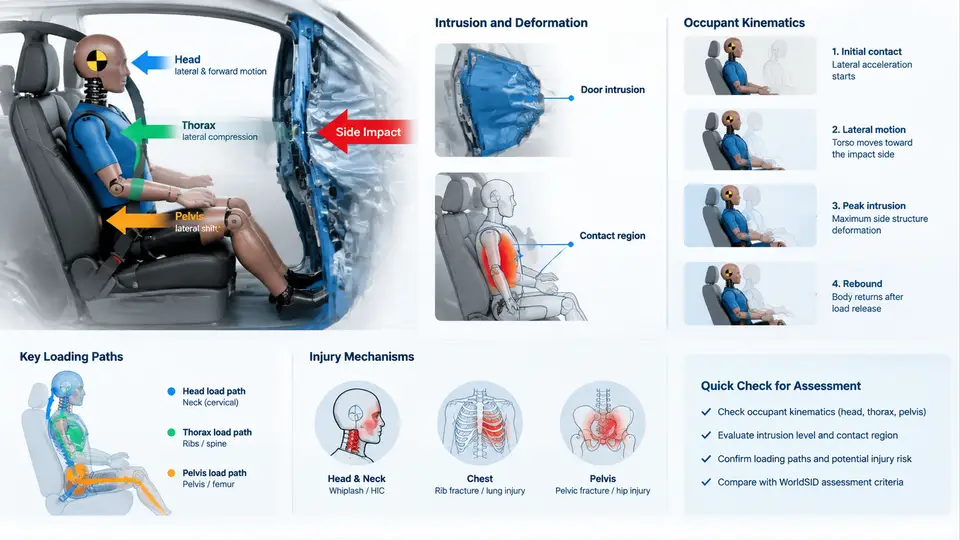
Side impact is fundamentally different from frontal impact, and that difference shapes every decision in WorldSID-based assessment. In a frontal crash, the vehicle front end provides a long, deformable crush zone that decelerates the occupant over 80–120 ms. In a side impact, the distance between the striking object and the occupant's torso may be only 200–300 mm, and the door structure itself is the crush zone. The occupant is loaded laterally, directly, and quickly — often within 30–60 ms from first contact to peak torso acceleration. Understanding this compressed timeline, and the specific loading paths that reach the WorldSID's sensing regions, is the foundation for interpreting its measurements correctly.
Occupant Kinematics in a Lateral Collision
Consider a nearside occupant (sitting on the struck side) in a passenger car hit at 50 km/h by a moving deformable barrier. The sequence is consistent and repeatable:
- 0–10 ms: Barrier contacts the outer door skin. The door begins to move inboard; the occupant has not yet moved relative to the vehicle because inertia holds the torso in place.
- 10–30 ms: The door trim, armrest, and inner panel intrude into the occupant's space. Contact occurs first at the pelvis/hip and lower thorax — the widest, most lateral parts of the body. The WorldSID's pelvic and lower rib accelerometers begin to register load.
- 30–60 ms: The torso is accelerated laterally. The occupant's upper body lags behind the pelvis (the spine is not rigid), producing lateral bending and a relative rotation between pelvis and thorax. The head, restrained by the curtain airbag and seat belt, moves later and often rotates toward the struck side.
- 60–100 ms: The occupant rebounds or is caught by the far-side restraint; the head may strike the far-side interior or the near-side window/airbag. The pelvis may slide under the door armrest (submarining) or the belt may load the abdomen.
The key kinematic signature for WorldSID assessment is pelvis-first, thorax-second, head-last loading, with a measurable phase lag between pelvis and thorax lateral acceleration. This lag is not noise — it is the physical basis for the dummy's multi-point rib and pelvic instrumentation, and it is why a single accelerometer cannot characterize side impact exposure.
Intrusion and the Loading Path
Intrusion is the inboard displacement of the door and B-pillar structure into the occupant compartment. It is the dominant injury driver in side impact because it converts vehicle crush directly into occupant contact force. Three loading paths matter for WorldSID:
- Direct door-to-pelvis/thorax path: The intruding door trim contacts the dummy's side. Force is transmitted through the pelvic iliac wing and the lower ribs. This path produces the highest rib deflection and is the primary target of side airbags and door padding.
- Belt/restraint path: The seat belt and pretensioner load the dummy diagonally across the chest and abdomen. In side impact, the belt can act as a fulcrum, concentrating load on the abdomen and producing abdominal injury — a region WorldSID instruments specifically (three abdominal pressure/deflection sensors).
- Far-side and head path: The head rotates and translates toward the struck side, then rebounds. Curtain airbags and far-side airbags intercept this path. Head contact with the near-side window or B-pillar is a major source of head injury in real crashes.
Intrusion magnitude is typically measured as the residual door displacement at the occupant's H-point height. In regulatory side impact tests (e.g., FMVSS 214, UN R95), intrusion of 150–300 mm at the pelvis level is common; beyond roughly 300 mm, pelvic and thoracic injury risk rises steeply. The WorldSID's pelvic acceleration and rib deflection outputs are read against these intrusion levels to judge whether the restraint system is keeping pace with the structure.
Injury Mechanisms and What WorldSID Measures
Side impact injuries cluster in four regions, each with a distinct mechanism and a corresponding WorldSID measurement:
| Region | Injury mechanism | WorldSID measurement | Typical assessment threshold (example) |
|---|---|---|---|
| Pelvis / hip | Direct lateral compression by intruding door; acetabular and iliac fracture | Pelvic lateral acceleration (Y), pelvic force | Pelvic acceleration > 130 g (injury reference) |
| Thorax / ribs | Lateral rib bending and compression; rib fracture, flail chest | Rib deflection (3–4 ribs, left/right), thoracic acceleration | Rib deflection > 40–50 mm (varies by rib) |
| Abdomen | Belt or door loading; liver/spleen rupture | Abdominal pressure/deflection (3 sensors) | Abdominal deflection > 40 mm (example) |
| Head / neck | Contact with window, B-pillar, or far-side interior; lateral bending | Head acceleration (triaxial), neck lateral force/moment | HIC and lateral neck moment limits |
These thresholds are illustrative reference values for teaching; actual pass/fail criteria come from the applicable regulation or rating protocol (e.g., Euro NCAP side impact, UN R95, FMVSS 214) and must be taken from the current official document. The point is that each WorldSID channel maps to a specific physical mechanism — the dummy is not a generic accelerometer package but a region-by-region injury transducer.
Why the Timing and Path Matter for Assessment
A common assessment error is to read peak values in isolation. A 45 mm rib deflection that occurs at 25 ms, before the airbag has deployed, tells a very different story from the same 45 mm at 45 ms with the airbag fully inflated. The WorldSID's time-history data, synchronized with barrier force and door intrusion measurements, lets the analyst reconstruct when each loading path acted and whether the restraint was present at that moment. This is why side impact assessment is inherently a time-correlated, multi-channel problem rather than a single-number check.
Reading the Diagram in Practice
The figure above is a top-view schematic of the near-side loading geometry. The barrier drives the struck door inboard along +Y; the door trim contacts the WorldSID's pelvis and thorax first, producing the direct intrusion load (red arrows). The belt path (blue dashed) crosses the abdomen and chest diagonally, and the head path (purple dashed) shows the lateral rotation that follows the torso. Each colored path terminates at a region the WorldSID instruments, which is why the dummy's channel list is organized by body region rather than by sensor type.
When you later review a side impact test, use this geometry as a mental checklist: Did the door contact the pelvis before the thorax? Was the belt loading the abdomen at the same time as the door? Did the head rotate toward the struck side before or after the curtain airbag inflated? The answers come from time-aligned channel data, and they determine whether an observed rib deflection or pelvic acceleration is a structural problem, a restraint timing problem, or both.
With this kinematic and loading-path foundation in place, the next step is to understand how the WorldSID itself is built and instrumented to capture these region-specific loads — which is the subject of the following chapter.