1. THOR-M dummy overview
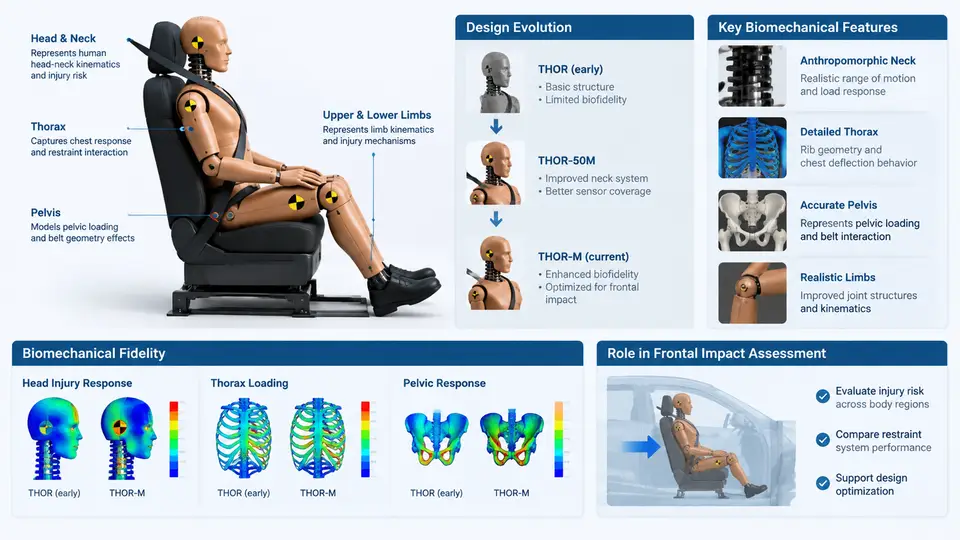
The THOR-M (Test Device for Human Occupant Restraint, Mid-size male) is an advanced anthropomorphic test device developed to address the limitations of the Hybrid III 50th percentile male, which has served as the regulatory standard for frontal impact testing since the 1970s. As vehicle restraint systems have evolved toward adaptive airbags, load-limiting seat belts, and pre-crash sensing, the limitations of Hybrid III's simplified biofidelity have become increasingly consequential. THOR-M was designed to provide more human-like kinematics and injury prediction in frontal and oblique frontal impacts, and it is now specified in several consumer rating programs and research protocols, including Euro NCAP frontal offset and mobile progressive deformable barrier tests.
Design Evolution from Hybrid III to THOR-M
The Hybrid III's architecture reflects a 1970s understanding of occupant behavior: a rigid steel and aluminum skeleton, a segmented rubber and vinyl flesh, and a spine that approximates a simple curved column. Its head and neck were tuned primarily to match cadaveric head kinematics in pure frontal loading, and its thorax was a single deflection-measuring chest band. These simplifications produced repeatable but sometimes unrealistic responses, particularly in oblique loading, in the presence of belt loading across the clavicle, and in the prediction of thoracic injury under combined compression and bending.
THOR-M introduced several architectural changes that directly target these gaps. The head incorporates a more human-like mass distribution and a deformable face and skull structure, allowing facial fracture and brain injury metrics to be estimated. The neck uses a flexible column with improved flexion and extension stiffness, and the cervical spine includes a more realistic lordotic curvature. The thorax is a multi-component structure with a flexible rib cage, a compliant sternum, and four chest deflection measurement locations (upper left, upper right, lower left, lower right), enabling the calculation of thoracic injury criteria that account for asymmetric loading. The abdomen is a separate, deformable structure with a pressure-based deflection measurement, and the pelvis includes iliac wings and a pubic symphysis that respond more realistically to belt loading. The lumbar spine is a flexible column with adjustable stiffness, and the upper and lower extremities include improved joint kinematics and load cells at the femur and tibia.
Instrumentation was also substantially upgraded. THOR-M carries a comprehensive sensor suite: head accelerometers and angular rate sensors, neck load cells, chest deflection potentiometers, abdominal pressure sensors, pelvic load cells, and femur and tibia load cells. This instrumentation supports the calculation of injury criteria such as HIC, Nij, chest deflection-based criteria, and femur force, and it enables the reconstruction of occupant loading paths that were previously invisible with Hybrid III.
Biomechanical Fidelity and Its Practical Meaning
Biomechanical fidelity refers to how closely a dummy's response matches that of a human under the same loading. THOR-M was tuned against post-mortem human subject (PMHS) data and volunteer data across a range of loading conditions, including frontal sled tests, belt loading, and airbag deployment. The practical consequence is that THOR-M produces kinematics and injury metrics that are more sensitive to restraint design details than Hybrid III. For example, a seat belt that routes across the clavicle rather than the sternum will produce a different chest deflection pattern on THOR-M, and an airbag that deploys with a particular pressure-time history will produce a different head rotation and neck load profile. This sensitivity is valuable for restraint optimization because it allows engineers to discriminate between design variants that Hybrid III would rate as equivalent.
However, higher fidelity also means higher sensitivity to setup and boundary conditions. THOR-M requires careful positioning, calibration, and instrumentation checks. Its flexible spine and multi-component thorax mean that small differences in seat back angle, belt routing, or dummy seating procedure can produce measurable differences in response. This is why test protocols specify detailed positioning procedures and why repeatability studies are essential before using THOR-M data for restraint tuning.
Role in Frontal Impact Assessment
THOR-M is used in frontal impact assessment in three main ways. First, in regulatory and consumer rating tests, it provides injury metrics that are used to score vehicle restraint performance. Second, in research and development, it is used to optimize restraint system parameters such as airbag vent size, belt load limiter force, and seat belt geometry. Third, in advanced restraint development, it is used to evaluate adaptive restraint strategies that adjust to occupant size, position, and crash severity.
A typical THOR-M frontal sled test setup includes the dummy seated in the driver or passenger position, instrumented with the full sensor suite, and restrained by the production seat belt and airbag. The sled is accelerated to a specified velocity pulse, and the dummy's response is recorded. Key outputs include head acceleration and HIC, neck loads and Nij, chest deflection and thoracic injury criteria, abdominal pressure, and femur loads. These outputs are then compared against injury assessment reference values (IARVs) or risk curves to determine whether the restraint system meets its targets.
Practical Considerations for Using THOR-M
Using THOR-M effectively requires attention to several practical details. First, the dummy must be calibrated and certified according to the manufacturer's procedures before each test series. This includes checking the head accelerometers, neck load cell, chest deflection potentiometers, and abdominal pressure sensors. Second, the seating procedure must follow the protocol precisely, including seat back angle, head restraint position, and belt routing. Third, the data acquisition system must be configured with appropriate anti-alias filtering and sampling rates, typically 10 kHz or higher for acceleration and load channels. Fourth, the injury metrics must be calculated using the correct algorithms and compared against the correct risk curves.
A common failure mode in THOR-M testing is inconsistent chest deflection readings due to improper potentiometer zeroing or belt routing. If chest deflection values appear unusually low or asymmetric, check the potentiometer calibration and verify that the belt is routed correctly across the chest. Another common issue is neck load cell saturation during high-severity impacts; if Nij values appear clipped, verify the load cell range and consider using a higher-range cell for severe tests.
In restraint optimization, THOR-M data is typically used in an iterative loop: baseline test, metric review, design change, re-test. Because THOR-M is more sensitive to restraint details than Hybrid III, it can reveal design trade-offs that were previously hidden. For example, reducing airbag vent size may improve head protection but increase neck load; THOR-M will show this trade-off more clearly than Hybrid III, allowing engineers to make more informed decisions. The key is to use THOR-M data as part of a structured optimization process, not as a single pass/fail gate.