1. Side impact crashworthiness fundamentals
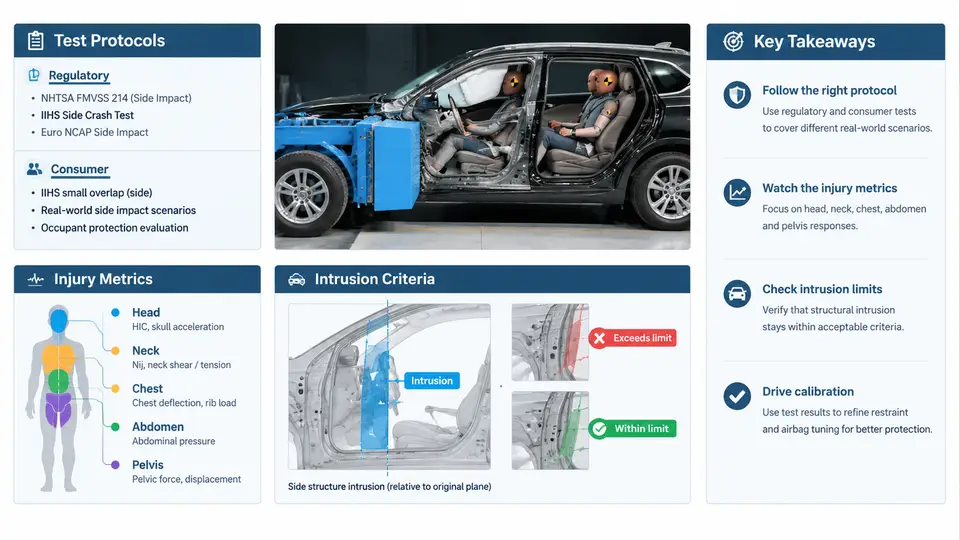
Side impact is one of the most demanding load cases in occupant protection. Unlike frontal crashes, where a long crumple zone and the restraint system share the energy absorption task, a side impact offers only 200–400 mm of structure between the striking vehicle or barrier and the occupant's torso. The occupant and the intruding door move toward each other, so the effective closing velocity at the occupant can exceed the vehicle's own velocity change. This geometric reality drives every design decision in side crashworthiness: the door beam, B-pillar, rocker, sill, seat structure, side airbag, and curtain airbag all work within a very short time window, typically 30–80 ms from impact to peak occupant loading.
This chapter establishes the vocabulary and quantitative framework used throughout the course. It covers the regulatory and consumer test protocols that define the load cases, the injury metrics used to score occupant response, and the intrusion criteria that connect structural deformation to occupant risk. These three elements form the reference system against which every subsequent intrusion analysis and restraint calibration is judged.
Regulatory versus consumer protocols
Side impact test protocols fall into two families. Regulatory protocols define minimum legal requirements; consumer protocols are more severe and are used for star ratings and public information. The two families differ in barrier type, impact velocity, impact angle, occupant dummy, and acceptance criteria, and a vehicle must usually satisfy both.
The most widely referenced regulatory test is the FMVSS 214 moving deformable barrier (MDB) test used in the United States. A 1,368 kg barrier with a honeycomb face strikes the stationary test vehicle at 90° and 54 km/h (33.5 mph). The vehicle carries an ES-2re dummy in the driver seat and a SID-IIs dummy in the rear seat on the struck side. The barrier face is designed to represent the front end of a typical SUV or pickup, so the load is applied high on the door and B-pillar. A second FMVSS 214 configuration, the pole test, drives the vehicle sideways at 32 km/h into a rigid 254 mm diameter pole aligned with the occupant's head, primarily to evaluate head protection devices such as curtain airbags.
In Europe, UN R95 uses a similar MDB concept but with a 950 kg barrier at 50 km/h and an impact angle of 90°. The dummy is the EuroSID-2 (ES-2) in the driver position. The UN R135 pole test complements R95 with a 32 km/h sideways pole impact. China's GB 20071 is closely aligned with UN R95 in barrier mass, velocity, and dummy, which simplifies global platform development.
Consumer protocols raise the severity. Euro NCAP side impact uses a 1,300 kg MDB at 60 km/h with a 50° oblique angle, and the Advanced European Mobile Deformable Barrier (AE-MDB) has a deeper, stiffer honeycomb face than the regulatory barrier. Euro NCAP also runs a 32 km/h pole test and, since 2020, a far-side impact test in which the struck side is opposite the driver, evaluating whether the occupant is retained by the far-side airbag and seat belt. IIHS in the United States uses a 1,500 kg MDB at 50 km/h with a 90° angle and the SID-IIs dummy, plus a separate side pole rating. The differences matter: a vehicle tuned only to FMVSS 214 will typically show high intrusion and elevated injury values under the Euro NCAP AE-MDB load because the barrier is heavier, faster, and strikes at an oblique angle that loads the door and sill differently.
Injury metrics
Occupant response is quantified with dummy-based injury criteria, each tied to a specific body region and a specific acceptance threshold. The most important for side impact are:
- HIC36 / HIC15 — Head Injury Criterion, computed from the resultant head acceleration over the critical time window. Side impact regulatory limits are typically HIC36 ≤ 1,000 for FMVSS 214; consumer protocols often use HIC15 with lower thresholds.
- BrIC — Brain Injury Criterion, based on the relative angular velocity of the head in three axes. BrIC is increasingly used in consumer ratings because it captures rotational loading that HIC misses, particularly in oblique and far-side impacts.
- Thoracic Trauma Index (TTI) — used with the SID-IIs dummy in FMVSS 214 and IIHS; combines rib and lower-spine acceleration with a mass-scaling factor. The FMVSS 214 limit is TTI ≤ 85 for the four-door configuration.
- Rib deflection — measured directly by the ES-2re and ES-2 dummies (upper, middle, lower rib). UN R95 limits are typically 42 mm for the upper and middle ribs and 42 mm for the lower rib, with viscous criterion (VC) limits around 1.0 m/s.
- Abdominal and pelvic force — measured with load cells in the ES-2 family; limits are typically 2.5 kN for abdominal force and 5–6 kN for pubic symphysis force depending on the protocol.
- Acetabulum force — relevant to the SID-IIs and to pelvic fracture risk in pole impacts.
Two practical points are often missed. First, injury metrics are dummy-specific: a TTI value from a SID-IIs cannot be compared with a rib deflection from an ES-2, because the dummy geometries and instrumentation differ. Second, metrics are evaluated over a defined time window and filtered per the protocol (typically CFC 1000 for accelerations, CFC 600 for deflections); applying the wrong filter class changes the peak value and can flip a pass into a fail.
Intrusion criteria
Intrusion is the structural counterpart to injury metrics. It is measured as the residual or dynamic displacement of specific points on the door trim, B-pillar, rocker, and seat relative to the occupant's original seating position. Regulatory and consumer protocols define measurement locations and limits; the most common are:
| Measurement point | Typical limit (example) | Why it matters |
|---|---|---|
| Door trim at H-point height | ≤ 150 mm residual (FMVSS 214) | Direct loading of pelvis and lower torso |
| B-pillar at occupant head height | ≤ 150 mm (regulatory); lower in consumer | Head strike surface and curtain airbag coverage |
| Rocker / sill lateral displacement | ≤ 100–120 mm (platform target) | Seat mounting integrity and floor deformation |
| Seat frame lateral displacement | ≤ 80 mm (internal target) | Maintains occupant-to-airbag gap |
Intrusion limits are not arbitrary. They are derived from the available occupant survival space: the distance between the intruding trim and the occupant's torso, minus the airbag's inflated thickness, must remain positive throughout the crash pulse. If the door trim intrudes 150 mm and the side airbag is 80 mm thick when inflated, the occupant has only 70 mm of margin before the airbag bottoms out against the trim. That margin is what the restraint calibration must protect.
How the three elements connect
The protocol defines the input, the intrusion criteria define the structural budget, and the injury metrics define the occupant outcome. A useful way to work with them is to treat the crash as a chain: barrier momentum enters the door, the door beam and B-pillar distribute load into the rocker and seat, the seat and floor accelerate the occupant, and the airbag and belt manage the occupant's relative motion. Each link has a measurable quantity — barrier velocity and mass at the input, intrusion at the structure, and injury criteria at the output. When a test fails, the first diagnostic question is always: is the failure structural (intrusion exceeds budget) or restraint-related (intrusion within budget but injury metric high)? The answer determines whether the fix belongs in the body-in-white or in the airbag and belt calibration.
As a worked example, consider a vehicle that passes FMVSS 214 with 120 mm residual door intrusion and TTI = 78, but fails the Euro NCAP AE-MDB with 165 mm intrusion and a rib deflection of 46 mm. The structural margin under the heavier, faster, oblique barrier is exhausted; the airbag cannot compensate because it is being compressed against the intruding trim. The correct response is structural — reinforce the door beam-to-B-pillar joint and add a rocker insert — rather than increasing airbag pressure, which would raise rib deflection further. This kind of reasoning, grounded in the protocol-intrusion-injury triangle, is the core skill this course develops.