4. Airbag inflator characteristics
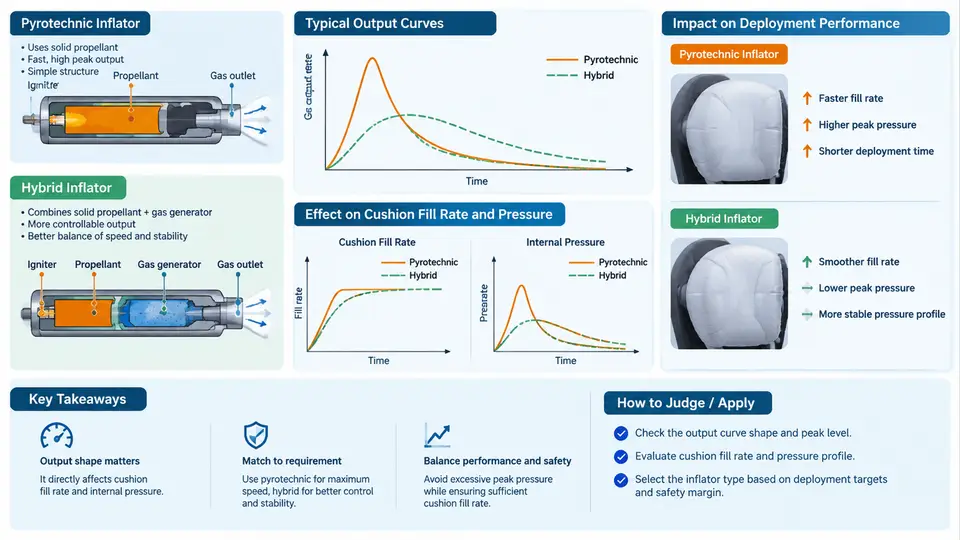
The inflator is the energy source of the entire restraint system. Every downstream decision — cushion volume, vent sizing, tether length, fold pattern, and even the timing of the seat-belt pretensioner — is ultimately a negotiation with the pressure curve the inflator produces. In side airbag and curtain airbag programs, where cushion volumes are small (typically 8–25 L for thorax bags and 20–45 L for curtains) and the time budget is brutally short (10–30 ms to full fill), the inflator's gas-generation characteristics dominate the achievable performance envelope. This chapter examines the two dominant inflator architectures, how their output curves differ, and how those differences propagate into cushion fill rate and internal pressure.
Two Architectures, Two Physical Principles
Pyrotechnic inflators (also called solid-propellant or "pyro" inflators) generate gas entirely by burning a solid grain — typically sodium azide historically, now more commonly guanidine nitrate or other non-azide formulations — inside a pressure vessel. The combustion reaction is self-sustaining once initiated: the igniter charge lights the grain, and the grain decomposes into hot gas at 1,000–2,000 K. Output is governed by grain geometry (burn surface area versus time), propellant formulation, and the burst pressure of the exit orifice. Because the gas is generated by chemistry rather than stored, a pyro inflator is compact and cheap, but its output is intrinsically hot and contains particulate and alkaline residue that must be filtered.
Hybrid inflators store a compressed inert gas (argon or helium-rich mixtures at 20–70 MPa) in a pressure vessel and use a small pyrotechnic charge only to open the burst disc and heat the released gas. The stored gas provides the bulk of the mass flow; the combustion adds energy to raise the gas temperature and therefore its pressure and volumetric expansion. Hybrid output is cooler, cleaner, and more "tunable" — the ratio of stored gas to pyrotechnic charge, plus the burst-disc opening profile, shapes the curve — but the pressure vessel is heavier and bulkier, which matters in door-mounted side bags.
Reading the Output Curve
The inflator output curve is usually presented as either mass flow rate (kg/s or g/ms) versus time, or as pressure in a fixed-volume tank (the "tank test," typically 60 L or 100 L at a specified temperature) versus time. The tank curve is the more practical characterization because it integrates mass flow and temperature effects into a single measurable pressure history, and it is the curve most often used for cushion fill calculations.
Four features of the curve matter for cushion performance:
- Time to first gas (T0): the delay from electrical trigger to meaningful pressure rise, typically 0.5–2 ms. It sets the start of the fill clock.
- Peak mass flow (ṁmax): the maximum rate at which gas enters the cushion. This is the single strongest driver of early fill rate.
- Rise time to peak (trise): how quickly the inflator reaches ṁmax. Pyro inflators with a large initial burn surface rise in 1–3 ms; hybrid inflators with a burst disc can rise in under 1 ms but then decay as the vessel empties.
- Total delivered mass and decay shape: the integral of the curve, and whether output tapers gradually (pyro, as grain is consumed) or drops sharply (hybrid, once the vessel pressure falls below the cushion pressure).
A representative comparison, using illustrative values for a side thorax application, is shown below. These numbers are teaching examples, not measured data from a specific product.
| Characteristic | Pyrotechnic (example) | Hybrid (example) |
|---|---|---|
| Time to first gas | 1.2 ms | 0.8 ms |
| Peak mass flow | 1.6 kg/s at 3.5 ms | 2.4 kg/s at 1.5 ms |
| Decay behavior | Gradual taper to 12 ms | Sharp drop after 6 ms |
| Total gas mass | ~38 g | ~42 g |
| Gas temperature at exit | High (particulate-laden) | Moderate (clean) |
| Typical use | Thorax, small curtains | Large curtains, dual-stage |
From Inflator Curve to Cushion Fill Rate and Pressure
The cushion is an open, vented control volume. Its internal pressure p(t) is governed by the balance of mass inflow from the inflator, mass outflow through vents and fabric porosity, and the changing volume as the cushion unfolds:
dp/dt = (γ·R·T / V) · ṁ_in − (γ·p / V) · dV/dt − (γ·p / V) · ṁ_out·(T/T_cushion)In practical terms, three regimes appear during deployment:
- Fill-dominated (0 to ~8 ms): dV/dt is large because the cushion is unfolding, and ṁ_in dominates. Pressure stays low relative to peak because volume is growing faster than gas is arriving. Fill rate — how fast the cushion front face reaches the occupant — is set almost entirely by ṁmax and trise.
- Pressure-build (8 to ~20 ms): the cushion is nearly fully deployed, dV/dt collapses, and continued inflow raises pressure sharply. This is where the inflator's decay shape matters: a hybrid that has already emptied its vessel cannot sustain pressure, while a pyro grain still burning can.
- Vent-controlled (after peak): inflow ends, and pressure decays through vents and porosity. Vent area and fabric permeability now dominate, and the inflator is largely out of the picture.
The practical consequence is a design trade-off that recurs in every side-bag program. A hybrid inflator's fast rise delivers excellent early fill rate — the curtain reaches the occupant sooner, which is valuable in rollover and far-side scenarios where the occupant may be out of position. But its sharp decay can leave the cushion under-pressured at the moment of occupant contact if the cushion is large or the vents are generous. A pyro inflator's slower rise delays fill slightly but sustains pressure longer, which suits thorax bags where the cushion is small and the occupant is close.
Practical Implications for Cushion Design
When selecting or tuning an inflator, the following engineering checks translate the curve into cushion behavior:
- Match total mass to cushion volume plus vent loss. Estimate required gas mass as m ≈ ptarget·V / (R·T), then add 15–30% for vent and porosity losses over the deployment window. A 25 L curtain at 60 kPa and 800 K needs roughly 30–35 g of effective gas; the inflator's delivered mass must exceed this with margin.
- Check fill rate against the occupant's position. If the cushion front face must travel 250 mm in 12 ms, the average fill velocity is ~21 m/s; the inflator must sustain enough ṁ through the unfolding phase to avoid a mid-deployment stall.
- Verify pressure at contact, not just peak pressure. A hybrid's early peak can be misleading; evaluate p(t) at the expected occupant-contact time (often 15–25 ms), not at the curve maximum.
- Account for temperature. Both architectures lose output at cold soak (−35 °C): pyro burn rate drops and hybrid stored pressure falls. Characterize at hot, ambient, and cold, and size vents for the hot case while confirming fill at cold.
In practice, the inflator–cushion system is tuned iteratively: the inflator curve is fixed by the supplier's available family, and the cushion volume, vent area, and tether geometry are adjusted to shape p(t) into the target window. Understanding whether the inflator is a chemical flow source or a stored-energy source tells you which knob to turn — vent sizing for a hybrid's early peak, or fill-path and fold geometry for a pyro's slower rise — and prevents the common error of chasing peak pressure while ignoring the decay that actually determines occupant loading.