4. Restraint system design space
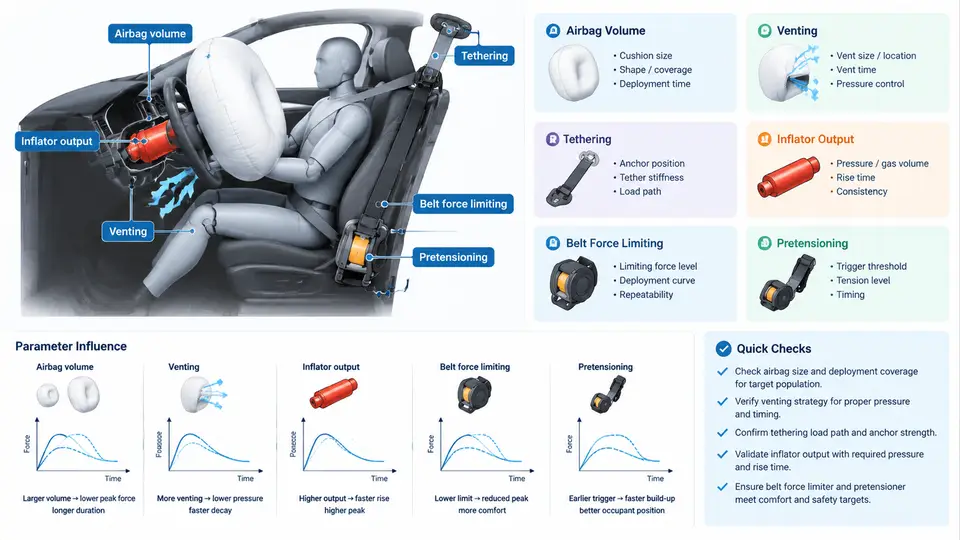
Frontal restraint calibration is not a search for a single "correct" airbag or belt setting. It is the task of placing a vehicle occupant through a set of load cases — rigid barrier, offset deformable barrier, pole, low-speed, out-of-position — while satisfying injury criteria, bottoming-out limits, and deployment timing constraints. The design space is defined by six coupled parameters: airbag volume, venting, tethering, inflator output, belt force limiting, and pretensioning. Each parameter changes the occupant's deceleration profile in a different phase of the event, and each interacts with the others. This chapter explains what each parameter physically controls, how they trade against one another, and how to structure a calibration study so that the interactions are visible rather than hidden.
What each parameter actually controls
Airbag volume sets the cushion's ability to absorb occupant energy without bottoming out against the steering wheel or instrument panel. A larger volume reduces peak pressure for a given inflator mass flow and gives the occupant more ride-down distance, but it also increases the time to fill, raises the risk of membrane contact with a small occupant, and adds mass and packaged volume. Volume is therefore chosen as a function of the available package space and the target occupant's forward excursion, not as an independent variable.
Venting controls how quickly the cushion releases pressure after peak inflation. Vent area and vent-hole geometry determine the pressure decay curve. Too little venting produces a stiff cushion that spikes chest acceleration late in the event; too much venting lets the occupant "punch through" and bottom out. Venting is the primary tuning knob for the late-phase (roughly 40–80 ms) chest response.
Tethering shapes the deployed cushion geometry. Tethers restrict the cushion's forward and lateral expansion, controlling the stand-off distance between the cushion face and the occupant, and they influence how the cushion wraps around the occupant. A shorter tether produces a flatter, more forward-biased cushion face; a longer tether allows a rounder cushion with more lateral coverage. Tethers are the main tool for matching cushion shape to occupant size and for controlling the cushion's interaction with the belt.
Inflator output — mass flow rate and total gas mass — sets the fill rate and the peak pressure. It is the parameter most directly tied to deployment timing: the cushion must be sufficiently inflated before the occupant arrives, but not so early that it is already venting when the occupant contacts it. Inflator output is usually selected from a family of available inflators rather than continuously tuned, so it acts as a coarse parameter.
Belt force limiting caps the shoulder-belt force transmitted to the chest. A force limiter (load limiter) with a lower threshold reduces chest deflection and rib acceleration but allows more forward excursion, which increases the risk of contact with the airbag or interior. Force limiting is the primary chest-injury lever in the belt-restrained load cases.
Pretensioning removes belt slack and pulls the occupant into the seat before the crash pulse peaks. Pretensioner stroke and timing determine how much of the occupant's initial forward motion is coupled to the vehicle deceleration. Aggressive pretensioning improves coupling but can increase chest loading and, in out-of-position cases, can pull the occupant toward the deploying airbag.
How the parameters interact
The six parameters are not independent. The most important couplings are:
- Volume ↔ inflator output: a larger cushion needs more gas mass to reach the same pressure; if the inflator is fixed, increasing volume lowers peak pressure and slows the pressure rise.
- Venting ↔ inflator output: vent area and mass flow together determine the pressure-time curve. Increasing venting without increasing inflator output shifts the entire curve down and earlier.
- Tethering ↔ volume: tethers effectively reduce the usable volume in specific directions; a tethered cushion behaves like a smaller cushion in the tethered direction but retains volume elsewhere.
- Belt force limiting ↔ airbag: a lower force limit increases forward excursion, which increases the occupant's penetration into the cushion and therefore the cushion pressure the occupant experiences. The belt and airbag share the occupant's kinetic energy, so tuning one without the other usually moves the injury metric from one body region to another.
- Pretensioning ↔ force limiting: stronger pretensioning increases the belt force early; if the force limiter threshold is low, the pretensioner's benefit is partly dissipated by the limiter paying out.
Structuring a calibration study
A practical approach is to fix the coarse parameters first and tune the fine ones second. Inflator output and airbag volume are usually selected from discrete hardware options, so they are fixed early based on package space and target occupant excursion. Tethering is then set to achieve the desired cushion shape. Venting and belt force limiting are the continuous tuning parameters and should be swept last, because their effect is most sensitive to the already-fixed geometry.
Consider a representative example (illustrative values, not measured results). A mid-size sedan frontal airbag is packaged with a 65 L cushion and a dual-stage inflator. The calibration team targets a 50th-percentile male in a 56 km/h rigid barrier test with a chest deflection limit of 40 mm and a head injury criterion (HIC15) limit of 700. The initial build uses a 60 mm tether, a 2×25 mm vent pair, and a force limiter set at 4.0 kN with a 60 mm pretensioner stroke. The first run shows chest deflection at 44 mm and HIC at 620 — chest is over limit while head has margin. The team increases vent area to 2×30 mm, which lowers late-phase cushion pressure and reduces chest deflection to 41 mm, but HIC rises to 680 as the head penetrates deeper. They then reduce the force limiter to 3.5 kN, which brings chest deflection to 38 mm and HIC to 660. The final step is a small tether shortening to 55 mm to restore head margin without re-spiking chest load. This sequence — vent, then force limit, then tether — reflects the coupling order described above.
Practical calibration workflow and verification
Because the parameters are coupled, a calibration study should be organized as a sequence of sweeps with explicit acceptance criteria at each step. A workable structure is:
- Fix hardware-level parameters. Select airbag volume and inflator output from the available package and inflator family. Record the resulting fill time and peak pressure from a tank test or a validated deployment model.
- Set cushion geometry. Choose tether length to achieve the target stand-off distance and lateral coverage for the 5th-percentile female and 50th-percentile male occupants. Verify with a static deployment or a validated out-of-position model that the cushion does not contact the occupant before full deployment.
- Sweep venting. With geometry fixed, vary vent area in discrete steps (for example 2×20, 2×25, 2×30 mm) and record chest deflection, chest acceleration, and HIC for each load case. Identify the vent setting that minimizes the worst-case chest metric without pushing HIC over its limit.
- Sweep force limiter threshold. With venting fixed, vary the force limiter (for example 3.0, 3.5, 4.0, 4.5 kN) and record chest deflection and forward excursion. The objective is the lowest threshold that keeps forward excursion within the airbag's bottoming-out margin.
- Re-check pretensioning. Confirm that the pretensioner stroke and timing do not pull the occupant into the deploying cushion in out-of-position cases, and that the pretensioner's early force is not fully dissipated by the force limiter.
Verification should be based on observable outputs, not on the parameter values themselves. The key observables are: chest deflection (mm), chest acceleration (g, 3 ms clip), HIC15, neck injury criteria (Nij), forward excursion of the head and chest relative to the interior, and cushion pressure-time history. A calibration is acceptable when all load cases meet their injury limits with margin, the cushion does not bottom out, and the deployment timing leaves a positive stand-off before occupant contact. Typical failure symptoms and their likely causes are summarized below.
| Symptom | Likely parameter cause | First corrective action |
|---|---|---|
| Chest deflection over limit, HIC within limit | Force limiter too high, or venting too low | Lower force limiter threshold; increase vent area |
| HIC over limit, chest within limit | Cushion too soft or too far forward; head penetrates | Reduce vent area; shorten tether to restore stand-off |
| Cushion bottoming-out (pressure spike late) | Volume too small or venting too high | Increase volume or reduce vent area |
| Occupant contacts cushion before full deployment | Inflator output too low or pretensioning too aggressive | Increase inflator output; reduce pretensioner stroke |
| Neck Nij over limit in offset case | Tether too short, cushion face too flat | Lengthen tether; re-check head rotation |
The design space is therefore best understood as a set of coupled trade-offs organized by phase: pretensioning and inflator output govern the early event, tethering and volume govern the cushion's geometry at contact, and venting and force limiting govern the late-phase load sharing between belt and airbag. Calibration proceeds from coarse hardware choices to fine continuous tuning, with each step verified against the full load-case set rather than a single test.