4. Side impact test configurations
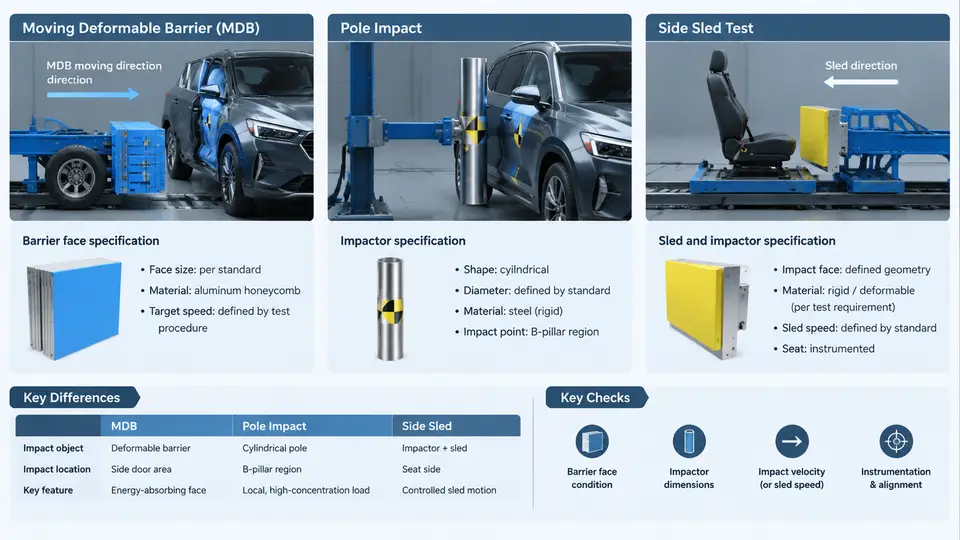
Side impact validation is fundamentally different from frontal validation. In a frontal crash, the vehicle front structure provides a long, controlled crush zone ahead of the occupant. In a side impact, the distance between the striking object and the occupant's torso is measured in tens of millimeters, and the struck vehicle's lateral structure — door beam, B-pillar, rocker, sill, and door trim — must absorb the energy within a very short stroke. Because of this, side impact performance is highly sensitive to the exact geometry, mass, stiffness, and velocity of the striking object. The three dominant laboratory configurations — moving deformable barrier (MDB), rigid pole, and side sled — each isolate a different part of that problem, and each has its own barrier face or impactor specification that must be controlled precisely for results to be comparable across tests and laboratories.
Moving Deformable Barrier (MDB) Test
The MDB test reproduces a vehicle-to-vehicle side collision. A trolley carrying a deformable barrier face is propelled into the stationary or slowly moving test vehicle at a defined angle and speed. The barrier face is the critical element: it must deform in a way that approximates the front end of a striking passenger car, so that the struck vehicle sees a realistic distributed load rather than a rigid point contact.
Two barrier specifications dominate global practice. The ECE R95 / Euro NCAP AE-MDB face is a honeycomb block with a stepped, multi-cell front profile, mounted on a trolley with a total moving mass of approximately 950 kg (the AE-MDB variant used in Euro NCAP is 1,300 kg). The impact speed is typically 50 km/h for regulatory R95 and 60 km/h for Euro NCAP, with an impact angle of 90° for R95 and 90° for the AE-MDB configuration. The FMVSS 214 / IIHS MDB uses a different face: a flat, rectangular honeycomb block with a defined crush strength, mounted on a 1,368 kg trolley, impacting at 90° and 54 km/h (FMVSS 214) or 50 km/h (IIHS side). The US barrier face is wider and flatter, producing a broader load distribution than the European stepped face.
In practice, the barrier face is certified before each test series by quasi-static crush of sample blocks, and the honeycomb cell size, density, and crush strength are recorded. A common failure mode in MDB testing is barrier face degradation after repeated impacts: the honeycomb loses crush strength, the struck vehicle appears to perform better than it should, and the test is invalid. Laboratories therefore track the number of impacts per face and replace it on a defined schedule, and they verify the face's static crush force against the certification curve before each run.
Rigid Pole Impact
The pole test isolates a narrow, rigid contact — the classic scenario of a vehicle sliding sideways into a tree, utility pole, or narrow column. A rigid cylindrical pole, typically 254 mm in diameter (FMVSS 214 and Euro NCAP pole), is fixed to the ground, and the vehicle is propelled laterally into it at a defined speed and angle. Because the pole does not deform, all the energy absorption must come from the vehicle's side structure and the occupant restraint, and the contact patch is narrow, so the local intrusion at the struck occupant's seating position is typically much higher than in an MDB test.
The pole specification matters more than it first appears. Pole diameter controls the contact area and therefore the local pressure on the door and B-pillar; a smaller pole produces deeper local intrusion for the same energy. Pole stiffness must be effectively rigid relative to the vehicle, and the pole must be anchored so it does not deflect or rotate during impact. The vehicle's lateral velocity at contact, the yaw angle at impact, and the vertical position of the pole relative to the occupant's H-point all influence the result. Euro NCAP pole tests are run at 32 km/h with the vehicle moving laterally, while FMVSS 214 specifies a 32 km/h (20 mph) lateral impact into a 254 mm pole. The pole test is the most demanding configuration for side airbag and curtain airbag deployment timing, because the time between initial contact and occupant loading is extremely short.
Side Sled Test
The side sled is a component-level configuration. Instead of crashing a complete vehicle, the body-in-white or a door-and-seat buck is mounted on a sled, and a programmable hydraulic or servo accelerator drives the sled to reproduce a measured or target lateral pulse — typically the door inner panel velocity or the seat lateral acceleration recorded from a full-vehicle MDB or pole test. The sled pulse is the key input: it is defined as a velocity-time or acceleration-time history, and the buck is instrumented to measure door intrusion, trim displacement, airbag deployment, and dummy response.
The side sled is where restraint system calibration actually happens. Engineers iterate on door trim energy absorbers, side airbag venting, curtain airbag coverage, and seat-mounted side airbag timing against a repeatable pulse, without consuming full vehicles. A typical setup uses a deceleration or acceleration pulse with a peak of 20–40 g and a duration of 50–80 ms, derived from the full-vehicle test it is meant to represent. The critical discipline is pulse fidelity: if the sled pulse does not match the door velocity history from the full-vehicle test, the sled results will not correlate, and calibration decisions made on the sled will not transfer to the vehicle.
Choosing and Controlling the Configuration
The three configurations answer different questions. The MDB test answers whether the vehicle's side structure and restraints perform acceptably against a realistic vehicle front, and it is the regulatory and consumer-rating backbone. The pole test answers whether the vehicle protects the occupant against a narrow, unforgiving object, and it is the hardest test for side airbag and curtain timing. The side sled answers whether a specific restraint design — trim absorber, airbag, seat — behaves correctly under a known pulse, and it is the tool for calibration and iteration.
For any of these tests, the specification control points are the same in principle: define the impactor or barrier face geometry and mass, define the impact velocity and angle, define the struck vehicle's condition (tire pressure, fuel load, seat position, dummy installation), and verify the impactor or pulse before the run. A side impact test that is not documented to these parameters cannot be compared with another test, and a restraint calibration performed on a sled whose pulse does not match the vehicle is a calibration that will not transfer. The practical discipline is to treat the barrier face, the pole, and the sled pulse as calibrated instruments, not as fixtures.
| Configuration | Impactor / Input | Typical Severity | Primary Use |
|---|---|---|---|
| MDB (ECE R95 / AE-MDB) | Stepped honeycomb face, ~950–1300 kg trolley | 50–60 km/h, 90° | Regulation, consumer rating, vehicle-to-vehicle |
| MDB (FMVSS 214 / IIHS) | Flat honeycomb face, 1368 kg trolley | 50–54 km/h, 90° | US regulation and rating |
| Rigid pole | Ø254 mm rigid cylinder, anchored | 32 km/h lateral | Narrow-object robustness, airbag timing |
| Side sled | Programmable lateral pulse (20–40 g, 50–80 ms) | Derived from full-vehicle test | Restraint calibration and iteration |