1. Restraint system validation scope
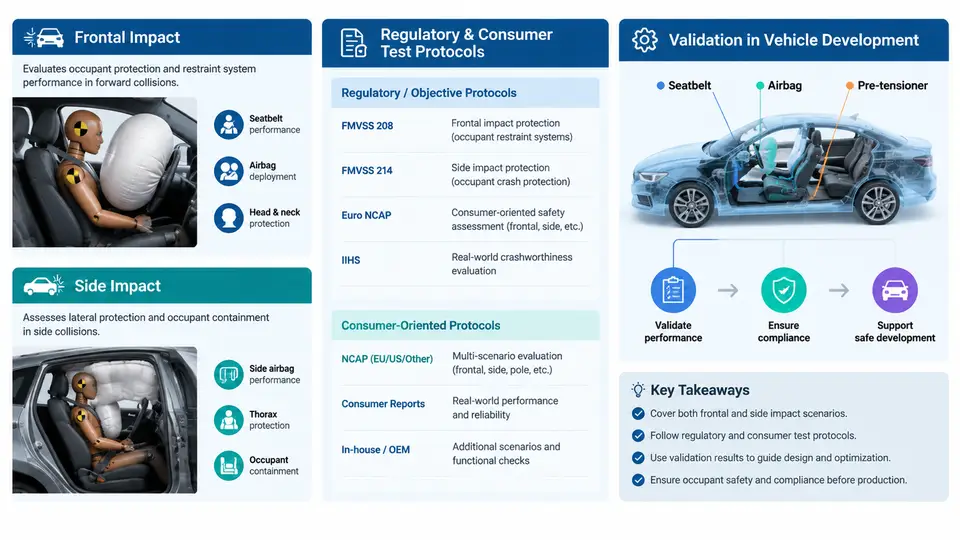
Restraint system validation is the structured process of demonstrating that seat belts, airbags, pretensioners, load limiters, seat structures, and their control electronics protect occupants across the crash modes a vehicle will realistically encounter. Its scope is defined by three intersecting forces: regulatory mandates that set the legal minimum, consumer test programs that drive market competitiveness, and the manufacturer's own development targets that must be met before any of those external tests are run. Understanding how these three layers interact is the foundation for every subsequent activity in this course.
Frontal impact: the primary load path
Frontal crashes account for the largest share of serious injuries in real-world accident data, and the restraint system carries most of the occupant protection burden here. The physical problem is straightforward to state: the vehicle decelerates rapidly, the occupant continues forward at initial velocity, and the restraint must manage that relative motion within the available ride-down distance. Validation therefore focuses on chest deceleration, head injury criteria (HIC), femur loads, and knee displacement, measured on instrumented Anthropomorphic Test Devices (ATDs) positioned in driver and passenger seating positions.
Regulatory frontal tests typically use a rigid or deformable barrier at a defined closing speed. The United States FMVSS 208 family includes full frontal rigid barrier tests at 56 km/h and offset deformable barrier configurations, with unbelted and belted occupant requirements depending on the vehicle category. UN Regulation No. 94 and No. 137 govern frontal and offset frontal impact in markets adopting WP.29 standards, while China's GB 11551 imposes its own frontal barrier requirements. Each regulation specifies barrier geometry, impact speed, ATD type, seating position, and pass/fail injury criteria — these are not interchangeable, and a vehicle validated to one standard is not automatically compliant with another.
Consumer programs raise the bar considerably. Euro NCAP's frontal offset test uses a 50 km/h impact into a deformable barrier with 40% overlap, and its mobile progressive deformable barrier (MPDB) test evaluates compatibility between vehicles of different masses. IIHS conducts a 40% moderate overlap test at 64 km/h and a 25% small overlap test at 64 km/h, the latter being particularly demanding because the main longitudinal rails are largely bypassed. These tests are not legally required, but a poor rating directly affects market position, which is why most OEMs treat consumer protocols as hard development targets.
Side impact: limited crush space, different physics
Side impact presents a fundamentally different problem. The distance between the striking vehicle and the occupant is measured in tens of millimeters rather than hundreds, so there is almost no ride-down distance available. The restraint system must act within milliseconds, and the door trim, B-pillar, and seat structure become part of the load path. Validation here emphasizes pelvic and thoracic injury, head injury from contact with the intruding structure or from far-side occupant interaction, and in some protocols, occupant-to-occupant interaction.
FMVSS 214 specifies a rigid moving deformable barrier (MDB) at 54 km/h striking the vehicle at 27° and a pole test at 32 km/h. UN R95 uses a similar MDB configuration at 50 km/h. Euro NCAP's side barrier test runs at 60 km/h with a heavier MDB, and its far-side impact test evaluates occupants on the non-struck side, where the primary risk is head excursion across the cabin and interaction with the center console or opposite door. Side airbags, curtain airbags, and seat-mounted thorax bags are validated against these specific intrusion and contact scenarios, not against a generic "side impact" condition.
How the protocols differ in practice
The table below summarizes the principal differences that drive validation test matrix design. Speeds, barrier masses, and ATD types are indicative of the current published protocols and should always be confirmed against the latest revision before building a test plan.
| Protocol | Impact mode | Nominal speed | Barrier / object | Primary injury focus |
|---|---|---|---|---|
| FMVSS 208 | Full frontal rigid | 56 km/h | Rigid barrier, full width | Head, chest, femur (belted and unbelted) |
| UN R94 | Offset deformable frontal | 56 km/h | Deformable barrier, 40% overlap | Head, chest, pelvis |
| Euro NCAP frontal | Offset deformable / MPDB | 50 km/h | Deformable barrier, 40% overlap | Head, chest, compatibility |
| IIHS small overlap | Offset rigid | 64 km/h | Rigid barrier, 25% overlap | Head, chest, lower extremity |
| FMVSS 214 | Side MDB / pole | 54 / 32 km/h | MDB at 27°, rigid pole | Thorax, pelvis, head |
| Euro NCAP side | Side MDB / far-side | 60 km/h | Heavier MDB, oblique far-side | Thorax, pelvis, far-side head |
Where validation sits in vehicle development
Restraint validation is not a single event at the end of a program; it is a thread that runs from concept to production. In the architecture phase, package studies determine whether a curtain airbag can deploy between the occupant and the intruding B-pillar, and whether the seat belt anchor points can be placed to satisfy both frontal and side requirements. During body-in-white development, sled tests using a deceleration sled and a buck representing the occupant compartment allow restraint calibration — pretensioner firing time, load limiter force level, airbag vent size — to be iterated quickly and at far lower cost than full vehicle crashes. Only once the restraint parameters are stable does the program move to full vehicle crash tests, which are expensive and consume significant vehicle build slots.
The validation engineer's job is to maintain a traceable chain from requirement to evidence. Each regulatory and consumer test becomes a requirement with a defined acceptance criterion; each criterion is linked to a test or simulation that produces evidence; and each piece of evidence is reviewed against the criterion before the program gate. When a test fails, the failure must be traceable back to the specific restraint parameter or structural characteristic that caused it, which is why sled testing and CAE correlation are treated as part of validation rather than as separate activities.
Reading the validation landscape as a whole
The diagram below shows how the three requirement layers feed into a single validation program, and how evidence flows from component and sled testing up to full vehicle confirmation.
The key insight from this structure is that validation is a filtering and confirmation process, not a single pass/fail event. Component and sled tests exist to reduce the number of full vehicle tests required, and CAE correlation exists to make the remaining full vehicle tests predictable. A program that skips the lower tiers and goes straight to full vehicle testing will discover problems too late and too expensively to correct within the development timeline.
What the validation engineer actually delivers
At each program gate, the deliverable is a validation status report that maps every requirement in scope to its current evidence state: tested and passed, tested and failed with a corrective action, analysis-supported pending test, or not yet started. The report must distinguish between evidence that is complete and evidence that is planned, because a gate review that treats planned tests as passed is how programs arrive at production with unresolved compliance risk. Alongside the status report, the engineer maintains the test matrix itself — the living document that records which configurations, ATD sizes, seating positions, and impact conditions have been run, and which remain open.
This chapter has established the scope: frontal and side impact requirements from regulation and consumer programs, the physical differences that make each mode demand different restraint strategies, and the layered validation structure that connects requirements to evidence. The chapters that follow examine each layer in detail, beginning with the frontal impact test protocols and the specific injury criteria they enforce.